Get Full Government Meeting Transcripts, Videos, & Alerts Forever!
Get email alerts on the Zoning Ordinance Amendments topic
No spam. Unsubscribe anytime.
Commission splits vote on zoning amendments; approves tattoo-parlor rules and tables remainder
Summary
The Coldwater Planning Commission approved a limited zoning change to allow tattoo parlors in the C-2 district as a special land use with location restrictions and tabled the remaining proposed ordinance amendments for further review.
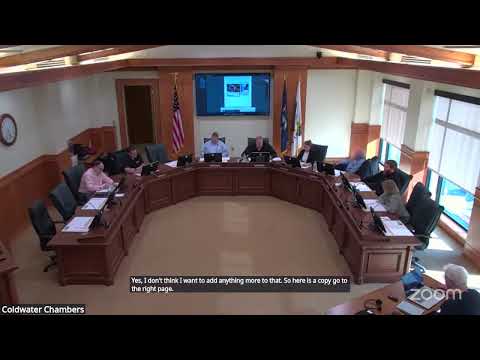
The Coldwater Planning Commission on an unspecified date voted to approve a narrowly focused amendment to allow tattoo parlors in the C-2 (central business) district as a special land use with location restrictions, and to table the remaining proposed zoning ordinance amendments for further review.
Robert (planning staff) opened a public hearing on a package of proposed zoning ordinance updates that included: revisions to Section 2.2 (definitions) covering dwelling types; a new definition for sidewalk café; allowances for limited ground-floor residential uses in the C-2 district (with a proposed maximum of 40 percent of ground-floor area in some streets); updates to commercial building transparency and front-door requirements; and several parking-reduction options in Section 5.2. Staff said notices were distributed in accordance with the Michigan Zoning Enabling Act and that the Downtown Development Authority (DDA) had submitted a letter with comments.
The DDA’s letter, read into the record by staff and authored by Audrey on behalf of the DDA, recommended several changes: remove location restrictions on tattoo parlors and permit them across the district; support ground-floor residential units but recommend they be processed as a special-use permit and preserve rear commercial entrances where feasible; support design and material standards for sidewalk cafés but oppose a proposed $500 special-use fee for cafés. The DDA letter was signed by Audrey and referenced board president Mike Kaye.
Staff cautioned that the city seeks Redevelopment Ready Communities (RRC) certification through the Michigan Economic Development Corporation (MEDC), and that the MEDC’s RRC guidance favors housing diversity that is permitted by right rather than placed behind a special-use requirement. Robert said permitting ground-floor residential only by special use could “bring us out of alignment” with the RRC standard.
Commissioners discussed several substantive points: whether allowing ground-floor residential would jeopardize rear commercial access and investments in parking lots; how building code requirements for ingress/egress might apply; DDA concerns about café fees and furniture standards; and whether tattoo parlors should be permitted across the district or limited to specific streets. Kenny (the building inspector) was cited by staff on code-enforced means of egress and occupancy thresholds.
After discussion, commissioners first voted to table the bulk of the amendments to allow more time to review the DDA’s letter and give staff and commissioners time for additional analysis. Later in the same meeting the commission took a separate vote on the tattoo-parlor provisions: the commission approved the ordinance language as presented to permit tattoo parlors as a special land use in C-2 with location restrictions (excluding US 12 and South Monroe Street, as drafted) and forwarded that recommendation to city council. Commissioners then voted to table the remaining amendments for the next meeting so staff could return with fuller information and any clarifying language.
Robert said the commission’s actions are recommendations to city council; final ordinance changes would be enacted only by council. Staff also noted that established businesses already using outdoor seating or other existing uses would not be required to change their operations retroactively.
The commission asked staff to provide examples and clarifying language on: how rear commercial access could be preserved when ground-floor residential is proposed; how the RRC/MEDC standards apply to the proposed definitions; and an itemized explanation of the sidewalk-café fee and possible alternatives to that fee.