Get Full Government Meeting Transcripts, Videos, & Alerts Forever!
Get email alerts on the Town Center Plan topic
No spam. Unsubscribe anytime.
Woodside opens Town Center Area Plan CAC, agenda centers on parking, circulation and preservation
Summary
At the first of four Town Center Area Plan (TCAP) Community Advisory Committee meetings, town staff, consultants and CAC members identified parking shortages, roadway safety on Woodside Road, preservation of historic resources and potential housing as top topics for the plan update and outlined outreach and environmental review steps.
The Town of Woodside convened the first of four meetings for its Town Center Area Plan Community Advisory Committee (TCAP CAC) to begin shaping a revision of the town center plan and to gather community priorities on parking, circulation, historic resources and housing.
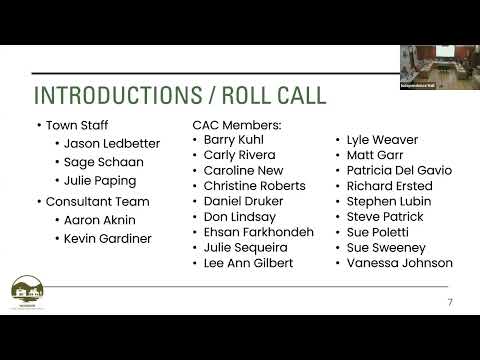
Town Manager Jason Ledbetter opened the session, calling it “the first of 4 CAC meetings” and laying out an engagement schedule that includes two pop‑ups in September, a community workshop planned for Oct. 9 and an online survey that staff said is already live.
Why it matters: The TCAP review will inform a plan update and the environmental review (an EIR) that must accompany any policy or zoning changes. The committee’s recommendations will feed the town council and planning commission; legal limits created by prior voter measures and state and federal technical requirements could constrain options the committee examines.
Consultants from Good City Company and Urban Field Studio presented an existing‑conditions summary and a draft boundary for the plan area, explained outreach steps and identified issues staff expects the CAC to weigh. Key topics raised by committee members, staff and public commenters included parking supply and distribution, pedestrian and equestrian safety, the character of the public realm, historic resources and how ballot‑box measures and ongoing litigation could affect potential changes.
Parking and circulation - Consultants reported an inventory of roughly 577 parking spaces in the town center area (estimate). They said about 92% of spaces are off‑street and that parking demand clusters at midday, particularly around Roberts Market and the Canada/Woodside corner. - Participants repeatedly cited short supply and uneven distribution as the principal constraint on business activity and expansion. Staff and consultants described possible responses: shared parking agreements, designated employee parking, timed limits or paid parking, targeted enforcement and small infrastructure changes to improve circulation. - Roadway character and speed came up across multiple speakers. Longtime residents urged changes to make Woodside Road feel less like a highway and safer for pedestrians, cyclists and horses; consultants said Alta (the team’s transportation subconsultant) will analyze multimodal improvements and that enlarging the plan boundary to include rights‑of‑way was intended to allow that work.
Historic resources and environment - A public commenter, Thalia Lubin of the History Committee, corrected a slide that said no buildings in the town center are on the register, saying explicitly, “This building we're in is on the national register.” Staff acknowledged the error and said cultural and historic resources will be reviewed in the CEQA process. - The presentation summarized environmental constraints the EIR will study in greater depth: a 50‑foot setback from the Dry Creek centerline, a roughly 60‑foot difference in grade across the plan area, localized air‑quality cancer‑risk exceedances near the gas station, and typical California seismic considerations including Alquist‑Priolo special study requirements near mapped fault traces.
Legal and regulatory constraints - Town attorney Jean Sabry reviewed disclosure and open‑meeting rules. She said members generally do not have to recuse for owning town‑center property because the FPPC guidance treats advisory recommendations differently from final decisions: “you do not need to recuse in any way, even if you own property within the town center,” she said. She also reminded members the Brown Act bars a majority from forming consensus outside public meetings. - Several speakers raised the effect of local voter initiatives (referred to in the meeting as Measure J, Measure 1 and Measure A) on allowable uses and heights. The consultants said changes that require altering voter‑adopted measures would proceed only if the community and the council choose that path; the town attorney noted ballot‑box measures can be changed only by another initiative or a council‑placed measure. - The meeting also noted ongoing litigation related to an amendment tied to Measure A; staff said a trial date is set for December and that the committee should continue discussing options while staff tracks the court schedule.
Zoning and building‑form details discussed - Consultants and staff described existing building‑form limitations: a 17‑foot height limit measured from the edge of the public right of way for commercial frontages on Woodside Road, and a 21‑foot/one‑story limit in the civic core that includes town hall and the museum. Staff said some buildings predate those limits and are nonconforming; nonconforming structures may be rebuilt to their prior configuration if damaged or replaced.
Public realm, civic uses and housing - CAC members and public commenters advocated for more public gathering places (amphitheater, community center, plaza use), stronger streetscaping with native plants, coordinated wayfinding and public art, and design guidelines to preserve Woodside’s “rural” character while allowing improvements. - On housing, participants urged exploration of limited, targeted housing options that could serve Town employees, teachers and others who work locally. Consultants emphasized this meeting was a visioning phase: if the group favors housing scenarios, staff will analyze feasibility, market viability and what implementation steps (including possible ballot measures) would be required.
Outreach and next steps - Staff and consultants said the visioning phase will continue through the fall. Specific near‑term items announced: two pop‑ups (Sept. 13 and Sept. 25), an Oct. 9 community workshop at Woodside Elementary and continuation of the online survey. The project team includes Good City Company (policy/land‑use lead), Urban Field Studio (design), Alta (transportation), EPS (market analysis) and David J. Powers (CEQA/EIR). - Consultants said the team will summarize CAC input, produce concept alternatives, and advance environmental review; Alta will engage with Caltrans on any changes that affect state right‑of‑way.
The meeting closed with staff encouraging CAC members to spread the survey and attend pop‑ups. Town staff and the consultant team said they will return with refined analyses at subsequent CAC meetings and at future planning‑commission and council hearings.