
Pleasanton Downtown Association launches foundation, council appoints advisory board for 2026 BID renewal
Get AI-powered insights, summaries, and transcripts
Subscribe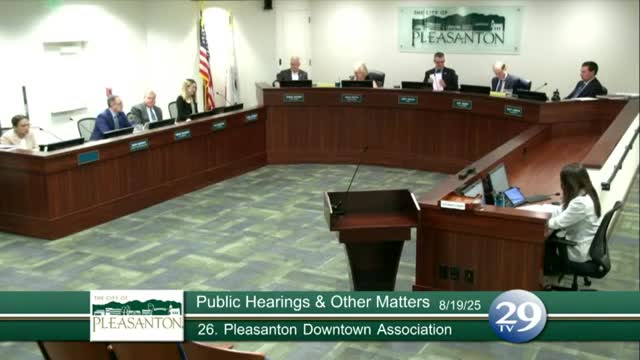
Summary
The downtown association unveiled a two‑year strategic plan and a newly formed 501(c)(3) foundation; the council appointed the PDA executive committee as the advisory board to prepare the 2026 Business Improvement District annual report and budget.
Pleasanton — The Pleasanton Downtown Association (PDA) presented a two‑year strategic plan to the City Council on Aug. 5 and announced it has formed a separate 501(c)(3) foundation to expand fundraising and grant eligibility. Council then appointed the PDA executive committee as the advisory board that will prepare the 2026 Business Improvement District (BID) annual report and budget.
What PDA presented: Gabrielle Welk, the PDA executive director, described a three‑part plan (2025–2027) to modernize downtown governance, increase funding capacity and expand stakeholder engagement. The PDA said the new foundation will enable the organization to accept tax‑deductible donations and grants for projects such as public art, wayfinding, window wraps on vacant storefronts and other streetscape improvements.
BID renewal process and council action: Under the Parking and Business Improvement Area Law of 1989, the city must appoint an advisory board to prepare the annual BID report and 2026 budget. The council approved appointing the PDA executive committee to that role; the advisory board will return in September with the annual report, budget and any proposed boundary or assessment changes. The current business improvement assessment structure (minimum $50, maximum $350) has not changed since 1996; anticipated BID assessment revenue for 2026 is roughly $80,000.
Engagement and property‑owner response: PDA staff said they held meetings with property owners after earlier feasibility work found limited interest in forming a property‑based BID (PBID) at this time. Property owners told PDA staff they were not ready for a PBID assessment structure but showed interest in targeted projects and in the foundation’s ability to support specific, visible improvements. The PDA plans outreach to reconnect with businesses and property owners and to launch an associate membership program in 2026 to broaden support and diversify revenue.
Why it matters: A refreshed BID and the newly formed foundation give downtown leaders more tools to pursue grants, corporate sponsorships and private donations to sustain events and targeted capital projects. Councilmembers asked staff and the PDA to continue outreach and to consider related historic‑preservation tools — including whether Mills Act incentives might be appropriate for historically significant downtown properties.
Next steps: The PDA advisory board will prepare the 2026 annual report and budget for council review at a September meeting; council action would follow a public hearing and any required adoption resolution.