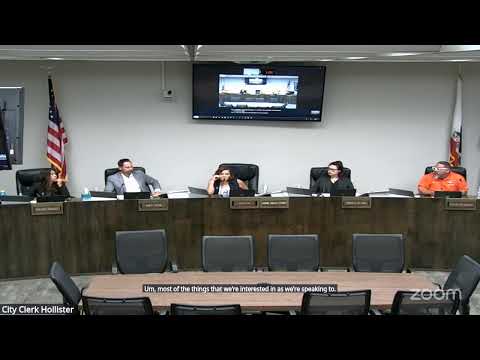
Hollister council hears mixed views on community workforce agreement; no policy change yet
Loading...
Summary
City of Hollister officials received a detailed staff briefing Aug. 18 on the city—s Community Workforce Agreement (CWA) with the Santa Clara and San Benito Counties Building and Construction Trades Council and heard nearly all public commenters urge the city to keep the agreement in place.
City of Hollister officials received a detailed staff briefing Aug. 18 on the city—s Community Workforce Agreement (CWA) with the Santa Clara and San Benito Counties Building and Construction Trades Council and heard nearly all public commenters urge the city to keep the agreement in place.
The presentation, given by Public Works Director William Baez, summarized the CWA—s key provisions, its legal basis in Hollister Municipal Code section 3.06 and implementing ordinance (adopted Dec. 4, 2023), and recent projects completed or under construction using the agreement. The council did not vote to change the ordinance or the city—s policy at the meeting.
The CWA, a form of project labor agreement that the council authorized by ordinance, requires participating contractors to recognize union referral systems, pay required contributions for vacation, pension and health funds, employ apprentices from state‑approved programs, and follow an arbitration process to resolve labor disputes without work stoppages. Baez told the council that the agreement—s initial term is three years, with a rollover provision if parties do not meet before that term ends.
Why it matters: The agreement affects which contractors and workers are likely to perform publicly funded construction in Hollister, how the city measures local hiring, and how taxpayers and ratepayers may see project costs and change orders. The issue generated one of the meeting—s largest public‑comment turnouts: the clerk reported 18 speakers signed up to speak on the item.
Most public commenters were union representatives, apprentices or journeymen who said the CWA keeps good jobs in Hollister, helps veterans and local residents access training and apprenticeships, and prevents wage theft. "A CWA changes that. It helps keep the jobs here, supporting Hollister families, strengthening our tax base, and fueling local businesses," said Nicholas Colon, who identified himself as an instructor with Sheet Metal Workers Local 104. Multiple speakers invoked programs such as Helmets to Hardhats and apprenticeships as pathways that let residents build careers without long commutes.
A minority view came from Paul Bruno, owner of Monterey Peninsula Engineering, who urged the council to rescind the PLA/CWA. "There was no input from the merit shop contractors when this was put in place," Bruno said. He said PLAs "discriminate against nearly 90% of the construction workforce" and argued they reduce competition and increase costs, citing that recent PLA projects received only one or two bids.
Staff provided project cost detail when asked by council members. Examples from Baez—s presentation included: - 2024 Citywide Roadway Improvements: engineer—s estimate $8,285,000; winning bid ~$8,278,000 (one bid); construction costs including contingencies and change orders $9,800,000, with change orders attributed to underground conflicts, tree removals and sidewalk adjustments. - Section 1 grind and overlay: engineer—s estimate $704,000; winning bid $445,000; final cost ~$511,000 (including a small change order). - West Gateway Roundabout: engineer—s estimate $4,500,000; bid $3,400,000; under construction with change orders pending. - IWTP Bridal Road outfall: engineer—s estimate $7,500,000; bid $8,400,000; under construction with limited change orders to date. - Other completed projects (pre‑CWA): Fremont Way, Sixth Street lighting, Hillcrest Road sewer improvements and Sally Street improvements (staff gave estimates, bid amounts and final costs including contingencies for each).
Baez said the city included contingency amounts on projects (larger percent for underground work) and that change orders on several projects were driven by unforeseen underground conditions or required infrastructure adjustments.
Council discussion and next steps: Council members voiced support for the goals behind the CWA — local hiring, apprenticeships, job safety and keeping wages and benefits local — but several members said it is too early to conclude whether the CWA has raised or lowered overall project costs or competition. Councilmember Roland Resendiz and others asked staff for a simple, side‑by‑side dataset showing engineer estimates, bid amounts, and final construction costs (including contingencies and change orders) for projects completed under the CWA so the council can evaluate outcomes when more projects are completed. Resendiz said the council is roughly halfway through the current three‑year contract and favored finishing the term and reassessing in about a year and a half.
Outcome: The council received the presentation, heard public comment and gave direction to staff to continue tracking project bids, costs and local hiring and to return with more data later in the contract term. No ordinance change or repeal was proposed or adopted at the meeting.
Members of the public and council stressed two recurring points: (1) the need for data showing whether CWA projects attract more or fewer bidders and how final costs compare with engineer estimates; and (2) the city—s obligation to protect public funds while supporting local workforce opportunities.
Speakers quoted in this article are drawn from the meeting record and include Public Works Director William Baez; Councilmembers Roland Resendiz and others; union representatives and apprentices including Nicholas Colon; and contractor Paul Bruno.
Taper: Staff said roughly three to five city projects are expected to move into construction during the remaining term; the council asked staff to compile a clear dataset and return to council for review before any decision about amending or ending the agreement.