
Pleasanton council declines immediate polling but unanimously directs staff to begin talks on raising hotel tax
Get AI-powered insights, summaries, and transcripts
Subscribe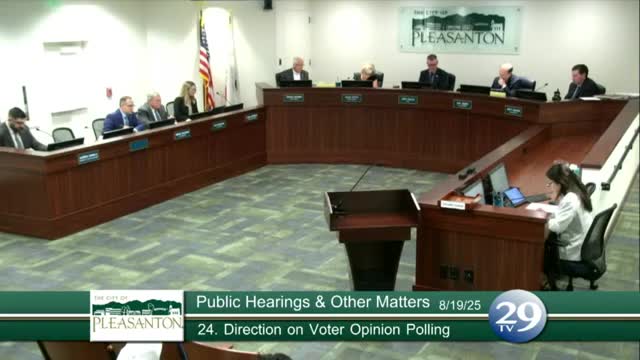
Summary
After months of budget shortfalls, council debated professional polling on potential new revenue measures; a motion to fund polling failed for lack of a second, but council later voted unanimously to direct staff to begin stakeholder discussions on a transient occupancy tax (TOT).
Pleasanton — The City Council spent more than two hours Aug. 5 debating whether to pay a consultant $31,000–$50,000 to conduct statistically valid voter polling on possible revenue measures including a hotel tax increase, a sales tax, a parcel tax and general‑obligation bonds.
The polling proposal would have tested up to three options, measured messaging, and assessed likely voter support and tradeoffs. "Professional polling would test initial support levels, measure impact of messaging, and determine which city services residents value most," City Manager Aron Zavala told the council.
Council split on strategy. Vice Mayor Nybert introduced a motion to authorize polling; the motion was seconded but later failed for lack of a sustained second. A separate motion — to begin formal discussions with hotels and other stakeholders about increasing the city’s transient occupancy tax (TOT) from the current 8% to 10% or 12% — passed unanimously.
Why it matters: The city is managing a projected structural gap in future years the staff estimated at roughly $6–9 million annually under current assumptions. Polling would have provided a statistically valid way to judge whether any ballot revenue measure could win voter approval before the city spent staff time and campaign resources; staff said the August 2026 deadline to place a measure on the ballot would require decisions in the first half of 2026.
Details of staff proposals: Staff outlined four options to test in polling: increase the TOT (8% now) to 10% or 12% (estimated to generate about $1.4 million to $2.8 million annually for the city if approved); a half‑cent sales tax (estimated roughly $10.8 million annually); a parcel tax (two‑thirds vote; staff estimate roughly $10.2 million); and a general‑obligation bond for infrastructure (requires a property tax levy; staff showed an illustrative $150 million authorization with phased issuances).
Why council did not immediately approve polling: Council members who opposed spending for polling said other priorities — building public trust after a recent failed ballot measure and performing a deeper organizational assessment and asset management work — should come first. "If we presume today that we know what voters will be inclined to support, that is showing a lack of respect for our voters," Vice Mayor Nybert said in favor of polling; others countered that it was too soon after the community’s recent vote and that spending on polling could be premature.
What passed: Council directed staff to open stakeholder talks around a TOT increase and to consider whether neighboring Tri‑Valley cities could align. The city manager said hotels’ occupancy and the regional hotel market would determine revenue generation and that any increase would likely require further outreach and coordination.
Public comment: Resident Debbie Wallace urged the council to pursue a hotel tax, saying it would be paid largely by nonresidents and could add modest but dedicated revenue. Other speakers urged careful planning and collaboration with school and regional agencies to avoid ballot conflicts.
Next steps: Staff will pursue stakeholder outreach on a potential TOT increase and return with follow‑up reports. Polling was not authorized at this meeting; staff will continue the organizational and fiscal work the council identified as priorities.