Citizen Portal
Sign In

Pleasanton planners probe proposed teardown at 231 Old Bernal; applicant seeks single large home with ground-floor live-work

5772468 · August 27, 2025

Loading...

AI-Generated Content: All content on this page was generated by AI to highlight key points from the meeting. For complete details and context, we recommend watching the full video. so we can fix them.

Summary

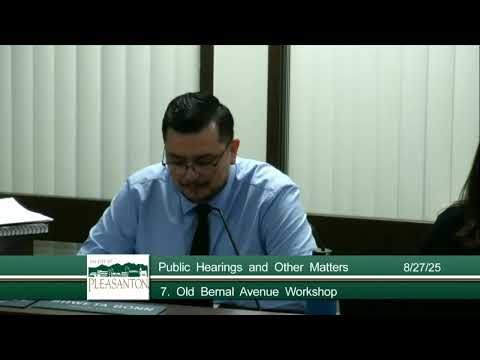
A Pleasanton Planning Commission workshop on Aug. 27 focused on a PUD application to demolish an existing two‑story commercial office building at 231 Old Bernal Avenue and build a three‑story single‑family residence with a 725‑square‑foot ground‑floor live‑work area.

A Pleasanton Planning Commission workshop on Aug. 27 focused on a PUD application to demolish an existing two‑story commercial office building at 231 Old Bernal Avenue and build a three‑story single‑family residence with a 725‑square‑foot ground‑floor live‑work area. The application was presented by city staff and discussed at length with the applicant and nearby residents; no formal action was taken because the item was a workshop.

Why it matters: The lot is in the Downtown Specific Plan (DSP) mixed‑use transitional (MUT) area, where DSP policies generally prioritize street‑front commercial uses. The applicant’s plan would reduce commercial square footage on the site and request deviations from several objective design standards in the Pleasanton Municipal Code and the city’s Objective Design Standards (ODS). Commissioners said the proposal raises policy questions about whether the downtown policies should be strictly applied on this block, and whether a single large home is appropriate on a site where zoning and the DSP anticipate higher residential density or ground‑floor commercial.

What staff told commissioners: Staff said the existing site contains a roughly 6,160‑square‑foot commercial building, 21 surface parking stalls and about 34 trees (none designated heritage trees). The proposal would demolish that building and construct a roughly 38‑foot‑tall structure with approximately 15,088 square feet of living area, a 725‑square‑foot ground‑floor live‑work space, about 6 total parking stalls for the new development, and roughly 6,320 square feet of new landscaping. Staff identified several nonconformities with the DSP, the ODS and the Pleasanton Municipal Code (PMC): proposed front setback of 5 feet to the porch (ODS minimum 10 feet); side setbacks of 5 feet and 10 feet (ODS requires 7 feet minimum and 16 feet combined); proposed height about 38 feet (PMC/ODS maximum 36 feet in MUT); proposed cumulative FAR around 85 percent (DSP maximum 125 percent) and an overall reduction in commercial square footage compared with the existing building (proposed ~725 sq ft vs. existing ~6,160 sq ft). Staff recommended design and landscaping changes to improve pedestrian activation of the frontage and to provide a more gradual transition to adjacent residential properties.

Applicant presentation and rationale: The applicant, who identified himself as Gautam Patel, said he and family members were born and raised in Pleasanton and presented the project as a multigenerational home for three brothers and their parents. Patel said he and family own other nearby parcels and had purchased a separate site on Harrison Street in part to prevent a larger multifamily development there; he described this project as an effort to preserve downtown character while keeping the site privately owned and occupied. Patel told commissioners the existing office building had low tenancy and was not a viable commercial corridor in practice, and he said the proposed live‑work area would be used by family members for business operations.

Discussion points and technical constraints: Commissioners and staff discussed two distinct regulatory issues: (1) building/fire code requirements that typically require fire separation and independent access for true ‘‘commercial’’ space, and (2) DSP policy goals that call for no net loss of commercial square footage, minimum commercial depth (50 feet minimum building depth and minimum commercial frontage depth called out in the DSP), and a street‑visible commercial presence (storefront glazing, separate entries). Staff explained that under building and fire codes a ‘‘live‑work’’ that functions as commercial space generally must be physically separated and protected from the residential unit (fire rating, independent access, corridor or separation). The applicant said he had considered separated access but was reluctant to eliminate internal access between home and work space for convenience; he also said he had adjusted front setbacks in past iterations after receiving feedback that the building should engage the sidewalk.

Community concerns: Neighbors who spoke at the public hearing said they welcomed development that was lower‑intensity than large multifamily projects proposed elsewhere, but asked the commission to preserve mature trees on Augustine/Old Bernal, particularly two coastal redwoods by a driveway. The applicant said he would attempt to preserve trees where possible but that some removals may be required for code‑required access or because trees were dead or stressed per the project arborist.

Policy and planning issues commissioners raised: Commissioners repeatedly framed the item as a tension between (a) DSP goals to retain and activate street‑front commercial uses in the MUT area and (b) market realities and the applicant’s desire for a residential outcome. Specific issues flagged included whether the lot is suitable for a one‑unit single‑family development given a DSP allowable density that the staff said equates to a minimum of about 10 units on the 21,384‑square‑foot lot (DSP density “more than 20 dwelling units per acre”), whether the proposed ground‑floor space meets the DSP’s commercial‑depth and no‑net‑loss provisions, whether a 38‑foot height is acceptable, and whether frontage design changes (storefront glazing, reduced front wall/opaque fencing, increased landscaping, or deeper setbacks) could achieve the DSP’s pedestrian and commercial activation goals. Several commissioners suggested townhomes or a small multiunit residential layout would better match zoning and city goals; others said the existing commercial vacancy on the property weakens the case for retaining commercial use and urged staff to consider whether an exception to some DSP policies might be appropriate.

Decision and next steps: Commissioners provided guidance to staff and the applicant but did not vote. Themes emerging from the workshop included: (1) general reluctance among several commissioners to support heights above the 36‑foot limit for the MUT; (2) a desire that, if the project is treated as residential rather than mixed‑use, the building be set back further and designed to read as residential from the sidewalk; (3) if the commission or council wants a genuine commercial frontage, the ground‑floor space must read and function as separable commercial space per building/fire code and DSP expectations; and (4) several commissioners expressed interest in planning for the block more holistically—citing nearby properties including Harrison Street and Augustine projects—before approving ad hoc exceptions. Staff said it will continue to work with the applicant and return with a formal hearing when the PUD application is complete.

What the application would change (clarifying details): Lot area stated by staff: approximately 21,384 square feet; existing building: ~6,160 square feet; proposed residence: ~15,088 square feet; proposed ground‑floor live‑work: ~725 square feet; proposed parking stalls on new development: 6; proposed height: ~38 feet; proposed FAR: ~85%; DSP maximum FAR for the site: 125%; ODS minimum front setback: 10 feet (proposal: 5 feet to porch, 9 feet to building wall); ODS minimum side setback 7 feet (combined 16 feet) versus proposed 5 feet and 10 feet combined; existing trees on site: 34; trees proposed for removal in current plans: 12 non‑heritage trees. All numeric items were reported by staff in the workshop packet.

Bottom line: The commission did not approve or deny the project at the workshop. The discussion centered on whether this specific lot should remain obligated to downtown commercial‑first DSP policies or whether flexibility is acceptable given market conditions and the applicant’s stated intent. Staff will use the commission’s feedback to refine the application before a formal hearing.

(Workshop item — no vote.)