
UEF and Lowell outline investment framework to bundle bankable urban projects
Get AI-powered insights, summaries, and transcripts
Subscribe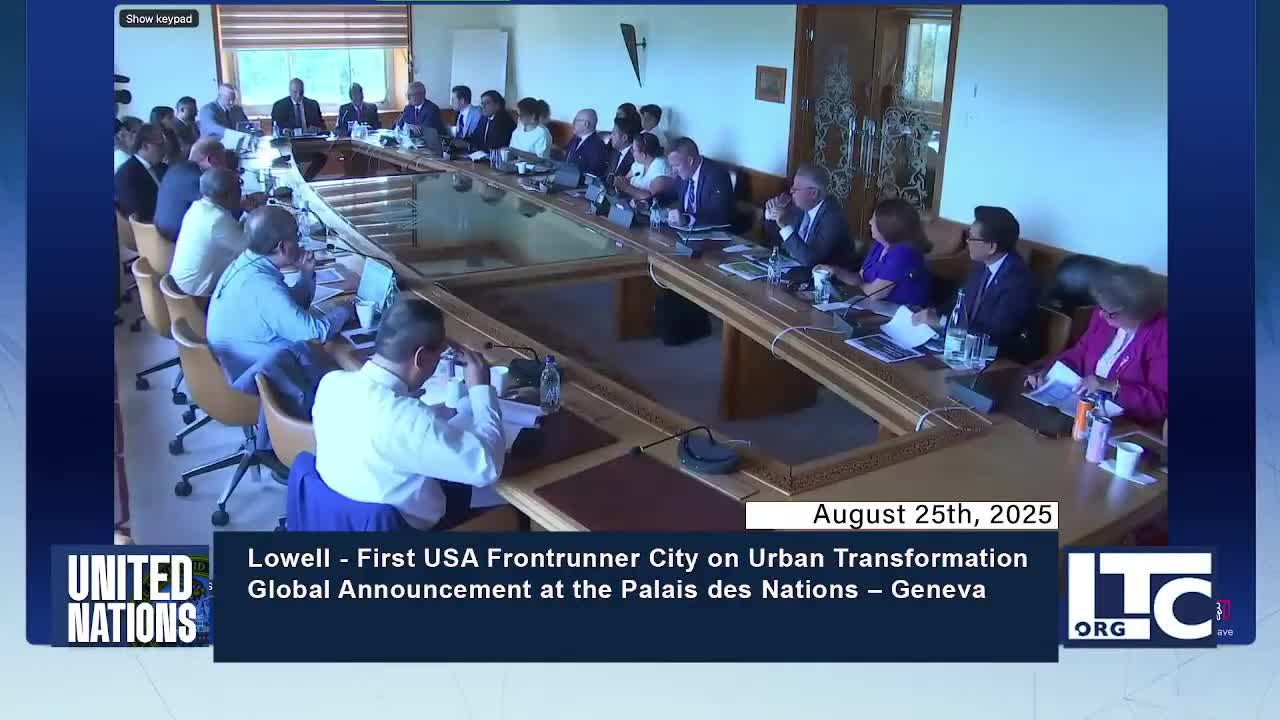
Summary
At the Geneva announcement, Urban Economy Forum staff and city officials described an investment architecture to de‑risk and bundle projects in green housing, renewable energy and mobility to attract private investors alongside public and philanthropic capital.
Urban Economy Forum executives and Lowell officials used the Geneva launch to describe an investment approach intended to make urban transformation projects "investable" by bundling priorities into bankable portfolios and offering risk mitigation tools.
Kamran Spele, executive director of the Urban Economy Forum, summarized the framework as built on five elements: a public‑private partnership platform; blended finance and risk mitigation; priority targeting of green and affordable housing, renewable energy, mobility and digital infrastructure; community value and equity building; and transparent governance and compliance aligned with global standards. "The framework is built on 5 5 cheap blocks," Kamran said during his session, describing the five pillars and later expanding on how to combine them into investable portfolios.
Why it matters: Many speakers said investor hesitation remains the main barrier to rapid scaling of urban projects. The framework presented in Geneva aims to reduce perceived risk by aggregating smaller projects into diversified portfolios, aligning them to environmental, social and governance (ESG) standards and using blended public money to guarantee early returns.
City financial leaders cited local precedents to illustrate how different funding sources can be combined. Connor Baldwin, Lowell's chief financial officer, outlined a mix of municipal general obligation bonds, state low‑interest loans (such as the Massachusetts Clean Water Trust), federal grants and ARPA funds; he also pointed to public‑private energy contracts and municipal aggregation as examples of programs that leveraged multiple revenue streams. "The model used to finance these sustainability initiatives is like Lowell itself. It's a patchwork quilt of funding sources," Baldwin said.
Speakers urged that finance structures be tied to measurable outcomes and transparent data. Reza Purvaziri and UNU representatives emphasized the need for an academic chair and living lab metrics at UMass Lowell to produce the evidence investors will require. Kamran and other presenters said investors will be approached with bankable pilots (for example, scalable green housing or renewable energy projects) that include guarantees and blended capital to lower first‑loss risk.
What was decided and next steps: event participants signed a partnership statement committing to pursue the investment architecture in follow‑up work. Organizers said they would convene financial partners to develop pilot portfolios and to develop standardized documentation to attract institutional capital. No binding financial commitments from new investors were announced at the Geneva ceremony.
Direct quotes from the transcript: Kamran Spele — "The framework is built on 5 5 cheap blocks." Connor Baldwin — "It's a patchwork quilt of funding sources put together from available local resources such as tax exempt municipal general obligation bonds, federal grants ... and partnerships with state financing agencies." Reza Purvaziri — "We need to interpret, accurately this concept to the language of finance. They need trust."