
Administration recommends joining Chagrin Valley dispatch; council refers membership ordinance to committee
Get AI-powered insights, summaries, and transcripts
Subscribe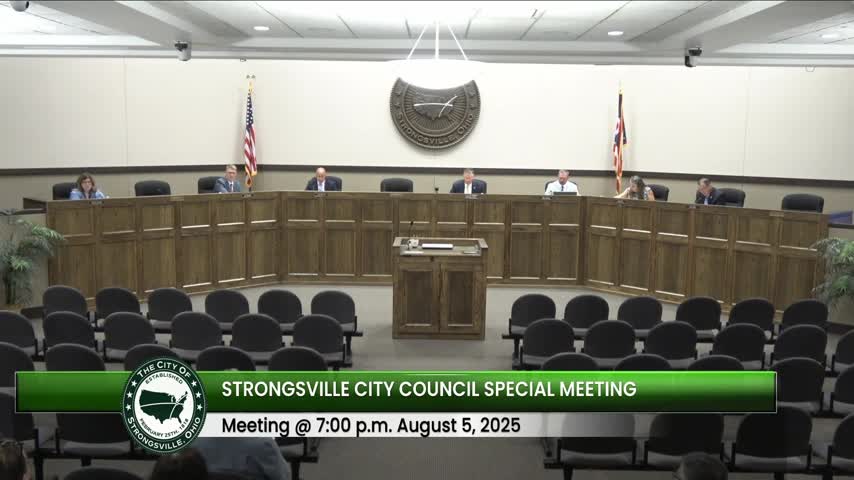
Summary
Strongsville administration told council that joining the Chagrin Valley Regional Communication Center would preserve jobs, improve wireless 9-1-1 routing and reduce costs; Council placed the membership ordinance on first reading and sent it to committee for further review.
Strongsville officials presented a recommendation on Aug. 5 that the city join the Chagrin Valley Regional Communication Center (CVD) to dispatch public-safety calls for Strongsville and several neighboring communities. The City Council placed Ordinance 20 25 86 — the proposed member-participation agreement — on first reading and referred it to committee for further consideration; no final vote to join was taken.
Why it matters: Administration said the move would preserve current dispatch jobs, speed 9-1-1 call routing by removing a county “middleman,” and lower the city’s dispatch costs compared with operating alone. Officials said CVD already accepts wireless 9-1-1 calls and that joining would give Strongsville access to related funding and technology upgrades.
The administration described three options it reviewed: maintain the existing multi-community center if members remained; run a Strongsville-only center; or join a council-of-governments dispatch center. “We eventually decided that the best alternative was to join the Council of Governments with Chagrin Valley Dispatch,” Law Director Jamieson told council as he introduced the administration’s presentation.
Charlie Goss, the director who led the presentation, said the administration negotiated assurances that “all of our current dispatchers will be offered immediate reemployment with a substantial pay raise and comparable benefits.” He added that roughly half the current staff had already applied to join CVD: “In fact, 17 of our 32 dispatchers have already indicated they would stay on with CVD and have completed the necessary application process.”
David Sims, identified as the city’s IT director, and other administrators said technology and scale are central to the recommendation. Sims said joining CVD would put Strongsville on a system that the administration expects to receive wireless 9-1-1 calls directly and to support faster voice and data transfer across the region. “By being part of that team, it becomes more difficult for the county to retain those wireless 9-1-1 calls,” Sims said, and that direct routing could save “anywhere between 30 and 60 seconds” on some calls.
Administration cited costs as a key driver. Eric Dean (administration) summarized recent center expenditures and said the proposed CVD participation cost to Strongsville would be about $1,200,000 per year, while continuing as a stand‑alone center for the city (if the other communities do not remain) would cost “over $2,000,000” annually, a comparison the administration used to support the CVD option.
Officials also described a transition timeline: Strongsville dispatchers would continue working in the city’s facility for about two years while CVD builds out a new central center in Valley View. After that build-out, administration said local dispatch staff who move to CVD would work in the new facility. The administration added it plans to maintain the Strongsville center as a backup and to keep some equipment active in case it is needed for redundancy.
Council members pressed for more input and details from employees. Councilwoman Kozak, chair of the public-safety committee, said she had learned about Berea’s departure late and asked for more outreach to rank‑and‑file public-safety personnel before a final decision: “I feel like I’m behind on knowing what we’ve done and what our options were… I feel that we need to have an opportunity to hear from our dispatchers and other safety forces and how would they feel about this before we make this decision.”
Council members also raised the dispatchers’ collective-bargaining status; Kozak noted concerns that CVD positions would not be in the same bargaining unit. In response, administration said CVD had explained benefits and transition terms directly to staff and that employees’ health coverage, longevity and other service accruals would be recognized at the time they became CVD employees. Administration said the city is still in contract negotiations with the dispatchers’ bargaining unit and that some transition details must be finalized with CVD.
Discussion items that remain open include whether remaining partner communities will stay in the Strongsville-centered center, precisely how county/state wireless 9‑1‑1 funds will be distributed if Strongsville joins CVD, the final terms of employment for dispatchers who transfer, and the full cost details of maintaining a backup center in Strongsville. The ordinance authorizing membership (Ordinance 20 25 86) was placed on first reading and referred to committee for further review; council scheduled public comment for the next regular meeting on Sept. 2.
(Reporting note: quotes and attributions come from presentations and exchanges during the Aug. 5, 2025 Strongsville City Council special meeting.)
Ending: The council will review the ordinance in committee and consider public comment at the next regular meeting on Sept. 2 before any final vote to join CVD is taken.