
Mundelein finance committee debates keeping 1% local grocery tax as state repeal takes effect Jan. 1, 2026
Get AI-powered insights, summaries, and transcripts
Subscribe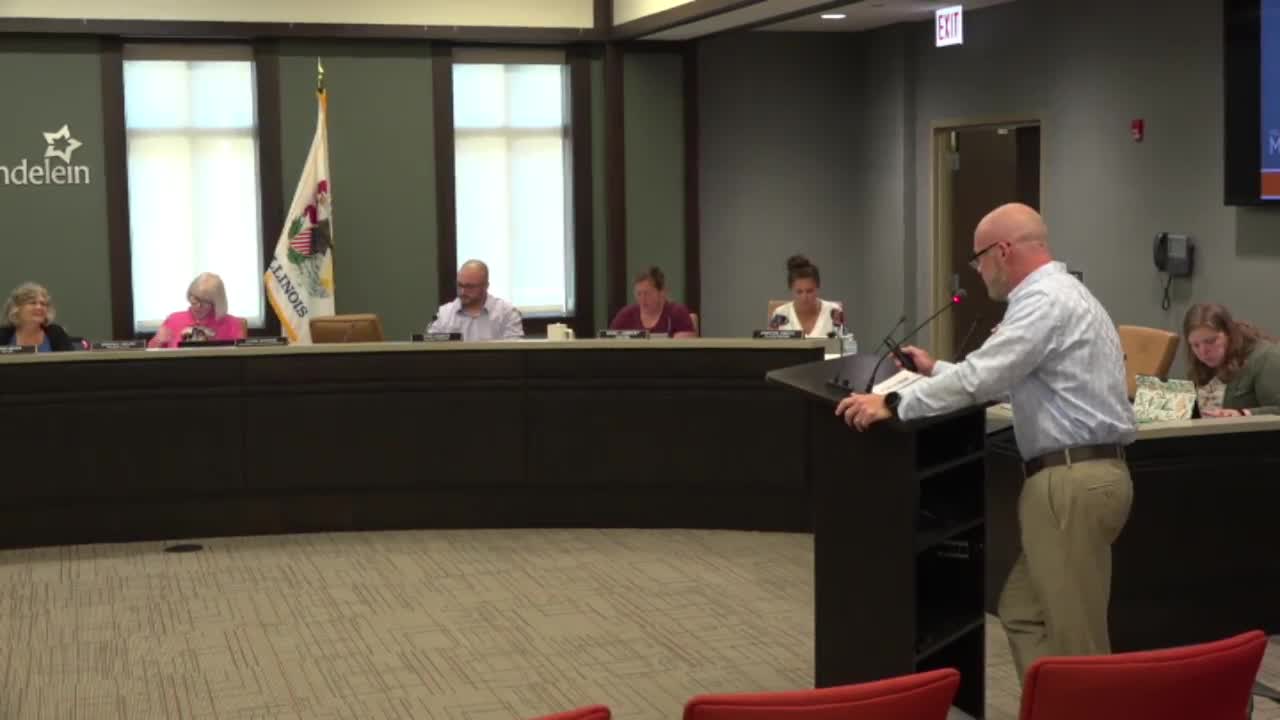
Summary
The Mundelein Finance Committee on Aug. 25 discussed whether the village should adopt a 1% local grocery tax after the state’s repeal of the grocery tax, effective Jan. 1, 2026, and the October 1 deadline for municipalities to notify the state if they intend to continue collecting the tax.
The Mundelein Finance Committee on Aug. 25 discussed whether the village should adopt a 1% local grocery tax after the state’s repeal of the grocery tax, effective Jan. 1, 2026, and the October 1 deadline for municipalities to notify the state if they intend to continue collecting the tax.
The discussion matters because the grocery tax generates roughly $1.1 million a year for the village general fund, and losing that revenue would require cuts, new revenue elsewhere or both. Gunther, a staff presenter, told the committee that “the state passed public act 103781, which was actually to repeal the grocery tax effect as of 01/01/2026,” and that municipalities must notify the state by Oct. 1 to continue collecting the tax locally.
Committee members heard two clear options from staff and discussed others: take no action and allow the grocery tax to lapse (state repeal will take effect), or adopt a 1% local grocery tax to retain the revenue locally. Gunther said the grocery tax brings in “approximately $1,112,000 dollars per year annually” and that those funds flow to the village general fund to pay operations and projects. He also noted the village increased its home-rule sales tax by 0.25 percentage points last year and that the quarter-point has produced roughly an $800,000 annual increase compared with prior projections.
Trustees raised trade-offs. Trustee Swank said the village will need to replace roughly “a million dollars between a million and 1.2” if the grocery tax is eliminated, noting the revenue comes in part from nonresident shoppers who cross municipal borders to buy groceries. Trustee Krinsky said she would vote to eliminate the tax, arguing that lower-income residents pay a higher share of their income for necessities and that selective “vice” taxes on tobacco or alcohol would be a fairer alternative. Another trustee said keeping the 1% would avoid property-tax increases, observing that the property-tax increase that would recapture the lost grocery revenue would cost the owner of a $385,000 home about $120 per year.
Committee members discussed other possible revenue options briefly: a municipal streaming tax was estimated by staff to raise roughly $85,000 to $100,000 annually in a conservative scenario; telecom and franchise fee revenues have been declining (Gunther cited roughly $400,000 annually in telecom tax with about a 10% decline in recent years). Several trustees and staff warned that projections are subject to uncertainty, including changes in retail patterns, new cannabis retail locations nearby and volatile project bids that can increase costs for capital items.
No formal ordinance vote took place during the meeting. Instead, trustees expressed individual preferences: several trustees said they favored continuing the revenue stream by adopting the 1% grocery tax, while others favored letting the tax lapse or pursuing alternative revenue options. At one point a tally was reported as roughly two trustees for eliminating the tax and two for keeping it, and multiple trustees asked staff to return with additional analysis and options.
Gunther told the committee that if the board wants to continue the tax, staff needs direction to prepare an ordinance: “Bring the ordinance no later than September 8 so that we can get it to the state of Illinois by the October 1 deadline.” The committee did not take a final vote; staff will prepare follow-up materials and potential ordinance language for the full board to consider before the Oct. 1 notification deadline.
Next steps: staff will prepare a report with revenue projections, alternatives (including targeted vice taxes and the implications of reducing the 0.25 percentage-point sales-tax increase enacted last year) and draft ordinance language if the board instructs them to proceed. The Finance Committee will reconvene and the full board must act — or decline to act — before Oct. 1 to determine whether the grocery tax continues locally.