Get Full Government Meeting Transcripts, Videos, & Alerts Forever!
Get email alerts on the Ivanhoe Development Impact Fees topic
No spam. Unsubscribe anytime.
Mundelein delays impact-fee vote on Ivanhoe Village after hours of public comment
Summary
The Mundelein Village Board removed an impact-fee ordinance from its March 10 agenda to allow further talks between the developer and school districts, after more than two hours of public comment raising concerns about school capacity, transparency and tax burden.
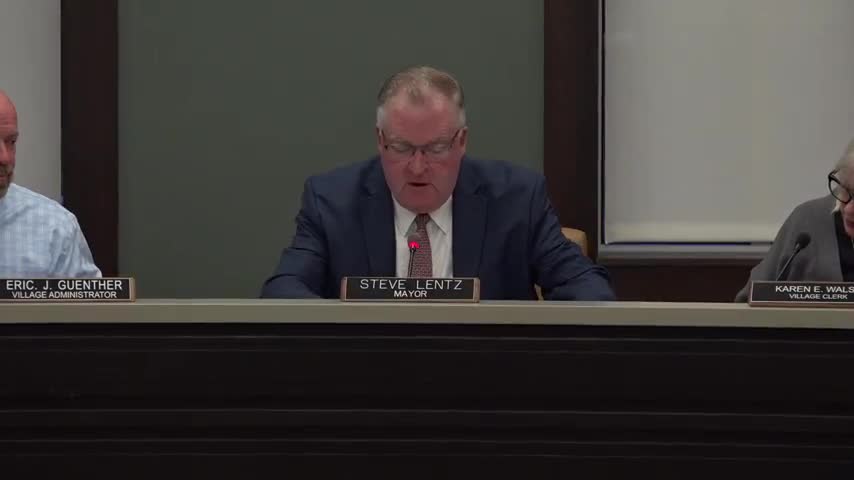
Mayor (name not specified) opened the March 10 Mundelein Village Board meeting by saying an impact-fee ordinance related to the Ivanhoe Village development had been pulled from the agenda to give the developer and affected school districts another chance to meet. “That was pulled from this, agenda last week…so tonight is a short agenda. There's nothing regarding Ivanhoe on the on tonight's agenda,” the mayor said.
The village’s move followed more than two hours of public commentary, in which parents, retirees, teachers and school officials pressed the board for transparency and negotiations that protect existing taxpayers and school quality. Tam Shaw, vice president of the Fremont District 79 Board of Education, cited a Johnson Research Group impact study and told trustees the district faces an estimated net annual shortfall of $1,560,000 from the Ivanhoe Village project because the buildout is predominantly residential. “Any shortfall from the developer, who will be the source of nearly a thousand new students to our schools, will force us to go to referendum sooner than we anticipated,” Shaw said.
Tricia, identified in public comment as superintendent of Fremont District 79, said Ivanhoe Village is expected to add 946 students — a roughly 50% increase over current enrollment — and said the district will need a new school if the projected enrollment arrives. “Without adequate funding from the developer, a significant cost will be passed to taxpayers, or we'll be forced into unacceptable choices, overcrowded classrooms, mobile units, reduced programming,” she said.
Kevin Byers, superintendent for District 120 (and District 75 referenced in his remarks), gave a lower projected range for District 120 of about 265 to 335 additional students and asked the village to write clear directions into any ordinance so officials can determine how and when other government entities participate. “We need your help. We can't do this without you,” Byers said, urging collaboration between the village, districts and developer.
Many residents said the scale of the proposed development — speakers cited figures ranging from about 3,100 to 3,237 units — would harm streets, water, sewer and other infrastructure and shift costs onto current homeowners. Rick Myers, speaking for Saddlebrook Farms residents, and other speakers including CJ Patrick, Stacy Brown (president of the Fremont PTO) and longtime residents, urged delay and phased construction or a funding mechanism that directly addresses school capacity. “The uncertainty around the impact fees…present a threat to the current school system and the community as a whole,” Brown said.
Several speakers also criticized public messaging and the village’s outreach. Lauren Forman and others said they had written trustees and received few responses. Some commenters urged the village to broker negotiations rather than allowing the parties to trade public statements. At least one resident asked for a referendum, saying voters should approve a project with such broad impacts.
Village staff and board members told the room the item had been removed to allow renewed negotiations; the mayor said a meeting date had been scheduled for the developer and the school districts. The mayor also explained the village posts agendas in compliance with state notice requirements and that the published agenda had not indicated the board would take action on impact fees that night.
No impact-fee ordinance was adopted on March 10; the board recessed into executive session later in the meeting for unrelated matters. The public-comment period and the board’s decision to delay action set expectations that the developer and districts would meet again before any village vote.
Why it matters: The Ivanhoe Village proposal is cited by district officials as likely to add hundreds of students to already near-capacity schools, and residents say the project could significantly affect local infrastructure and property taxes. How the village mediates negotiations between school districts and the developer will influence whether costs fall more on new units, the developer or existing taxpayers.
Ending: The board did not vote on impact fees at the March 10 meeting and told the public the item was removed so the developer and school districts could continue talks; trustees and district leaders said they hope the subsequent meeting will produce a negotiated solution.