
Board denies Hidden Pond rezoning amid family‑subdivision, traffic and well concerns
Get AI-powered insights, summaries, and transcripts
Subscribe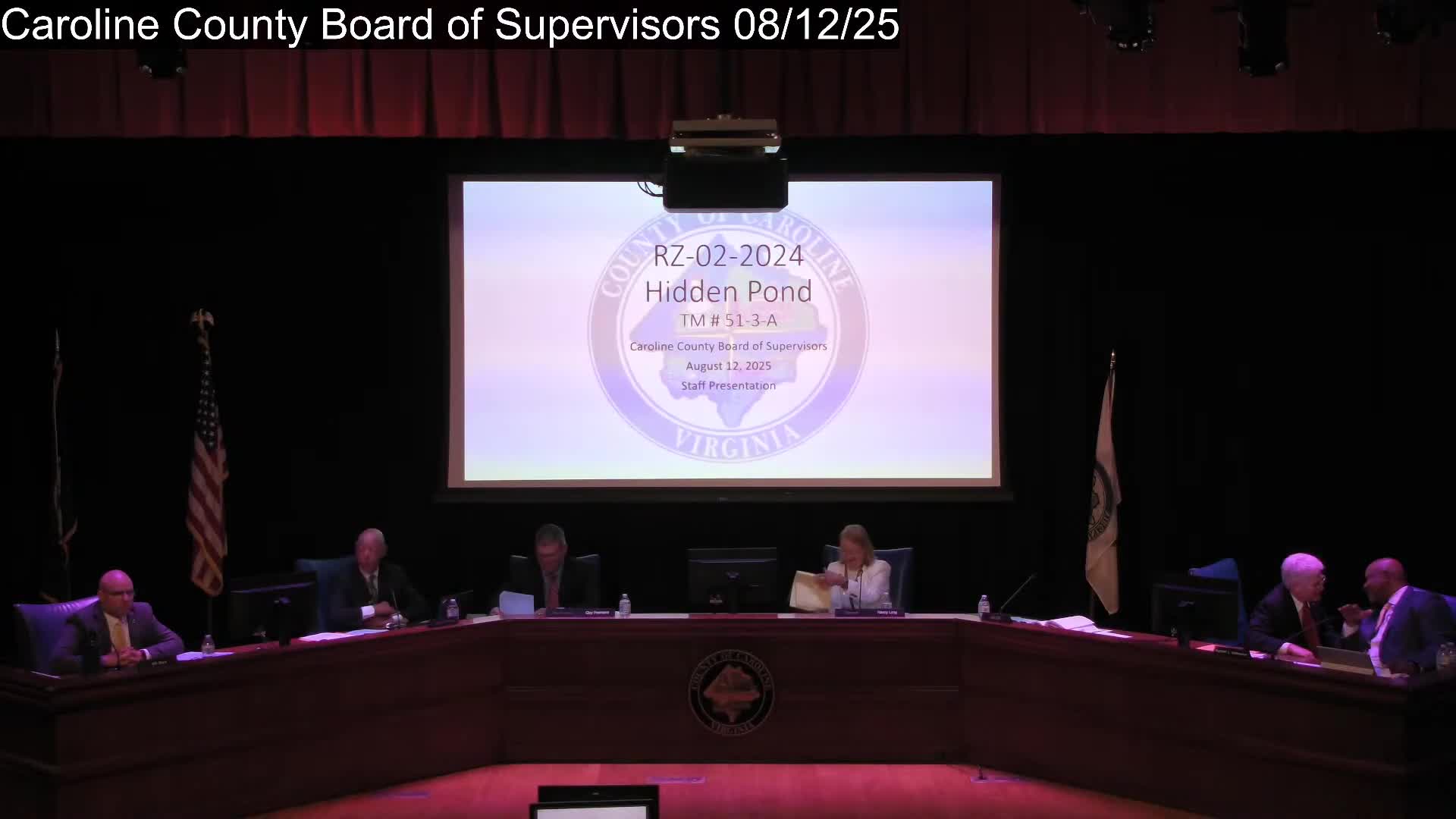
Summary
The Caroline County Board of Supervisors voted to deny a request to rezone a 220‑acre parcel on Ladysmith Road to allow a 20‑lot subdivision, citing planning commission concerns about by‑right family subdivisions, traffic and groundwater; planning staff said a text amendment on family subdivisions is in progress.
The Caroline County Board of Supervisors denied RZ‑022024, a rezoning request known as Preserve at Hidden Pond, after a public hearing in which residents raised concerns about traffic, groundwater availability and the way family subdivisions are applied in rural preservation areas. The motion to deny carried after a majority vote by the board.
The rezoning sought to change a 221‑acre parcel on Ladysmith Road from Rural Preservation (RP) to Rural Residential‑2 (RR‑2) to allow 20 clustered, roughly 2‑acre lots while leaving a 167‑acre residual parcel zoned RP. Planning staff told the board the proposal would not increase by‑right density versus RP but would permit smaller clustered lots closer to the Ladysmith growth area. The planning commission recommended denial over questions about the residual parcel’s future by‑right family subdivisions and the absence of turn‑lane improvements on Ladysmith Road.
Residents at the hearing urged denial. Theresa White, a Western Caroline District resident, said schools are already overcrowded, water availability is uncertain and traffic on Ladysmith Road is “already a problem,” asking the board not to approve more rooftops until infrastructure catches up. Other residents described concern for wildlife, wetland impacts and the rural character of the area.
The applicant’s representative said the plan was developed with county staff input, emphasized clustering to protect wetlands and proffered limits on new family subdivisions of the residual parcel, and offered to revise proffer language further if the board requested it. The applicant also said the area does not show the groundwater constraints noted east of I‑95 and added they had offered a right‑turn lane although VDOT did not warrant left‑turn improvements.
Planning staff and several board members expressed particular concern about the county’s family‑subdivision rule, which allows two‑acre family lots in RP if certain conditions are met. Staff said the ordinance could be used repeatedly in sequence to subdivide a large residual parcel into many small lots over time. Board members described this as an abuse of intent and said it undercuts the county’s RP policy. Planning staff told the board a text amendment to the family‑subdivision provisions is underway and will be brought forward for the board’s consideration.
On traffic and site access, staff noted applicant’s turn‑lane warrant analysis concluded no turn lanes were required, but VDOT had requested additional detail and questioned road and cul‑de‑sac dimensions in the applicant’s submissions. Commissioners and supervisors said the VDOT comments illustrate the plan needs further technical work before approval.
The board voted to deny the rezoning. The recorded votes were read at the meeting; the motion carried with a majority in favor and one abstention recorded. The applicant and staff were encouraged to work on clarified proffers and VDOT‑requested details and to coordinate with planning staff on the forthcoming family‑subdivision text amendment.
Why this matters: the decision illustrates county officials weighing pressure for new housing near growth edges against rural‑preservation policy, infrastructure capacity and ordinance loopholes that can change the practical density of large tracts over time. It also prompted a board‑wide request to accelerate work on a family‑subdivision text amendment to prevent repeat instances of piecemeal lot creation.
For follow‑up: planning staff said they are preparing a text amendment to the family‑subdivision rules; staff also will relay VDOT’s engineering questions to the applicant if the applicant returns with a revised application.