
Wellington staff recommend streamlined administrative path for electric‑vehicle charging permits
Get AI-powered insights, summaries, and transcripts
Subscribe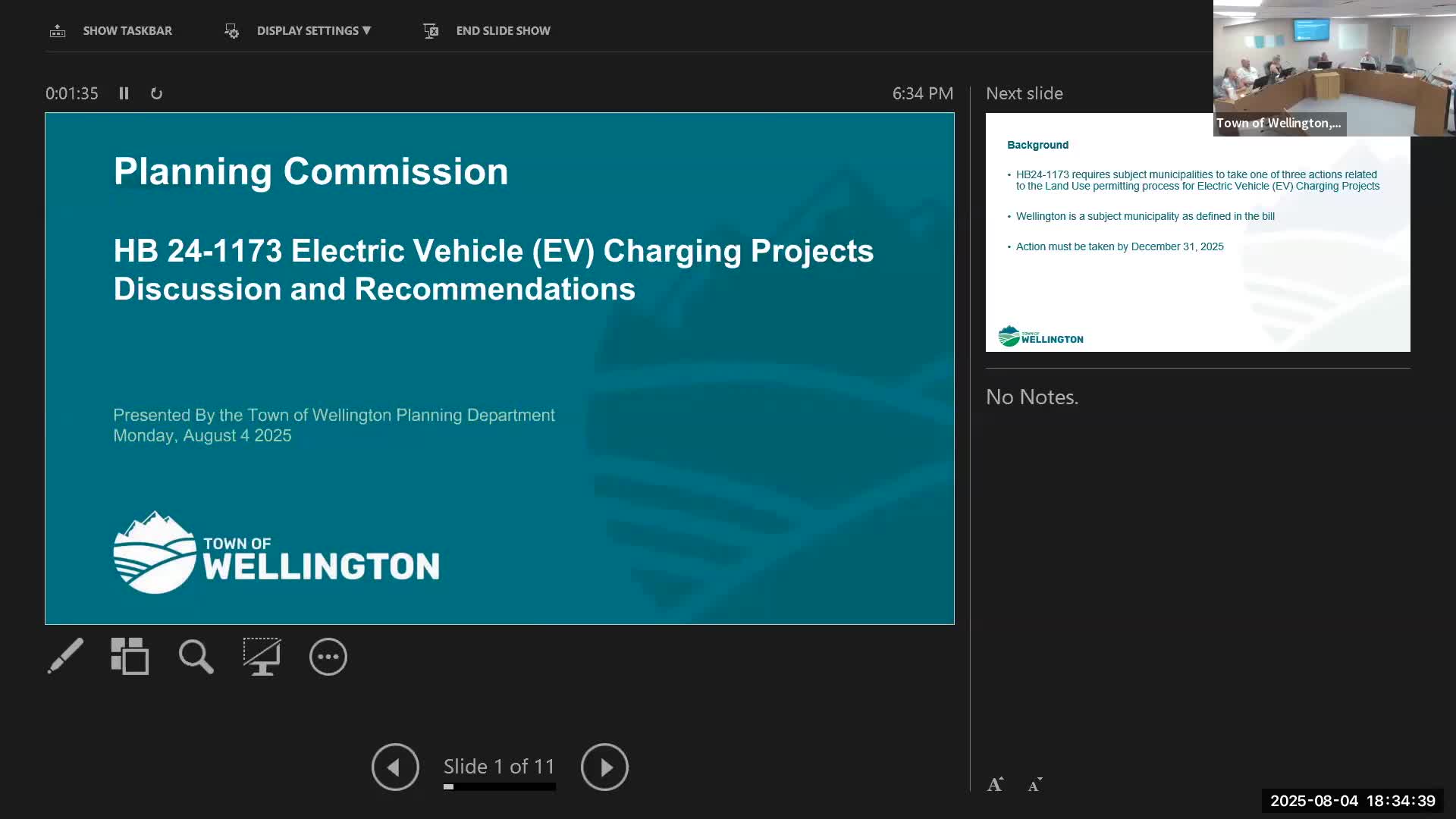
Summary
Planning staff told the Planning Commission they favor a limited, administrative approach ("option 2") to comply with House Bill 24‑1173 and to meet the state's 12/31/2025 deadline, while preserving local review for public safety and site constraints.
Wellington planning staff recommended that the Planning Commission pursue a limited administrative permitting approach to electric‑vehicle (EV) charging stations rather than adopting the state's full model code or formally opting out, staff said at a Planning Commission meeting.
The recommendation responds to House Bill 24‑1173, which requires municipalities to adopt one of three compliance paths for EV charging permit processes and to report permit activity to the state. Mr. Byrd, planning staff, told commissioners the town must take action by Dec. 31, 2025, and said staff favors option 2 — amend local permitting procedures and add objective standards and a checklist — rather than wholesale adoption of the state model code or an opt‑out vote.
The model‑code option (option 1) would adopt the state's comprehensive EV permitting language, including detailed definitions and development standards for level 1, level 2 and DC fast‑charging facilities. Option 2 would meet only the statute's minimum requirements: objective administrative review, defined timelines and public reporting. Option 3 would be an opt‑out (or an entirely town‑written alternative), which staff said could invite additional state oversight later.
Why it matters: the statute is intended to reduce inconsistent local review that can delay deployment of charging infrastructure. Under all three options, towns must provide written notification of a permit denial or approval within three days of the decision and must track and report EV permit applications during the period the statute identifies (staff cited reporting from 12/31/2025 through 12/01/2026).
Staff said Wellington currently has no EV‑specific definitions in its land‑use code and has handled one EV installation to date (the Maverik site at Cleveland Avenue and Sixth Street) through the building‑permit process plus staff planning comments. "We would need to add EV charging stations into our administrative approval table and include objective standards and a checklist," Mr. Byrd said. He recommended allowing EV charging as an accessory use in all zone districts and permitting primary‑use charging stations only in certain commercial and industrial districts (C‑1, C‑3, light industrial and industrial). Staff recommended excluding the downtown core (C‑2) as a primary‑use district because the downtown intent favors restaurants, entertainment and active uses.
Commissioners asked whether that C‑2 limitation would block town decisions such as locating chargers in a future town parking garage. Mr. Byrd said the town already has a "public parking" category in the land‑use code and that public parking or on‑street charging could be permitted even if C‑2 remains a non‑primary district for sole‑purpose charging: "I don't think it would be problematic, but we can explore that further," he said.
Commissioners and staff also discussed whether the three‑day requirement applies to complete review or only to notifying applicants of a decision; Mr. Checkat (planning staff) clarified that the statute's three‑day clock applies to written notification after a decision has been made and that state guidance does not impose an explicit, shorter review window for the underlying technical review.
Staff asked the commission for feedback and reported a clear consensus support for option 2 at the meeting. Commissioners voiced agreement that option 2 is appropriate for a smaller municipality and that option 1 would be unnecessarily complex; none requested pursuing the opt‑out track.
Next steps: staff said it will draft code amendments to implement the administrative review path, add definitions, prepare an application checklist/builder guide for the website, coordinate with utility providers (Xcel Energy and Poudre Valley REA) and the fire and building departments for technical input, and return with public‑hearing materials to the Planning Commission and the Board of Trustees. The statutory compliance deadline cited by staff is Dec. 31, 2025.
Speakers quoted or paraphrased here are taken from the meeting record and include the staff presenters and named commissioners; direct quotations are attributed to those speakers in the body text.