
City moves large, uncertain projects to ‘unfunded’ list while keeping others in five‑year CIP
Get AI-powered insights, summaries, and transcripts
Subscribe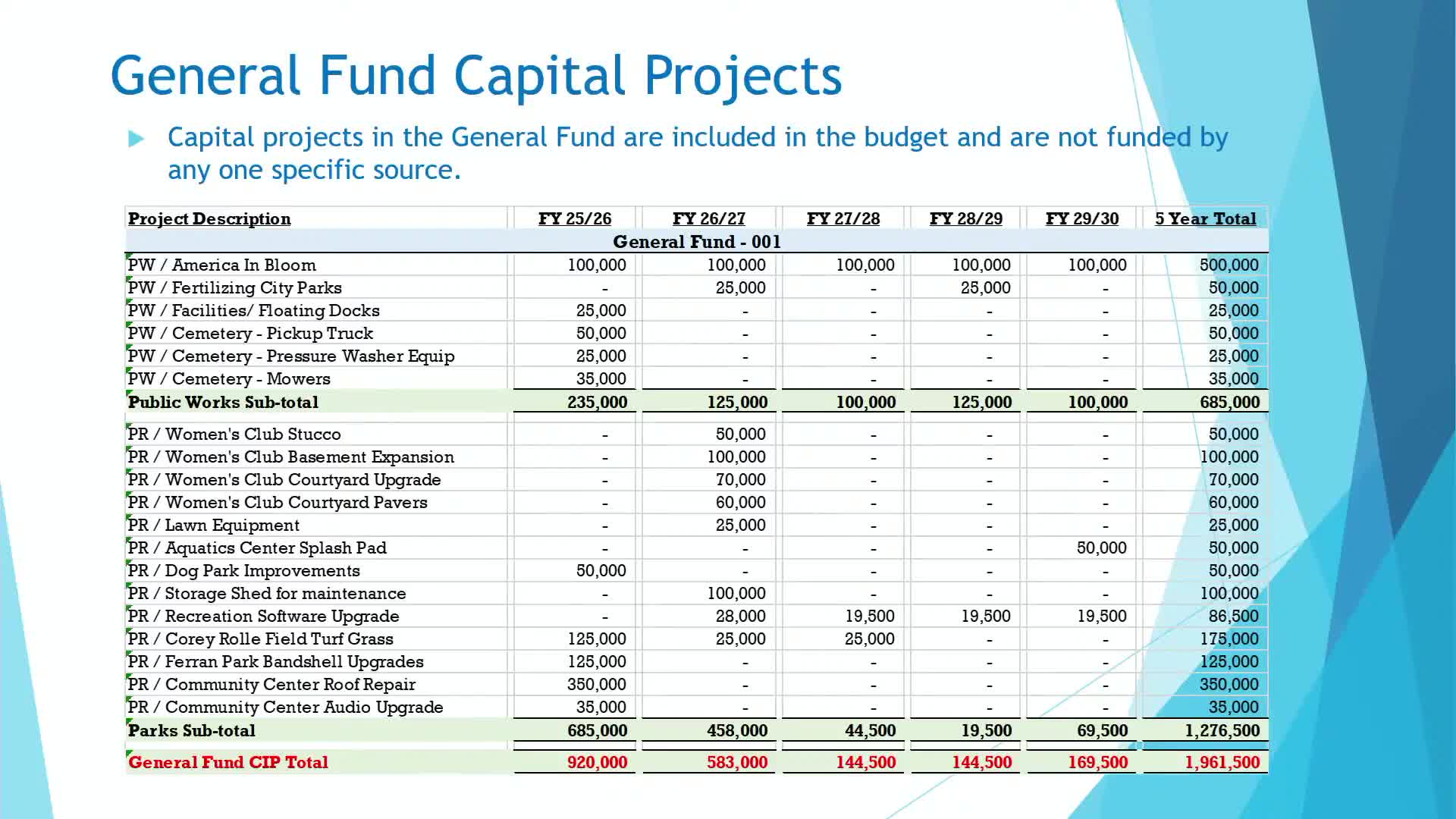
Summary
City staff presented a revised five‑year capital improvement plan that shifts high‑cost, not‑yet‑authorized projects — including a proposed North Shore bridge, an aquatic center renovation and a downtown parking garage — to an “unfunded” list, leaving smaller capital and equipment items in the funded five‑year plan.
City staff on Aug. 8 presented a revised five‑year capital improvement plan that separates large, not‑yet‑committed projects from the city’s funded capital program and places them on an “unfunded” list for later consideration. The change is intended to make the plan a more realistic financial tool and to avoid skewing future‑year cash‑flow projections.
The move affects large, high‑cost items including the North Shore Bridge, an aquatic center renovation estimated in the presentation at $3,200,000, a proposed downtown parking garage, and other major projects that staff said had not received firm direction or funding. Tom (staff member) told the commission the city will “come back to you, once we have engineering complete and we have a firmer number” before asking how to fund construction.
Why it matters: separating “unfunded” projects reduces the appearance of future budget shortfalls driven by speculative construction costs and focuses the CIP on projects the city expects to fund in the short term. It also gives commissioners clearer choices about whether to use reserves, grants or partnerships to pursue large items.
Key details presented by Laurie (finance staff) explained the city’s funding sources and limits: general‑fund surplus for one‑time projects, a countywide 1¢ local option sales tax that can be used only for capital through 2032, fuel taxes restricted to roads and streets, community redevelopment agency (CRA) incremental tax dollars limited to CRA area activities, stormwater and utility enterprise funds restricted to their systems, and impact fees usable only for expansion tied to growth. Laurie noted the CIP treats grant‑funded projects as gross expense with revenue shown separately so slide numbers are not net figures.
Staff said several large items were moved to the unfunded list because the city had not given final approval or because the timing, scope or funding were unclear. Examples discussed: a proposed dock package for tour boats and seaplanes (staff will engineer both but return later to ask whether to build both docks or phase construction); a $1,500,000 conversion to field turf at Corey Roll (uncertain priority); $450,000 for lighting at Carver Park softball fields; and the $3.2 million Aquatic Center renovation, which staff said represented a redo of the existing site rather than a new downtown pool.
Commissioners and staff also discussed a potential mobile stage purchase. Staff estimated renting the stage used for downtown events at about $4,500 per year (stage rental only; setup and sound labor were additional) while a new mobile hydraulic stage might cost about $150,000 depending on size. Staff said the stage purchase remains an unfunded option, and commissioners noted rental costs were low enough that buying might not be cost‑effective for the scale of downtown events.
Staff urged commissioners that unfunded items could be targets for grants, appropriations and intergovernmental partnerships, especially projects such as the North Shore Bridge that staff said would likely require county or state help. “We are moving on that project, but it hasn’t been funded, and so what we’re gonna do is … come back to you once we have engineering complete and we have a firmer number,” Tom said.
Ending: Staff recommended using the unfunded list to focus grant‑seeking and reserve planning rather than to remove projects permanently. Commissioners gave general direction to keep the newly restructured plan but asked staff to return with firm engineering estimates, funding scenarios and a phased approach where appropriate.