
Texas Supreme Court hears case over when local economic-development deals run afoul of the constitution
Get AI-powered insights, summaries, and transcripts
Sign Up Free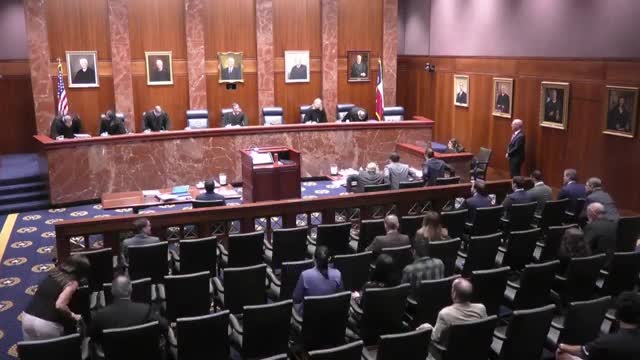
Summary
The Texas Supreme Court on [date of argument] heard argument in JPMorgan Chase Bank v. City of Corsicana and Navarro County over whether Article 3, Section 52-a of the Texas Constitution allows local governments to make periodic, sales-tax–linked payments for economic development without satisfying longstanding gift-clause controls.
The Texas Supreme Court on [date of argument] heard argument in JPMorgan Chase Bank v. City of Corsicana and Navarro County over whether a 1987 constitutional provision authorizing economic-development programs, Article 3, Section 52-a, displaces longstanding gift-clause limits on grants and requires courts to apply the older "controls" analysis when public money is paid to private entities.
At issue is whether Corsicana and Navarro County’s agreements to redirect sales tax revenue to support construction and financing of a retail development (including the Gander Mountain facility) were constitutional under Section 52-a or whether the deals lacked sufficient contractual controls and thus violated the gift clauses of the Texas Constitution. The contracts tied payments to sales tax generated by the retail facility and surrounding development; counsel said one participant obtained a $10,000,000 construction loan and quarterly reports were required to be provided to the jurisdictions.
The question matters because a ruling for the petitioner could limit local governments’ ability to rely on Section 52-a to structure economic-development incentives and could revive stricter judicial review of such agreements. Petitioners argued the court should protect contractual and vested rights and read Section 52-a narrowly; respondents and the state urged deference to legislative and local determinations of public purpose while preserving established controls to protect taxpayers.
Petitioner's counsel argued Section 52-a is a specific constitutional authorization for economic-development programs but said courts must still ask whether a particular arrangement satisfies any continuing constraints that prevent gratuitous transfers. "One of the reasons Texas is known as a business friendly state is that the Texas constitution and statutes expressly authorize cities and counties to grant public money to companies for economic development," counsel for the petitioner said, adding the court must decide whether the agreements at issue are constitutional. Petitioners emphasized the need to respect the text of the constitution and the agreements as written in 2004.
Respondent counsel, Harry Jacobson, representing the City of Corsicana and Navarro County, said the constitution includes multiple "gift clauses" that require a different analysis when public money is at stake and urged the court to preserve the "controls" requirement that links public benefits to any incentives. "The control element ... is absolutely critical to all of this," Jacobson said, arguing controls tie incentives to measurable public benefits and protect taxpayers. Jacobson described the challenged structure as one that required the retail center to be built, required a construction loan, and required periodic reporting; he said payments to the foundation began only after the store opened and were made for about 11 years.
An amicus representing the State argued Section 52-a addresses only the public-purpose element of the gift-clause test and does not nullify other aspects of the test, including controls that prevent no-strings-attached transfers to private parties. "Section 52-a speaks only to the public purpose requirement of the gift clause test, and the rest of the test remains unaffected," the amicus said.
Justices pressed both sides on how to frame the controlling test. Some asked whether the inquiry should focus on the public purpose and the government’s determination at the time the agreement was adopted, while others probed whether courts should examine later events and whether individual periodic payments must independently satisfy the gift clause or instead be evaluated as part of a broader, program-level grant.
Counsel for the petitioner urged the court to assess the public purpose as articulated when the agreements were adopted in 2004 and to evaluate the contractual structure as a program-level arrangement rather than by isolating each periodic payment. Counsel noted statutory procedures enacted more recently — including requirements that local development agreements be filed with the comptroller and contain particular information — reflect legislative oversight but argued those statutory measures do not change the constitutional baseline.
Respondent counsel and the amicus stressed the role of contractual controls and monitoring. Jacobson said the interlocal agreement contained provisions requiring construction, a $10,000,000 construction loan, and regular reporting, and he argued the agreements were intended to ensure that redirected sales tax would be paid only when the retail activity generating those taxes actually occurred. The amicus noted that if a government could label any transfer "economic development" without additional limits, older constitutional protections against gratuitous transfers would be hollowed out.
Both sides addressed remedial consequences if the court finds the agreements unconstitutional. Respondents noted equitable-restoration principles could limit retroactive clawbacks and that payments made while a contract was performed might be treated differently from future obligations. Petitioners warned that allowing governments to void past contracts without consequence could disrupt expectations and inflate financing costs.
The court asked whether a clawback or a contractual recapture provision is a minimum control required in such deals; respondents said clawbacks are one of several possible controls, while petitioners said the agreement here was "self-regulating" because payments were tied to actual sales tax receipts from the retail center and surrounding development. Counsel for the City argued that where no additional tax revenue was generated, no payments were required, and where taxes were generated the public received a share.
No decision was announced at argument; the case was submitted after questioning and the court recessed. The justices’ questions indicated concern both for protecting taxpayers from no-strings-attached transfers and for avoiding a rule that would deter municipalities from negotiating development deals.
Background and clarifying details: The litigation arises from agreements executed in 2004 tied to the financing and construction of a retail facility (the Gander Mountain center). The record includes an interlocal agreement that the parties say required a construction loan of about $10,000,000, quarterly reporting by the receiving entity, and payments tied to sales tax collected from the retail facility and surrounding development. Counsel said payments were made for about 11 years after the store opened. The project also overlapped a 20-year tax increment financing (TIF) arrangement described in the record.
Why this matters going forward: A ruling narrowing or eliminating the controls inquiry could ease the path for some local economic-development incentives but may increase litigation risk or financing costs if banks and developers cannot rely on stable local commitments. A ruling that preserves the controls requirement would reinforce judicial oversight designed to prevent gratuitous transfers of public funds, according to the respondents and the amicus.
The court heard extended questioning probing whether the proper unit of analysis is the contractual program entered into in 2004 or each periodic payment over time, whether a government’s later cessation of payments is an adequate control, and what minimum contractual features (for example, clawbacks, reporting, or linkage of payments to demonstrable economic activity) are required to satisfy the gift-clause test in light of Section 52-a.
The case was submitted to the court at the close of argument and no opinion has been issued.
Sources: oral argument before the Supreme Court of Texas in JPMorgan Chase Bank v. City of Corsicana and Navarro County (argument transcript).