Get Full Government Meeting Transcripts, Videos, & Alerts Forever!
Get email alerts on the Signage topic
No spam. Unsubscribe anytime.
Riverwoods panel continues overhaul of village sign code, asks staff to draft ordinance language
Summary
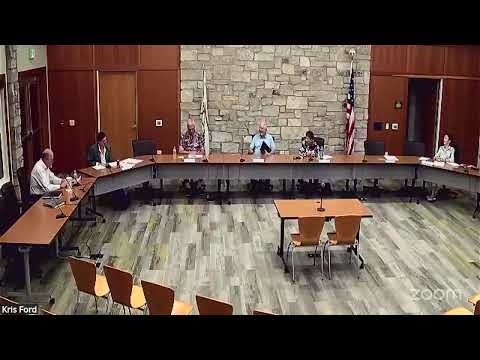
The Riverwoods Zoning Board of Appeals continued its multi-meeting review of the village sign code on Aug. 14, focusing on wall and window signage for the Shops at Riverwoods and Colonial Court and directing staff to prepare draft ordinance language that reflects the commission’s preferences on size, illumination, and temporary window signs.
Riverwoods Zoning Board of Appeals members continued their review of the village sign code on Aug. 14, concentrating on wall and window signage for the Shops at Riverwoods and Colonial Court and directing staff to prepare ordinance language for final review.
The panel, led by Chairperson Grama, spent the meeting comparing Riverwoods’ current sign criteria with neighboring communities and discussing a range of detailed standards — including primary versus secondary wall signs, maximum sign area, aggregate sign height, lettering size, logo rules, illumination hours and types, and temporary window-sign limits. Director Witt presented a comparative chart of nearby communities and recommended language the commission could convert into ordinance text.
Board members generally favored keeping the village’s current baseline limits for primary wall signs (the commission referenced a storefront-percentage method with an 80-square-foot cap), allowing a smaller secondary sign for corner tenancies, and retaining internally illuminated individual letters rather than cabinet or bare-bulb signs. Commissioners debated, but did not change, criteria for sign area calculation (percent of storefront vs. square-foot cap vs. one-square-foot-per-linear-foot), and they asked staff to draft clear rules for aggregate vertical height so multi-line signs cannot produce excessive overall sign heights.
Commissioners raised several specific implementation points: they said secondary signs should remain limited to 50% of the primary sign size where the code already so provides; they discussed keeping the existing letter-height minimum (18 inches was mentioned in the discussion) but also setting a maximum aggregate sign height so stacked rows do not create a 5- or 6-foot-high wall band; and they favored maintaining channel or internally lit letters while restricting exposed bare-bulb neon or continuously flashing/electronic messages. Director Witt confirmed LED illumination is acceptable provided lighting is not “bare bulb” and is appropriately diffused.
On illumination timing, members asked for a sustainability-minded compromise. The current rule in the packet said signs may be lit from dusk to midnight; commissioners favored restricting illumination to business hours plus a short post-closing interval for safety (the group discussed “one hour after close” as a practical standard) while retaining midnight as a maximum allowable end time for late-night businesses. The board agreed staff should draft precise, enforceable language (for example: “while business open + one hour, not to exceed midnight except for uses open overnight”).
Window signs drew lengthy discussion. The commission moved toward allowing limited temporary or event-related window signage but sharply restricting permanent window coverage. Members favored limiting temporary window signs to a fraction of a single window pane (discussion ranged between 25% and 50% of the pane) and setting a cap on frequency and duration modeled on nearby communities (Lincolnshire-style rules were cited as a helpful example: multiple events per year, total allowed days per year). The commission signaled support for adding a requirement that temporary window signs carry a clearly visible posting date so enforcement can determine whether the allowed display period has expired.
The commissioners also discussed other sign types (projecting signs, A-frame signs, inflatable and animated signs, reader boards, digital moving-message displays) and generally agreed to prohibit attention-getting formats that flash, animate, or mimic bare-bulb neon as storefront features. Several commissioners emphasized uniformity and enforceability: a clear, unambiguous set of measurements and a small list of permitted formats will be easier for staff to apply consistently than many discretionary allowances.
Commission members repeatedly said the board did not intend to require existing tenants to replace grandfathered signage, but they asked staff to draft a compliance timeline and a reasonable phased schedule so tenants can bring permanent nonconforming window signs into compliance over time. For obvious operational differences, the group discussed tiered compliance windows (shorter time for trivial fixes such as unplugging neon; longer for replacing full-window shades or ordering new fabricated signs).
Director Witt told the panel he will work with Village Attorney Hoover to convert the commission’s guidance into ordinance language and return the draft to the ZBA for a final “blessing” before the village board considers the change. The commission stressed they wanted the final text to balance aesthetics, visibility for local businesses and enforceability for staff.
The board did not take a final vote on text changes during the meeting; the principal formal actions recorded were approval of the minutes as amended and direction to staff to prepare and return ordinance language informed by the discussion.
What happens next: Director Witt will draft language incorporating the commission’s numeric choices and examples from the two centers, consult Attorney Hoover, and present the draft to the commission at a future meeting for final review before referral to the village board.