Get Full Government Meeting Transcripts, Videos, & Alerts Forever!
Get email alerts on the Budget Finance topic
No spam. Unsubscribe anytime.
Hopkinton closes FY25 with positive variance; town asks schools to absorb special-education reserve
Summary
School officials reported a net positive variance at the close of fiscal 2025 and told the committee the town is asking that a previously available special-education reserve not be used as an offset for FY27, shifting those costs back into the operating budget.
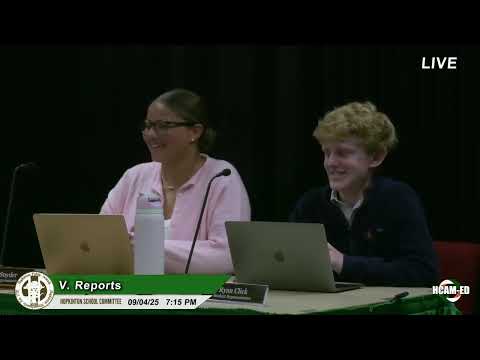
Hopkinton School Committee members heard a financial close-of-year report Sept. 4 showing a net positive variance for fiscal 2025 and were told the town will not make the special-education reserve available as an offset for the FY27 budget. The committee’s finance presenter said unspent operating funds will return to the town’s general fund and outlined where payroll and expense variances arose. The report noted a negative payroll variance driven largely by substitute pay, long-term substitutes and vacation payouts, and positive expense variances in central office, athletics and technology that offset payroll overruns. The presenter said student services and certain tuition lines remained over budget because those costs are driven by student need. Committee members asked for more public explanation ahead of FY27 budgeting; staff said the select board and appropriations committee have requested that the district carry what had been funded from the reserve fund. The presenter described the special-education reserve as a roughly $1 million balance that historically has not been increased by Proposition 2½ adjustments; moving those costs into the main budget could change the appearance of year-to-year comparisons and will be explained publicly. Revolving accounts (parking, bus, preschool and athletics) were projected to require reevaluation beginning in FY29, with the international tuition account flagged for review in FY27. The finance presenter also briefed the committee on the district’s solar arrangements. The district participates in power purchase agreements (PPAs) where third-party vendors lease rooftops or parking lots, install solar arrays, and sell the generated power back to the district at reduced rates compared with the utility (Eversource). Town or district did not pay for the installations; the district pays the vendor for generation at contracted rates which partially offset the Eversource bill. No vote was required on the report itself; committee members discussed public outreach and agreed to coordinate messaging with the select board and appropriations committee so residents understand the FY27 presentation.