Get Full Government Meeting Transcripts, Videos, & Alerts Forever!
Get email alerts on the Utilities Sewer Rates topic
No spam. Unsubscribe anytime.
Akron officials propose phased sewer-rate increase tied to consent-decree projects
Summary
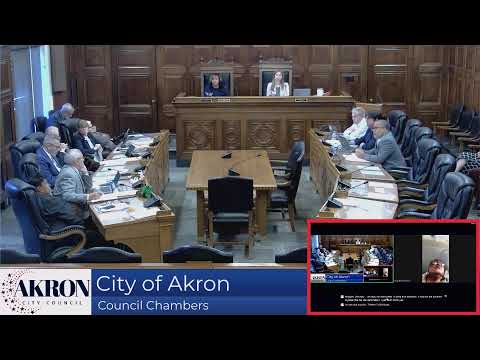
The Public Service Committee of the Akron City Council heard a detailed presentation Sept. 1 from city staff proposing a phased sewer‑rate adjustment beginning in 2026 to cover capital and operating shortfalls tied to long‑running consent‑decree projects.
The Public Service Committee of the Akron City Council heard a detailed presentation Sept. 1 from city staff proposing a phased sewer-rate adjustment that would begin in 2026 and run through 2029 to cover capital and operating shortfalls linked to long-running consent-decree work. Service Director Chris Luddle and Environmental Services Manager Emily Collins told the committee the change is intended to spread costs over several years and preserve affordability for low-income customers.
Why it matters: City staff said the sewer modernization program under the consent decree has required large capital investments and that final projects tied to the North Side Interceptor Tunnel could create multi‑year financing needs the present revenues will not cover. Without an adjustment, staff estimate annual revenues could fall roughly $10 million short of projected expenses beginning in 2027, jeopardizing the city’s ability to make debt payments for upcoming projects.
City presentation and rationale: Collins, who leads Akron Waterways Renewed, said the consent decree launched a modernization program that has grown into a multi‑hundred‑million‑dollar program of work and community investment. She told the committee the city has invested more than $1,200,000,000 on sewer modernization and is 24 of 26 major projects complete. Luddle summarized near‑term capital needs: the amended North Side Interceptor Tunnel construction remains a multi‑hundred‑million‑dollar project (he cited $283,000,000 for the tunnel), and an enhanced high‑rate treatment (EHRT) facility, if required by regulators, has an engineering estimate the presentation listed as $265,000,000.
Proposed structure and schedule: Staff said they are proposing modest multi‑year adjustments instead of a single large increase. The presentation proposed a volumetric increase of 5.3% in 2026 and similar percentage increases through 2029, which staff translated into per‑unit dollar cents on the meter: 56¢ per hundred cubic feet (HCF) in 2026 (an average residential user of 4 HCF would see $2.24 more per month at that per‑unit figure), then 59¢, 63¢ and 66¢ in the subsequent years as presented. The proposal would also add a new fixed‑cost recovery charge: staff described a $5 monthly fixed fee to begin in 2026, with the fixed charge rising in later years as shown in the presentation. Staff said after 2029 rate adjustments would be tied to the municipal cost index with a per‑unit cap noted in the presentation.
Conditional fee tied to regulatory outcome: Staff told the committee the EHRT remains under review by U.S. and Ohio EPA. If the EHRT is mandated, the legislation as presented would add a $15 monthly EHRT charge to each customer beginning in 2028; Collins and Luddle said that charge would be removed if the city is not required to build the treatment facility. “If we do not have to build that high rate treatment, that $15 goes away,” Collins said.
Customer assistance and equity measures: The proposal would expand eligibility and simplify enrollment for discounts. Staff said HEAP (Home Energy Assistance Program) and Homestead customers would receive a 40% discount applied to volumetric charges and the fixed‑cost recovery fee; for the first time eligible tenants on HEAP would be included automatically if they already receive the water discount. Presenters said a HEAP‑eligible tenant on the sewer discount could pay less in 2026 than in 2025 under the proposed structure.
Questions and concerns from council members: Committee members probed technical and equity impacts. Councilwoman McKittrick asked whether bib (hose) meters would be affected; staff said bib meters would see no impact. Councilman Bolden asked whether the fixed charge would apply to Homestead and HEAP recipients; staff said the fixed fee would be assessed but be reduced by the 40% discount for eligible customers. A council member asked how many sewer bills go out each month; staff said approximately 75,000 sewer bills. Several members, including Councilman Lombardo and others, expressed concern about delegating multi‑year rate increases and removing year‑to‑year council review; members said they wanted more time to study the proposal before any formal vote.
Timing and next steps: Staff said they are not asking for a vote in committee. They proposed coordinating the first increase with a new water‑billing system and that, if necessary, the increase could begin as early as February 2026 but not before 2026. Staff asked for two weeks of follow‑up questions from council members and said they would attend ward meetings and provide additional detail on impacts to large customers and on customer assistance.
Discussion only: The committee did not take formal action on rates at the meeting. Staff repeatedly said the presentation was informational and that formal legislation would return to council for consideration after further briefings and outreach.