
Ordinance Committee adds EV chargers to lighting rules, leaves retroactivity question unresolved
Get AI-powered insights, summaries, and transcripts
Subscribe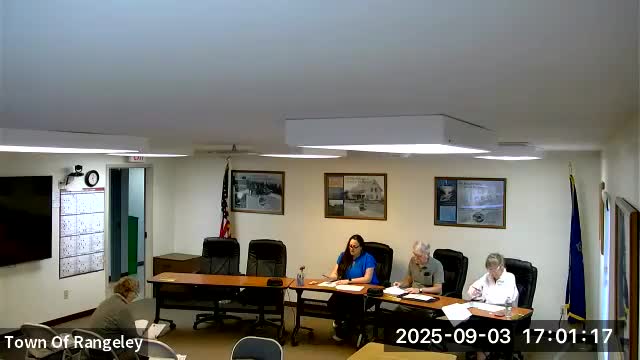
Summary
Rangeley’s Ordinance Committee on Sept. 3 accepted edits to a draft lighting ordinance intended to move the town toward Dark Sky compliance, voted unanimously to include electric vehicle (EV) charging stations in the ordinance’s list of covered service machines and left unresolved whether the draft’s wording would require owners of existing lighting to retrofit to new standards.
Rangeley’s Ordinance Committee on Sept. 3 accepted edits to a draft lighting ordinance intended to move the town toward Dark Sky compliance, voted unanimously to include electric vehicle (EV) charging stations in the ordinance’s list of covered service machines and left unresolved whether the draft’s wording would require owners of existing lighting to retrofit to new standards.
Committee members said the lighting ordinance is the cornerstone for any future Dark Sky certification and discussed whether language in the draft would operate retroactively — potentially obliging property owners who complied with prior rules to alter previously approved installations.
Why it matters: Lighting rules determine what fixtures and color temperatures are allowed across residential and commercial areas, influence application for Dark Sky certification and affect local businesses that operate illuminated pumps or EV chargers. The committee’s changes clarify coverage for EV charging stations but did not restore a previously removed five‑year retrofit deadline for existing lights.
The meeting opened with a review of continuing business on “lighting, dark sky compliance, 3882,” and moved into a lengthy discussion about a single word in the draft ordinance. “I would strike the existing from us because otherwise, we are in effect creating a retroactive ordinance,” said Scott, an Ordinance Committee member, arguing that forcing previously approved lighting to meet new standards could expose the town to legal challenges. Another committee member described retroactive application as a common source of litigation in land‑use matters and said typical practice is to allow existing installations to be grandfathered.
Committee members noted that language requiring owners to bring lighting into conformance within five years had already been motioned and removed at a prior meeting. The removal of that five‑year compliance clause was referenced in the discussion as already decided; the committee did not reinstate it at the Sept. 3 session.
The committee next addressed a separate subsection of the ordinance (point 11), which covers service machines and similar fixtures. Carolyn, an Ordinance Committee member, moved to add “EV charging stations” after the existing reference to gas‑station pumps. The motion was seconded and approved unanimously. “So motion to include EV charging stations after gas stations,” Carolyn said; the chair confirmed the vote was unanimous.
Members discussed practical limits and enforcement. Several said owners of EV charging stations are often third‑party vendors on private property and the town may have limited enforcement options for previously installed equipment. The group suggested outreach and voluntary compliance as the first step for existing installations, while reserving regulatory teeth for future installations.
The committee also reviewed technical and definitional items that staff and volunteer reviewers flagged for follow‑up. Linda, planning staff/consultant for the committee, said she would seek model language from the Dark Sky organization and from the Illuminating Engineering Society (IES) model lighting guidance about “veil lighting” limits and lighting zones. The IES material referenced by staff includes tables that recommend average luminance limits and differentiated lighting zones for downtown, industrial and residential areas; staff said the full IES approach is complex and more oriented to large cities, so the committee is looking for simpler language appropriate to Rangeley.
Members discussed a proposed color‑temperature limit (3,000 Kelvin) and how to describe it in nontechnical terms that the public will understand; the committee agreed to keep the Kelvin benchmark in the draft but to clarify the policy text. The committee also discussed a proposed exemption for “string mini lights” (holiday‑style mini lights) and the need to define those versus rope or festoon lighting so the exemption is narrow and enforceable. Cindy (committee member) noted other communities specify limits such as no individual lamp over 50 lumens and a lumen density cap (for example, 25 lumens per foot) for permissible string lights; staff said they will research standard definitions and present revised language.
The committee asked staff to obtain targeted guidance from the Dark Sky organization about whether a 10% allowance above recommended IES light levels or a specific veil‑lighting provision should be added to the draft. Linda said she would share the Dark Sky feedback and other model language with town staff (Marty) and the committee ahead of the next meeting.
The committee did not take new final action on whether to change the single word from “current” to “existing”; members said a prior vote left the draft using “current,” and one member noted that changing a previously decided vote would require the participation of members who were absent for that vote. The group agreed to carry remaining lighting and internally illuminated sign work as continuing business and to seek follow‑up materials by the committee’s next possible meetings (Sept. 17 or Oct. 1).
Less urgent details: committee members discussed signage brightness (a previously raised figure of 100 nits), the relationship of the lighting ordinance to a pending comprehensive plan update and the logistics of presenting separately worded ballot questions for lighting and internally illuminated signs at a future town meeting. The meeting ended with a unanimous motion to adjourn.
What’s next: Staff will request model language from the Dark Sky organization and the IES guidance, draft narrower definitions for exempted string lights, and circulate updates to committee members prior to the next meeting so the group can resolve remaining technical language and enforcement questions.