Get Full Government Meeting Transcripts, Videos, & Alerts Forever!
Get email alerts on the Consolidated Plan topic
No spam. Unsubscribe anytime.
Lorain holds second public hearing on 2025–2029 consolidated plan, outlines $2.175 million spending priorities
Summary
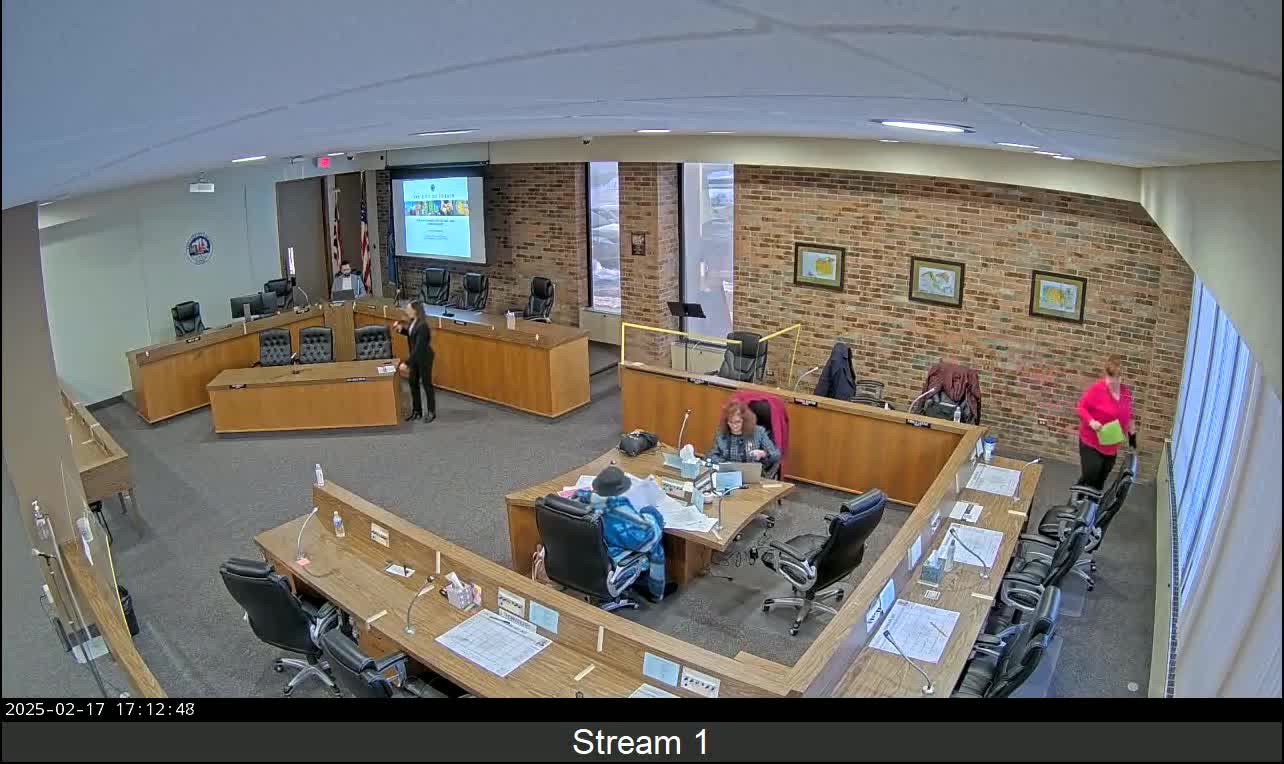
City of Lorain staff presented the second public hearing on the draft 2025–2029 consolidated plan and the city’s 2025 action plan, outlining how the city would use anticipated federal Community Development Block Grant and HOME funds to serve low‑ and moderate‑income residents.
City of Lorain staff presented the second public hearing on the draft 2025–2029 consolidated plan and the city’s 2025 action plan, outlining how the city would use anticipated federal Community Development Block Grant (CDBG) and HOME funds to serve low- and moderate-income residents.
Kushnard, a staff member with the Department of Building, Housing and Planning, told council and attendees the city received 129 unduplicated survey responses and held three in-person planning workshops at Lorain High School, the South Branch Library and the Main Branch Library to collect public input.
The consolidated-plan goals presented focus on preserving and expanding affordable housing, addressing homelessness, improving community and economic development assets, and increasing services for non‑homeless special needs and seniors. "We want to preserve the existing 3,000 affordable housing units within the City of Lorain," Kushnard said, and recommended partnering to "increase housing diversity" and promote infill development on vacant lots.
Staff reviewed specific objectives: continuing owner‑occupied repair programs and CDBG-funded housing efforts; pursuing demolition of blighted residential and commercial properties to stabilize neighborhoods; expanding homeless services through partner organizations; improving streetscapes, sidewalks and utility upgrades; and promoting programs that support aging in place such as accessory dwelling units (ADUs) and homestead-exemption outreach.
The presentation summarized a fair‑housing impediment study performed for the city and its recommendations, including a review of the zoning code to remove exclusionary barriers and greater attention to transportation and mobility coordination with Lorain County Transit.
On funding, Kushnard presented anticipated federal allocations for 2025: roughly $1,500,000 in CDBG and $600,000 in HOME funds for a combined estimated allocation of $2,175,000. Kushnard cautioned these are estimates and said the city must repeat the public‑hearing process if the actual allocations change by more than 10 percent: "If funding is cut more than 10% of what we've estimated here, we will have to come back to city council, and we will have to do public hearings again," Kushnard said.
Staff outlined proposed uses of the draft action‑plan budget. For CDBG and related funds they listed administration, continuation of a small business loan program, housing programs including an essential home‑repair program and lead abatement, demolition, public‑facility improvements (including the Longfellow Skatepark), street and sidewalk repairs, public art, bike infrastructure, and public‑service grants for nonprofit program support and emergency services.
For the HOME allocation, staff proposed $60,000 for administration, a mandatory CHDO set‑aside of $82,500, and $457,500 for homebuyer activities and new construction in partnership with developers or nonprofits, totaling the $600,000 HOME estimate.
Council members asked detailed questions about implementation and resident protections. Councilwoman Duval raised concerns about infestations in low‑income housing and asked whether the city’s program can coordinate with the health department; Kushnard said the city routinely partners with health‑department inspectors on housing inspections and enforcement and that funding to support that partnership is possible: "The health department has been a really good partner to work with, and they ... come along on inspections with us," Kushnard said.
Councilmember questions also probed the lead‑abatement program. Kushnard said the city partners with the Erie County Health Department through a Healthy Homes grant match that leverages federal funding for lead testing and abatement. "I would say an average about 10 to 12 a year between probably 10 and 12 year going back to 2017," Kushnard said when asked how many homes have received intervention since 2017, and noted abatement project costs vary "from a couple thousand dollars to tens of thousands of dollars."
Staff explained tenant recourse and inspection protocol: tenants may invite building and planning staff to inspect, but staff advised following local court processes and rent‑escrow procedures first because inspectors’ visits can sometimes trigger retaliatory eviction concerns. Kushnard recommended tenants pursue legal protections and the rent‑escrow process before requesting enforcement visits.
Members of the public asked about program access and municipal services. Brandon Vosowski suggested allowing nonprofit organizations to apply for public‑facility funds for capital repairs; Kushnard said public‑facility dollars are part of the consolidated plan but not the current annual action plan and that building, housing and planning staff will host summer workshops and release application guidance in advance of an early‑fall application window with awards anticipated in early 2026.
Resident Keith Gordon said tenants in several properties had persistent pest problems despite extermination attempts and asked whether funds could assist; staff acknowledged the issue and offered to follow up.
The hearing is the second of two required public hearings on the consolidated plan; staff said they will continue to accept written comments for a period and will provide hard copies of the draft plan at the Lorain Public Library main and south branches and at the building, housing and planning office. Kushnard closed by asking for advocacy to protect federal funding, saying cuts at the federal level could reduce the city’s allocation and blunt planned activities.
The draft plan remains subject to change pending final HUD allocations and further public comment.