Get Full Government Meeting Transcripts, Videos, & Alerts Forever!
Get email alerts on the Floating Local Option Sales Tax topic
No spam. Unsubscribe anytime.
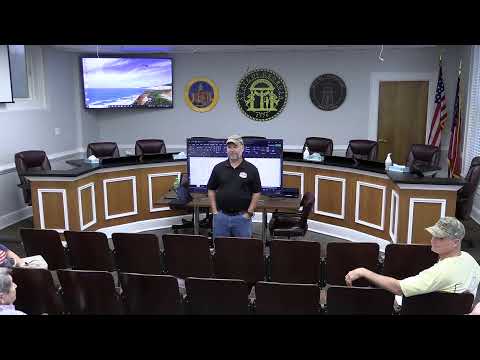
Upson officials outline plan to use new "floating" sales tax to lower property bills; propose 26% city share
Summary
Upson County officials told residents at a town hall that a new state law allowing a floating local-option sales tax (FLOST) would raise more than $5 million a year for the county and that the county recommends giving the city 26% of revenue so homeowners inside and outside city limits pay equivalent tax on identical-valued properties.
Upson County officials said at a public town hall that a new state law authorizing a floating local-option sales tax would generate an estimated more than $5 million a year and must be used only to reduce property taxes.
The county’s chairman, Dan Brute, told about an hour-long meeting that House Bill 581, which he called the Save Our Homes Act, froze homestead assessment values at their 2024 level and authorized a one-cent local sales tax whose revenue “can only be used to reduce property taxes.” He said the county’s staff modeled three distribution options and recommends a 26% share to the city so homeowners inside and outside the city pay the same tax on identical-valued properties.
Brute said the 26% share comes from a city property digest of roughly $357 million and a county digest of about $1.025 billion, for a combined taxable digest of about $1.38 billion; the city’s share of that combined digest is about 25.86 percent. Using a $5 million annual revenue estimate, Brute said, the 26% split would yield roughly $1.3 million to the city and would “completely eliminate the city M&O tax” for homesteaded property under the county’s calculations.
Why it matters: the law and the county’s proposal target homeowners who hold long-standing homesteads and could face rising bills because of recent jumps in fair-market values. Brute emphasized the measure was intended “to help people stay in their homes,” and cited the bill’s provision that surviving spouses retain an existing homestead exemption.
Details from the meeting
Legal framework and limits: Brute described House Bill 581 and the later House Bill 92 as the state statutes underlying the program and said the Department of Revenue uses a form described in the meeting as PT‑32.1 to roll back taxes only on maintenance-and-operations (M&O) millage. “You can only roll them off on the form PT‑32.1,” Brute said, adding that the statute limits rollbacks to county and city M&O taxes and does not allow counties or cities to take the FLOST revenue and apply it to unrelated funds or “create a windfall.”
Which split the county considered: Brute summarized three options the county modeled: - County-only (0% to city) — every parcel in the county would receive the same M&O reduction; under county figures that would remove roughly five mills from county M&O, a large percentage reduction. - Pro rata by current tax receipts (about 88% county / 12% city) — the county said that produces different percentage savings for city and county homeowners. - Split by digest share (about 26% city / 74% county) — the county recommended this option to equalize the tax paid on identical-valued properties inside and outside the city.
Timing and scope: Brute said the county’s modeling assumes the FLOST would take effect for bills in 2027 and noted online and out-of-county purchases will also contribute revenue. He repeated that the sales tax is “projected to bring in over $5,000,000 in extra sales tax revenue each year” and that the state’s 4% sales tax plus local option pennies currently produces typical combined rates around 8% on many purchases.
Equity and concerns raised: Residents and officials asked about whether the city’s requested 40% share (which county officials said the city has proposed) was justified; Brute said the city “has given no explanation for the 40%.” Several attendees raised concerns about whether savings would persist if future budgets or millage rates rise; Brute responded that no elected official can promise taxes will never rise and that growth and changes in the digest also affect future bills. A resident who identified herself as a widow said, “I barely can make my payments,” and the chairman returned repeatedly to the bill’s intent to protect long-term homesteaders.
Related programs and constraints: Brute and other speakers described the difference between LOST (county/local option sales tax), SPLOST (special purpose local option sales tax), TSPLOST (transportation SPLOST) and the proposed FLOST: they said SPLOST and TSPLOST proceeds are restricted to capital or transportation projects and cannot be used for direct property-tax rollbacks; by contrast FLOST proceeds under HB 581 are limited to reducing property taxes. Brute also noted that surplus SPLOST funds, bond proceeds or other special-purpose receipts are legally segregated from general M&O property-tax relief and are not interchangeable with the FLOST revenue.
Decisions and next steps
Discussion vs. formal action: The town hall was a public explanation and question-and-answer session; Brute said the county previously “voted and sent it back to the city for study” and that the board of commissioners — which he identified as having “unanimously said we’re opting in” to HB 581 — has modeled the three options and is seeking an agreement with the city on the percentage split so the measure could appear on the ballot. He said, if a joint agreement is reached, the county’s intention is to place the question on the November ballot (Brute mentioned a November 4 date).
Unresolved matters: attendees and county officials discussed the possibility that other nearby counties or cities could adopt similar taxes, shifting where consumers spend and which local government benefits. Brute and participants also discussed the Industrial Development Authority (IDA) and previous pauses in funding; Brute said IDA director Slade Govich and IDA chairman Chase Follin plan to present a funding request to the county.
Ending note: Brute closed by urging residents to study the proposal, and said the county will post the town-hall recording for public review. He repeated that the county’s recommendation is the 26% city share to equalize tax burdens.
Sources and direct quotations in this article come from remarks at the town hall by Dan Brute and by residents who spoke during the Q&A.