
Upson County, Thomaston officials set 74/26 split for sales-tax property‑tax rollback after hours of debate
Get AI-powered insights, summaries, and transcripts
Subscribe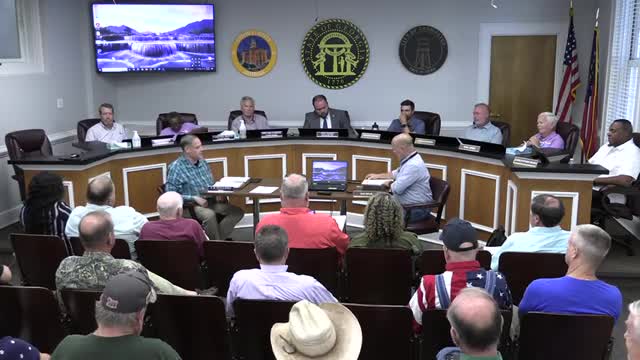
Summary
Upson County commissioners and the Thomaston City Council voted Sept. 3 to allocate 74% of proposed local‑option sales tax proceeds to Upson County and 26% to the City of Thomaston to fund property‑tax millage rollbacks under House Bill 581, after hours of competing presentations over equity, revenue effects and legal limits on how proceeds may be applied.
Upson County commissioners and the Thomaston City Council met in a special joint session Sept. 3 to debate how to apply proceeds from House Bill 581 — the Save Our Homes Act — and approved a 74% county / 26% city allocation of the proposed local-option sales tax proceeds to roll back property-tax millage rates. The vote followed competing proposals from county and city representatives and more than three hours of questions about equity, revenue impacts and legal limits on how the proceeds may be used.
The measure matters because House Bill 581 requires revenues collected under the local-option sales tax designated for property‑tax relief to be used to roll back certain millage rates; proponents said the allocation would reduce annual property-tax bills for homeowners and businesses once the rollback is implemented.
County staff said they modeled three options and presented detailed millage‑reduction calculations to show differences in taxpayer impact. The county’s “county-only rollback” would cut the county maintenance-and-operations (M&O) millage by roughly 4.88 mills and produce identical absolute savings for owners of equal-valued properties regardless of whether they live inside Thomaston or in unincorporated Upson County. City presenters countered that splitting proceeds by cost-of-government or point-of-sale patterns would better reflect where sales are generated and the differing service demands of the city.
The county said the 74/26 split (county/city) produces parity when applied to the combined net digest, reducing both city and county M&O millage by roughly 3.608 mills and eliminating the city M&O tax under that formulation. County presenters emphasized that the distribution they proposed would equalize the tax on a same-valued property whether inside city limits or not. City presenters and several council members argued the city bears disproportionate daytime service demand (police, fire, utilities) and captures the majority of point-of-sale revenue; they pressed for a higher city share (proposals presented ranged from roughly 33% to 40%+ during the meeting).
Speakers repeated multiple cautions about legal constraints and transparency. The transcript records references to the Official Code of Georgia Annotated and to specific statutory sections including OCGA 48-8-109.42 and OCGA 48-5-32.1. County officials said the code requires the sales-tax proceeds be used exclusively for tax relief and that the law explicitly sets rollback procedures only for M&O millage; they warned that using proceeds through “joint projects” could create a path for tax‑rate changes without the publicity and rollback advertising that accompany M&O millage increases. City officials said negotiated credits from other sales-tax streams (SPLOST/TSPLOST) already return nearly $1 million a year to the city via past bargaining, and they urged recognition of that when judging equity.
Participants debated distributional effects on particular groups. County speakers said renters — roughly 65% of Thomaston residents referenced in the discussion — would not receive direct property-tax savings and that landlords and large landowners would be primary beneficiaries of a property‑tax rollback; county presenters used an example that landlords could receive many times the savings of an average homesteader. City speakers countered that lowering property taxes in the city would spur commercial growth and long-term economic gains that could indirectly help renters.
Several technical figures were discussed at length: the county presented a combined net digest of $1,383,275,392 (county $1,025,495,333; city $357,780,059), repeated that each local penny yields roughly $5,000,000 in annual receipts in Upson County, and noted a $700,000 figure (about 0.7 mills for the county) as one element they sought to address. Staff showed modeled savings on example properties (nonhomestead and homestead examples at $100,000, $150,000 and $200,000 values) under each allocation method to illustrate how much individual taxpayers would see in annual reductions.
County officials also warned that “joint projects” — a special taxing approach discussed by the city — carry no statutory rollback procedures and can obscure tax-rate effects if funds are shifted between joint‑project budgets and general funds. Several commissioners described joint-project funding as lacking statutory rollback triggers and therefore a potential transparency and rollback‑notice risk to taxpayers.
After discussion, a motion to adopt a 26% allocation of the proposed sales-tax proceeds to the City of Thomaston (74% to Upson County) was made and seconded; the roll call in the transcript shows Commissioners Biggs, Watson, Ellington, Chairman Brew and Commissioner Jones voting in favor. The clerk recorded the motion as approved. The record shows commissioners and city councilmembers discussed next steps and the timing for a ballot measure; several speakers noted state deadlines and that final timing of any referendum and the effective date depend on the election schedule and Department of Revenue administration.
Officials repeatedly stressed legal uncertainty in areas where the statute is silent. Multiple speakers said they had discussed interpretation with Department of Revenue contacts and at least one drafter of the legislation but that no definitive written state opinion had been provided on whether proceeds may be applied to joint projects or must be applied to M&O rollbacks. Several speakers urged obtaining formal Department of Revenue guidance or legislative clarification before final implementation.
The meeting closed with commissioners and council members discussing options for future negotiation or arbitration and agreeing to reconvene after the clerks and legal counsel prepare the final written intergovernmental agreement and ballot language. The transcript documents both substantive disagreements (distribution percentage, treatment of joint projects, and equity for renters vs. property owners) and the formal action to set the allocation at 74/26 for the purposes of moving forward with the rollback calculation and ballot planning.
A full accounting of who said what is available in the meeting record; quotes in this report are attributed only to speakers named in the transcript.