Get Full Government Meeting Transcripts, Videos, & Alerts Forever!
Upson County, Thomaston officials set 74/26 split for sales-tax property‑tax rollback after hours of debate
Summary
Upson County commissioners and the Thomaston City Council voted Sept. 3 to allocate 74% of proposed local‑option sales tax proceeds to Upson County and 26% to the City of Thomaston to fund property‑tax millage rollbacks under House Bill 581, after hours of competing presentations over equity, revenue effects and legal limits on how proceeds may be applied.
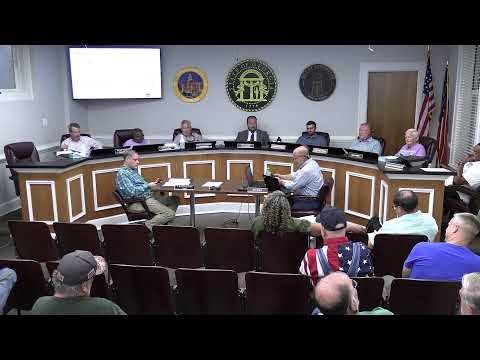
Upson County commissioners and the Thomaston City Council met in a special joint session Sept. 3 to debate how to apply proceeds from House Bill 581 — the Save Our Homes Act — and approved a 74% county / 26% city allocation of the proposed local-option sales tax proceeds to roll back property-tax millage rates. The vote followed competing proposals from county and city representatives and more than three hours of questions about equity, revenue impacts and legal limits on how the proceeds may be used.
The measure matters because House Bill 581 requires revenues collected under the local-option sales tax designated for property‑tax relief to be used to roll back certain millage rates; proponents said the allocation would reduce annual property-tax bills for homeowners and businesses once the rollback is implemented.
County staff said they modeled three options and presented detailed millage‑reduction calculations to show differences in taxpayer impact. The county’s “county-only rollback” would cut the county maintenance-and-operations (M&O) millage by roughly 4.88 mills and produce identical absolute savings for owners of equal-valued properties regardless of whether they live inside Thomaston or in unincorporated Upson County. City presenters countered that splitting proceeds by cost-of-government or point-of-sale patterns would better reflect where sales are generated and the differing service demands of the city.
The county said the 74/26 split (county/city) produces parity when applied to the combined net digest, reducing both city and county M&O…
Already have an account? Log in
Subscribe to keep reading
Unlock the rest of this article — and every article on Citizen Portal.
- Unlimited articles
- AI-powered breakdowns of topics, speakers, decisions, and budgets
- Instant alerts when your location has a new meeting
- Follow topics and more locations
- 1,000 AI Insights / month, plus AI Chat