Get Full Government Meeting Transcripts, Videos, & Alerts Forever!
Get email alerts on the Zoning Amendments topic
No spam. Unsubscribe anytime.
Planning commission delays zoning and subdivision amendments, discusses training takeaways and procedural fixes
Summary
Upson County’s planning commissioners voted to continue work on proposed zoning and subdivision ordinance amendments to allow time to review recent edits; commissioners also reported takeaways from Vincent Institute training including comp-plan timing, clearer density definitions, and procedural recommendations for packets and public engagement.
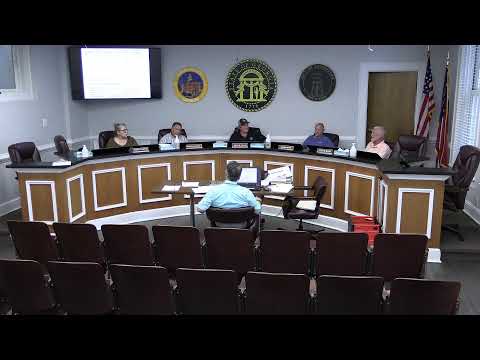
The Upson County Planning & Zoning Commission voted to continue consideration of proposed zoning and subdivision ordinance amendments to give members time to absorb recent edits and prepare a comparative review, the commission said at its Sept. 8 meeting.
Commission staff and commissioners said the amendments have gone through multiple rounds of change and that members need time to compare versions. “We had at least four rounds of changes from the original language,” Vice Chair Rush said during the discussion, urging clearer change-tracking in the draft documents.
Nut graf: Commissioners also reported back on training at the Vincent Institute and used the session to identify procedural fixes — including clearer density definitions in the zoning ordinance, resolving conflicting wording on manufactured-home parks, improving staff-to-commission communication, and providing packets earlier — before returning to substantive ordinance decisions.
Discussion and legal details Commission staff summarized zoning questions that surfaced while assembling the amendments. The transcript records a conflict in the county’s current ordinance regarding manufactured-home parks: one section indicates a 3-acre minimum, while another says 10 acres; staff noted that, if litigated, the 3-acre provision would control. Staff also described an existing PR (planned residential) district provision requiring a three-acre minimum and allowing up to seven manufactured homes per each three-acre increment in certain circumstances. “If that were to go to court, it would go with 3,” staff said when describing which conflicting provision would likely prevail.
Training takeaways and procedural recommendations Commissioners who attended a Vincent Institute training reported several takeaways they want to apply locally. Commissioner Jacqueline, who attended the training, summarized the instructor’s guidance that minor comprehensive-plan changes should be made every five years and major updates every 10 years and urged better information-sharing: “Planning and Zoning Commission Board are as good as the information they share with one another,” she said.
Jacqueline also read the county’s comp-plan vision aloud for the group: “Our vision is simple. Involving everyone, embracing change, and achieving our potential.” She urged commissioners to review the plan and to meet periodically with the Board of Commissioners to align land-use priorities.
Operational concerns Commissioners flagged workload and staffing as constraints on advancing ordinance work. Staff reported that a planner position recently advertised has been taken down and that hiring remains uncertain for the coming fiscal year; commissioners discussed the possibility of recruiting interns or local graduates as a stopgap. Commissioners also raised packet timing: training attendees recommended that planning packets be distributed well ahead of meetings and that minutes be posted online within two days; staff said current workload and budget constraints make a strict 10–14 day distribution window difficult.
Formal action A motion to continue consideration of both the zoning and subdivision ordinance amendments was made and seconded at the meeting; the chair called the motion and it was carried. The commission scheduled further planning-session work and asked staff to produce consolidated drafts with tracked changes so members can compare rounds of edits.
Ending: Commission members said they will circulate comments by email and asked staff to prepare revised, color-coded drafts prior to the next workshop so the board can move from planning to formal recommendation.