Get Full Government Meeting Transcripts, Videos, & Alerts Forever!
Get email alerts on the Electric Rates topic
No spam. Unsubscribe anytime.
Milton rate study recommends reclassification, higher fixed charges and power‑cost adjustment to reduce cross‑subsidies
Summary
A Quanta rate study presented to the Milton City Council found a subsidy flowing from commercial to residential customers and proposed gradual increases in fixed charges, customer‑class reclassification, a power‑cost adjustment and possible debt financing to smooth capital costs including AMI replacement.
Milton — Consultants presenting an electric rate study to the Milton City Council on Sept. 8 proposed reclassifying customers, increasing fixed monthly charges and adopting a power‑cost adjustment to reduce a commercial‑to‑residential subsidy and protect the utility from rising BPA costs.
“The two main findings of the cost study are 1, that there is a subsidy flowing from the commercial customers to the residential customers, and the second finding is the base rates that are currently charged do not fully recover the estimated customer related costs,” Elliot Tanis of Quanta Technology said during the presentation.
Why it matters: Milton’s utility faces rising wholesale and transmission costs and a wave of capital needs — including replacement of aging AMI meters — at the same time the Bonneville Power Administration has introduced new pricing methodology and higher charges that will shift more costs onto local utilities. Tanis identified two recent BPA proceedings by name and said BP‑26 increases power supply prices by about 8–9% and transmission charges by about 20%, and that a new BPA rate‑design approach (BPPRDM) will move costs toward variable energy and demand charges.
Quanta’s financial analysis said Milton’s utility currently has strong fund balances (Quanta reported fund balances for utility funds in the millions) and the city can use CPI‑U indexing to adjust rates annually. But the consultants cautioned that rising supply costs, the city’s planned capital programs, and an AMI replacement wave will reduce margins over the study period unless rates and cost allocation are adjusted.
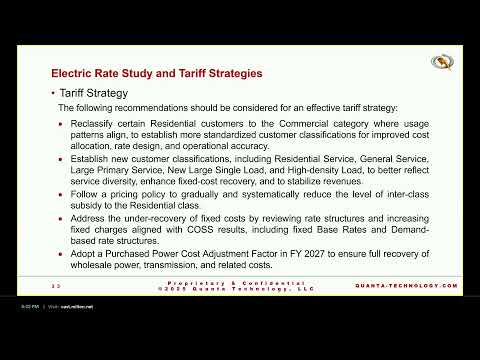
The study recommended several tariff and program changes: standardize customer classifications and reclassify very large users now in the “regular” class to commercial or a new primary service class; increase monthly base (fixed) charges for residential and general service customers to recover more customer‑related cost; create a new large‑primary service class with a three‑part rate (base, commodity and seasonal demand charges) for untransformed primary users such as large warehouses; adopt a power cost adjustment factor to reconcile projected and actual supply and transmission costs; and consider debt financing as a tool to spread large near‑term capital costs while preserving fund balances.
Quanta recommended implementing changes gradually beginning with the June 2026 CPI‑U adjustment so bill impacts are phased in. The consultants noted that the AMI system was installed in 2017 and that meter failures are increasing; they reiterated an AMI replacement program will be needed and that charted replacement costs (a $1.6 million figure shown in the slides) would be phased over about five years rather than a single year.
Councilmembers asked about policy choices and alternatives. Councilmember Seeder said she is concerned about the presentation moving from policy options into a single recommended action and urged that the council receive multiple options and explicit policy tradeoffs before selecting a path. Several councilmembers also questioned the use of debt financing; consultants and staff said debt is one available tool to smooth rate impacts and preserve fund balances but acknowledged it adds interest costs.
No formal action was taken at the study session. City staff said the full distribution and tariff reports will be circulated to council and that a structured rate proposal and ordinance will return to council for action in October.