
Audit of Athens land-development code finds fragmented rules, flags federal legal issues
Get AI-powered insights, summaries, and transcripts
Subscribe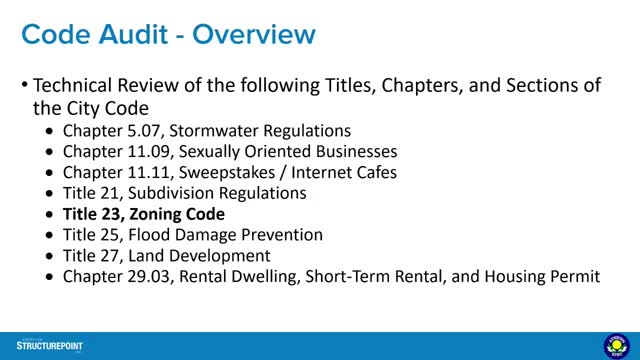
Summary
Consultant presentation identified scattered land-development regulations across multiple city code chapters, recommended consolidation into a unified development ordinance, and flagged potential federal issues around religious assembly, sign regulation and housing definitions that staff should address in code updates.
A consultant told the Athens City Planning Commission on Sept. 3 that the city’s land-development regulations are fragmented across multiple code chapters and that a consolidated rewrite could reduce conflicts and speed redevelopment. The consultant, David, said the audit found numerous overlapping chapters and inconsistent terminology and recommended a user-friendly structure such as a land-use table and dimensional standards tables.
"Most cities that we work with when we start this code audit review, there are maybe 2 or 3 titles that have land development regulations. There are literally 2 pages worth for the city of Athens," David said, describing the extent of scattered provisions.
Why it matters: the consultant said the current organization makes it hard for staff and prospective developers to determine whether a use is allowed without lengthy review, and that streamlining could reduce the number of variances and unclear interpretations that slow projects. The consultant recommended an "annotated outline," a land-use matrix and clear conditional-use standards to consolidate similar uses and list any extra conditions in one place.
The audit also identified federal legal considerations the city should address in code updates. The consultant noted a requirement that religious and nonreligious assembly uses be treated consistently under federal law and urged a definition and consistent treatment across zoning districts. He summarized the standard this way: "It basically means that religious and non religious activities have to be treated the same."
Staff and commissioners discussed a related sign-code issue. The consultant cited the U.S. Supreme Court decision in Reed v. Town of Gilbert and advised that sign regulations be content-neutral — for example, regulating temporary yard signs by size or duration rather than by whether signage advertises political, commercial or real-estate messages.
The audit also recommended adding clear definitions for residential-care and assisted-living facilities to align local rules with federal housing law; David said the city’s current terminology is inconsistent and that a defined term would reduce interpretive disputes. The audit document is complete and available to staff; the consultant said any code edits beyond the audit require a separate scope and budget.
What was not decided: no text amendments or ordinance changes were adopted at the meeting. Commissioners asked for follow-up steps and whether the consultant would present to City Council; the consultant responded that he would welcome that engagement and that staff would need to set the scope and budget for code revisions.
Next steps: staff and the consultant will coordinate to prioritize code sections for revision, consider the legal items flagged (religious-use parity, sign content neutrality, facility definitions), and prepare draft changes for future Planning Commission and Council review. The consultant and staff offered to provide examples from recent Ohio projects, including a near-adopted rewrite for Chillicothe, as local precedents.