
Athens staff push neighborhood corridor overlay for Stimson Avenue after wide public input
Get AI-powered insights, summaries, and transcripts
Subscribe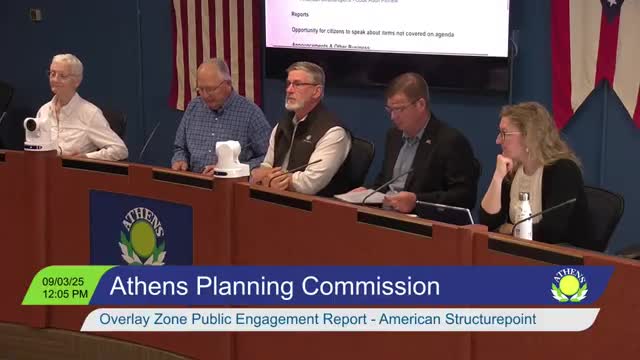
Summary
Consultants and city staff presented a proposed neighborhood corridor overlay for Stimson Avenue and portions of State Street, citing 424 public comments and broad support for small businesses, active transportation and pedestrian-friendly building form; parking and floodplain concerns were the main community caveats.
Consultants and city planning staff told the Athens City Planning Commission on Sept. 3 that a neighborhood corridor overlay district centered on the Stimson Avenue corridor could strengthen walkable, small-scale retail and residential development while preserving neighborhood access. The presentation followed a public engagement process that produced 424 comments and included 10 stakeholder sessions and an open house. "We got 424 total comments," the consultant David said during the presentation, summarizing the outreach.
The overlay, the presenters said, would not change underlying land uses but would add standards for building placement, sidewalks, parking orientation and signage to create a more pedestrian-oriented corridor. "The overlay zone itself is going to be general in nature, and can be applied on multiple corridors around town," Megan Jennings, a planning staff member, told the commission, explaining that Stimson Avenue is likely to be an early application but that other corridors were identified during outreach.
Why it matters: the overlay is intended to implement recommendations from the federally funded Stimson Avenue Corridor Plan (funded through an Opportunity Zones program) by aligning zoning standards with the corridor’s existing small-scale, walkable character. Proponents said the change could ease redevelopment of properties that currently fail to meet standards tailored for large, auto-dependent development.
Key findings and public themes from the engagement included strong support for small businesses, improved sidewalks and active-transportation infrastructure, street trees and green space, and requests for clearer information about how standards would be applied on the ground. Parking was the most divided topic: many respondents favored reduced parking requirements to enable redevelopment, while nearly as many asked for more parking. The consultant said lowering parking minimums and orienting parking behind buildings were the primary code options to enable small-scale redevelopment.
Commissioners and residents raised practical concerns. Commissioner Stone asked whether an overlay could relax some requirements while adding others; David replied that parking reductions are the clearest example of a relaxation the overlay could include. Resident Paul Miller asked which specific zoning changes would reduce the need to seek variances; the consultant recommended converting frequently requested exceptions into by-right standards where appropriate to speed redevelopment. Resident Susan Guilford urged officials to revisit zoning on Columbus Road (the former Dairy Queen site) because of drive-through circulation and safety concerns; staff said that parcel’s review would be handled separately from the Stimson overlay work.
Staff noted that the overlay is one implementation tool and that some infrastructure items — new parking decks, sidewalk improvements, traffic calming — are expensive and would require separate funding or projects. The consultant and staff committed to sharing the public engagement summary, raw survey data and the presentation on the city website; David said printed copies of the summary were available at the meeting.
What was not decided: the commission did not adopt any ordinance language at the meeting and took no formal vote on the overlay concept. Instead, staff and the consultant said they will draft ordinance language and return with details for further review. "The devil's in the details," the consultant said, urging skeptics to review draft text when it is released.
Next steps: staff will post the presentation and engagement materials online and will prepare draft overlay language and a code audit report for future meetings and possible presentation to city council. The consultant said the audit and engagement deliverables are complete and that future code edits would require a separate scope and budget.