
Committee weighs appeal-process changes and whether to make statements of consideration public
Get AI-powered insights, summaries, and transcripts
Subscribe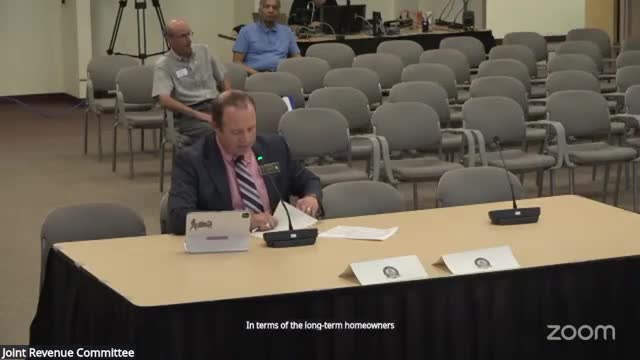
Summary
A draft bill would expand exchange of evidence in property tax appeals and make assessor statements of consideration public going forward; assessors and stakeholders warned about calendar, workload and confidentiality impacts and asked for targeted revisions.
The Revenue Committee reviewed 26LSO104, a draft that would change the property tax review and appeal process and make certain assessor "statements of consideration" public records for cases arising after the bill's effective date. Under the draft, taxpayers or authorized agents would be entitled to review and receive copies of assessor materials relied on to value a parcel — including statements of consideration, spreadsheet analyses and other evidence — during a review and at discovery, with request windows and delivery deadlines specified in statute. The draft also extends the statutory period to file an appeal from 30 to 45 days in one section, and otherwise updates exchange and disclosure requirements for hearings. County assessors and system users raised practical concerns. Converse County assessor Dixie Huxtable and other assessors told the committee Wyoming is currently a "non-disclosure state" for sales prices and related statements of consideration and that making all statements public would be a significant policy change. Huxtable said assessors can make materials available for review and can accommodate many requests but warned the draft's language — for example, requiring assessors to "provide" material within three days — could impose operational burdens and suggested changing statutory language to require assessors to "make available" requested material rather than to deliver it within three days. Assessors also flagged tax-calendar interactions: the lien date is January 1, notices are mailed by the fourth Monday in April, abstracts are due to the State Board of Equalization June 1, and many appeals must be resolved by October 1. Several assessors warned that extending the appeal window to 45 days without adjusting the abstract and certification calendar could require reworking other statutory dates. Other participants urged caution about mandatory public disclosure. Pat Sweeney (online) and Marty Hartzog, vice chairman of a board of equalization, both questioned whether a broad disclosure requirement was needed or would be politically feasible. Hartzog recommended clearer statutory language if the committee wants to modify presumption standards and to reconcile any new authority with existing statute that limits county boards from "performing the function of an assessor" (39-13-102(d) was cited). Outcome: the committee did not adopt the public-disclosure provision as drafted. Members asked staff to separate the two topics — exchanges during appeals and the public-records question — and to return with language that addresses: (1) whether and how assessor statements of consideration should be made public; (2) reasonable deadlines for producing evidence (assessors suggested more time than three days for complex requests); and (3) whether the appeal filing period should remain 30 days or be extended, and if extended, how to adjust the tax calendar accordingly. Ending: LSO, Department staff and county assessors will work on revised language and provide recommendations at the next meeting.