Get Full Government Meeting Transcripts, Videos, & Alerts Forever!
Get email alerts on the Graduation Requirements topic
No spam. Unsubscribe anytime.
School board studies tiered diploma options, staff to survey students and teachers
Summary
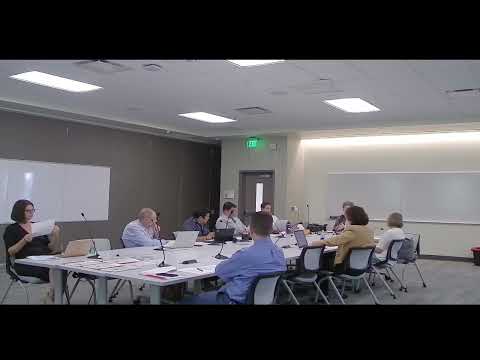
The school board met in a study session to review proposals for changing high school diploma offerings and to consider a tiered structure that would keep the current 24-credit standard diploma while adding an advanced/honors option requiring additional credits.
The school board met in a study session to review proposals for changing high school diploma offerings and to consider a tiered structure that would keep the current 24-credit standard diploma while adding an advanced/honors option requiring additional credits. Dr. Kyla Hall, the district presenter, laid out comparative data from other districts and states and recommended narrowing options and surveying students, teachers and counselors before any change is adopted.
The discussion matters because the district’s baseline diploma currently requires 24 credits and staff data show the majority of students already earn more than that minimum; the board debated whether raising minimums or creating a second advanced diploma would improve college and career readiness or risk excluding students who struggle with attendance and engagement. "I want students to leave with choices," Dr. Kyla Hall said, summarizing the district’s stated goal.
Staff presented enrollment and course-taking data, showing that at the three comprehensive high schools a majority of graduates already take more than 27 credits (East 61 percent, Highland 73 percent, West 56 percent). The presentation explained that staffing allocations are based on average daily membership (ADM) and a planning ratio of roughly 30.2 students per teacher; teacher FTE are allotted by grade-level student counts rather than by how many periods an individual teacher carries. Dr. Hall said increasing required credits would not necessarily require more FTE unless the district mandated many small, specialized sections.
Board members pressed on several risks and implementation details. One member noted that raising the minimum credit requirement without strengthening counseling and attendance supports could widen opportunity gaps and potentially increase the number of students who fail to graduate. A board member cited West High as an example: staff analysis suggested that moving from a 24-credit baseline up by one or two credits could affect dozens to hundreds of students at that campus if schedules and supports are not adjusted.
Attendance and senior scheduling were central concerns. Staff and board members discussed how free periods and part-time senior schedules can contribute to truancy; some trustees said requiring fuller schedules could reduce absenteeism by giving seniors more class time and fewer chances to skip. At the same time, several trustees urged caution, saying the district should not "put the cart before the horse" by raising requirements before improving engagement, counseling capacity and outreach.
The group reviewed alternative models from other jurisdictions, including an Ohio example that lists diploma seals (career/technical, biliteracy, military enlistment, honors) and state-level credit mixes; staff noted some states require four years of math or four years of English for certain diplomas. Dr. Hall described several diploma types under consideration—a basic or standard diploma (24 credits), a district diploma with additional electives, and an honors/advanced diploma with extra credit and possible seals or cords—and recommended a narrow initial scope if the board prefers to move forward.
Staff identified next steps and interim actions rather than a formal decision. Tiffany (staff coordinating a committee) is assembling a committee to review academic awards, diploma seals and high-school-level consistency across campuses. Staff said they would draft surveys and suggested using Canvas or focus groups (including AVID classes and incoming student board members) to gather student input. Dr. Hall said the administration would aim to have a decision point by October if the board wished to implement diploma options for incoming freshmen in the 2026–27 school year, to allow counselors and schools time to prepare and communicate requirements.
No motion or formal vote was taken during the study session; board members agreed the item should proceed through data collection, student and teacher engagement, and committee work before any change is finalized. Board members and staff emphasized that any change would not be applied retroactively to students already enrolled in a cohort. "Changes would never affect a sitting cohort," Dr. Kyla Hall said, clarifying implementation policy.
The board also discussed related topics that could be coordinated with diploma changes: weighted grades, expansion of concurrent enrollment options, and clearer districtwide guidance on cords, seals and awards so that students who move between high schools receive consistent recognition. Several trustees urged that the diploma that lists a student’s home high school remain available so school-level pride and traditions are preserved.
Staff and trustees identified a preliminary set of survey questions and outreach targets: student intent for postsecondary pathways (college, vocational training, workforce), counselor capacity, teacher and principal input on master scheduling and course capacity, and ZIP-code–level access disparities (trustees cited lower college-attainment rates from ZIP codes 84104 and 84116 as a reason to coordinate with University Neighborhood Partners and community partners). The district will return with survey results, committee recommendations and an updated implementation plan for further board discussion.
The study session closed with direction to staff to develop a simple set of diploma structure options for board review (for example, two-option: standard diploma at 24 credits and an advanced/honors diploma at a higher credit threshold), to run targeted surveys and focus groups this fall, and to clarify how related policy changes (weighted grades, concurrent enrollment) could be phased alongside any diploma change.
The session was exploratory; no policy change or vote occurred.