Get Full Government Meeting Transcripts, Videos, & Alerts Forever!
Get email alerts on the Workplace Safety topic
No spam. Unsubscribe anytime.
Trainer urges local agencies to inspect and upgrade emergency eyewash and shower stations
Summary
A safety training session reviewed OSHA guidance and ANSI Z358.1 recommendations for emergency eyewash and shower stations, emphasizing placement, water volume, tepid temperature, weekly flow testing and unobstructed access to reduce eye and skin injuries from corrosive or infectious materials.
Jason, a staff member, led a session for local government personnel on emergency eyewash and safety shower stations, saying the first 10 to 15 seconds after an eye exposure “are really critical” to limiting damage and urging agencies to ensure equipment is available, accessible and functioning.
He told attendees that OSHA requires facilities to provide “suitable facilities for quick drenching or flushing of the eyes and body” where workers may be exposed to corrosive materials, and he cited the voluntary consensus ANSI Z358.1 standard (last updated in 2014) as the operational guide for installation, testing, maintenance and training.
Why it matters: Immediate flushing reduces the severity of injuries from acids, bases, organic liquids and debris, and can be relevant for bloodborne-pathogen exposures in jails, EMS and public-safety work. The trainer noted that in some cases emergency showers also help extinguish clothing fires.
Key installation and performance points Jason reviewed: eyewash stations should be within a 10-second walking distance (about 55 feet) of likely exposure points, in the same room with no change in elevation or doors to traverse; eyewash nozzles should be 33–45 inches above the floor and about 18 inches from the wall; shower heads should be 82–96 inches above the floor and produce a roughly 20-inch spray diameter at 60 inches above the floor. Valves must be reachable (no higher than 69 inches) and operate on a stay-open mechanism so water continues until turned off.
Plumbing and water-volume guidance: eyewash outlets must supply about 0.4 gallons per minute at 30 psi in the ANSI-specified pattern; safety showers should deliver about 20 gallons per minute at 30 psi. Both devices must be capable of flushing for a minimum of 15 minutes (ANSI minimum), which equates to about 300 gallons for the shower at that rate. Jason warned attendees to plan for drainage and slip hazards when weekly testing releases that volume of water.
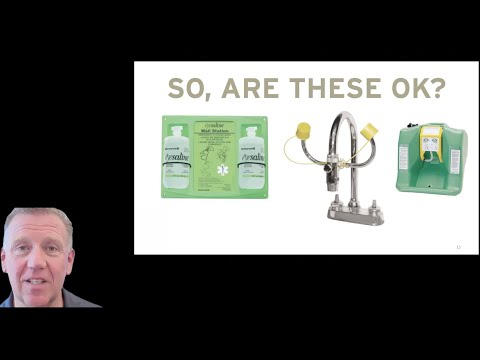
Temperature and system types: ANSI requires tepid water (about 60–100 degrees Fahrenheit). Jason explained that mixing valves are commonly used to deliver tepid water by blending hot and cold sources. He described three common system types: hard-plumbed (preferred), gravity-fed wall units (contain a finite supply and require sanitizing additives), and portable units for remote job sites; he said personal saline bottles do not meet ANSI requirements and should not replace a fixed or portable emergency station.
Maintenance, inspection and training: Jason emphasized weekly flow testing and inspection to prevent sediment, rust and bacterial growth, and to ensure manufacturer caps and components are present and function. He noted that weekly flow tests are part of maintaining sanitary, ready systems and encouraged documenting inspections. He also advised agencies to avoid siting units where flowing water could spray electrical panels, and to ensure valves cannot be easily shut off by others.
Operational advice and training reminders: Jason recommended buying commercially assembled units that meet ANSI requirements rather than piecing a system together; train staff to pull the paddle valve, hold eyes open and remain under flushing for the full ANSI minimum of 15 minutes; and provide appropriate personal protective equipment (gloves, aprons, face shields) to reduce the likelihood of needing emergency flushing.
The session closed with a request to inspect existing stations, document results and, where stations are missing or nonfunctional, plan installations that meet the ANSI guidance. Mike, a staff member who commented during the session, said the presentation highlighted issues inspectors often notice and praised the practical examples shown.