Get Full Government Meeting Transcripts, Videos, & Alerts Forever!
Get email alerts on the Vehicle Safety topic
No spam. Unsubscribe anytime.
Trainer urges strict PPE, inspections after presenter cites 36 utility-vehicle accidents costing $313,000
Summary
A safety presenter reviewed controls, rollover risks, PPE, and pre-trip checks for ATVs, UTVs and golf carts, citing national injury figures and local incident costs and urging organizations to require helmets and routine inspections.
Mike, the safety presenter, reviewed operational controls, rollover risks and personal protective equipment for all-terrain vehicles (ATVs), utility task vehicles (UTVs) and golf carts during a webinar, and urged organizations to require helmets and pre‑trip inspections.
The presenter said the national toll is “500 deaths and over a hundred thousand injuries every single year,” and that his organization’s insurance trust logged 36 accidents involving golf carts, UTVs, ATVs or similar utility vehicles since 2020, with claims totaling about $313,000. Mike said some potential claims were not filed, and that total costs “could have been much higher.”
Why this matters: webinar organizers and municipal maintenance crews commonly use these vehicles for parks and roads work; the presenter framed the session as a risk‑reduction briefing focused on operator controls, vehicle limitations and procedural checks that staff and supervisors can adopt to reduce accidents.
The presenter reviewed vehicle controls and common failure modes in detail: handlebars and the importance of keeping both hands on ATVs; a right‑hand, thumb‑operated throttle that should be used with “smooth, even pressure” rather than “feathering”; brake lever and pedal layouts; the presence of an ATV kill switch; and differences between ATVs (single‑seat, exposed) and UTVs or golf carts (steering wheel, pedals, parking brakes in console or on the brake pedal).
Mike cautioned that ATVs have low‑pressure knobby tires, fixed rear axles and a high center of gravity, and that those design features increase the risk of loss of control on paved surfaces and of tip‑overs on slopes. He advised operators to check owners’ manuals for minimum size/weight and load specifications and to avoid altered or non‑manufacturer accessories that change balance.
On slope limits, the presenter recommended a maximum 15‑degree incline and a 25‑degree maximum side slope for safe operation, and warned that overloading rear cargo or giving excessive throttle on an incline can make an ATV or UTV flip backward. He said rollovers are the most common accident type and attributed many incidents to excessive speed, shifted centers of gravity and vehicle modifications.
For golf carts he recommended several practices to reduce injuries: require all riders to be seated before motion, operate from the driver’s side only, avoid cell phones and headphones, use designated paths, avoid sudden maneuvers or excessive speed and keep arms and legs inside the vehicle. The presenter noted that “over half of the injuries that we saw in golf carts were because somebody was sticking their arm or leg out the left hand side.”
On inspections and documentation, Mike introduced a pre‑trip checklist mnemonic: START and GO (steering and drive system; throttle and brakes; activate lights; registration and OHV decal; tires; gas and oil; operate safely). He advised checking that throttles snap back to idle, that parking brakes are set before shutdown, and that low‑pressure tires be checked with an appropriate gauge.
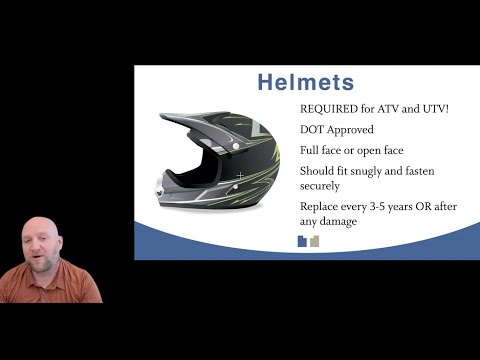
Personal protective equipment (PPE) guidance included repeated instruction to wear a helmet for ATVs and UTVs—“Always wear a helmet when operating ATVs and UTVs,” Mike said—plus long pants and sleeves, gloves, over‑the‑ankle boots and eye/face protection. He recommended DOT‑approved helmets that fit snugly and replacement every three to five years or after any damage.
On age and labor rules the presenter said operators should be 18 or older under applicable child‑labor restrictions discussed in a referenced webinar segment; he directed viewers to a 23‑minute mark of a recorded webinar where a speaker named Jason explains those child‑labor rules.
The host, Daniel, opened and closed the session and invited questions; no formal policy or rule change was adopted during the webinar. Mike repeatedly framed items as recommendations for organizations: for example, he said, “We should require [helmets] as an organization.”
Ending: The presenter urged organizations and operators to adopt the recommended PPE, pre‑trip checks and slope limits and to consult owners’ manuals for vehicle‑specific limits. He emphasized training and cautious operation to reduce the risk of rollovers, ejections and roadway crashes.