Get Full Government Meeting Transcripts, Videos, & Alerts Forever!
Get email alerts on the Zoning Conditional Rezoning topic
No spam. Unsubscribe anytime.
Planning commission defers action on extending conditional‑rezoning timelines
Summary
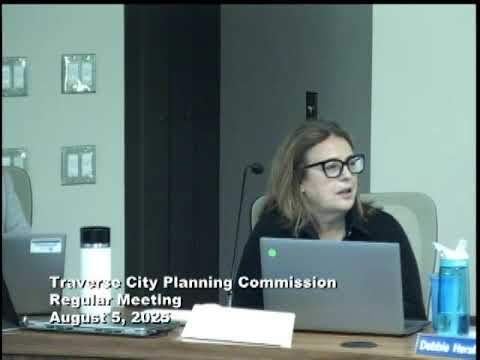
The Traverse City Planning Commission opened a public hearing Aug. 5 on a staff‑initiated zoning text amendment to extend timelines for conditional rezonings, heard legal concerns about vesting and enforceability, and voted to defer the amendment to staff for additional work and recommendations.
Traverse City Planning Commission members on Aug. 5 opened a public hearing on a proposed zoning text amendment that would extend the time allowed for conditional rezonings, heard legal concerns from staff about vesting and enforcement, and voted to defer the matter so staff can prepare revised language and legal guidance.
The amendment under consideration would move the ordinance’s current milestone schedule — roughly 75% complete at two years and 100% at three years — one year later and would add up to two one‑year administrative extensions authorized by the planning director, with further extensions requiring Planning Commission and City Commission review. Planning Director Sean Winter summarized the background: the amendment was initiated after a property owner asked for more time to assemble plans and financing and the Planning Commission asked staff to explore options.
Why it matters: conditional rezonings are a tool that lets applicants voluntarily accept limits or conditions on future development in exchange for rezoning flexibility. The Planning Commission’s conversation focused on whether the city’s ordinance should preserve that tool, change its timing metrics, or remove it because of legal and practical concerns raised by the city attorney.
Most of the discussion centered on legal risk and enforceability. Winter reported that the city attorney had "no problem with those changes," but warned that conditional rezoning raises special legal issues because “zoning travels with the land” and courts may recognize a developer’s vested rights once construction is substantially underway. Winter said the attorney viewed the statutory authority for conditional rezoning as limited — "the act says that you may have it. You're not required to have it" — and that the attorney may recommend removing conditional rezoning from the municipal ordinance when the proposal reaches the City Commission.
Commissioners debated alternatives to the percentage completion metric, noting that a 75% completion threshold can be subjective and contested in litigation. Several commissioners favored replacing percent‑complete triggers with clearer, objective milestones such as a certificate of occupancy or a requirement to have footings in the ground within a set number of years. A range of other points were raised in discussion: deed restrictions as a possible but imperfect neighbor protection, the rare but legitimate uses of conditional rezonings to resolve neighborhood concerns, and the administrative burden of repeated public hearings.
Outcome and next steps: Commissioner Brian moved to defer the amendment and direct staff to return with revised options and legal guidance; David seconded. The Planning Commission voted to defer the item to staff for further work (roll call recorded in the meeting: O'Brien — no; Fredwell — no; McGillivary — yes; Knapp — yes; Anderson — yes; Naturi — yes; Hershey — yes). Staff said it will consult further with the city attorney, prepare alternate ordinance language (including options to remove the provision, to replace percent‑complete with an occupancy or footing standard, and to clarify administrative extension authority), and return the item to the Planning Commission for a future public hearing — the commission discussed scheduling a return in September.
Discussion vs. decision: the meeting produced direction to staff (defer and refine the amendment) but no change to the municipal code. Commissioners warned the amendment could prompt the city attorney to recommend complete removal of conditional rezoning authority; staff emphasized that any changes requiring a different public notice would come back to the Planning Commission.
What remains unresolved: legal clarity about vesting and whether the City Commission will follow the attorney’s anticipated recommendation to remove conditional rezonings from the city ordinance; the precise alternative milestone (certificate of occupancy vs. footings vs. a set years limit); and whether the Planning Commission or the City Commission will ultimately pursue elimination or retention with revised standards.
Ending: Staff will prepare written options and legal analysis and return the proposal for additional public hearing and commission action; no change to existing conditional rezonings was enacted at the Aug. 5 meeting.