Get Full Government Meeting Transcripts, Videos, & Alerts Forever!
Get email alerts on the Parks And Recreation topic
No spam. Unsubscribe anytime.
Planning Commission finds proposed park at 429 East Front Street consistent with master plan
Summary
The Traverse City Planning Commission voted to find that a proposed park at 429 East Front Street is consistent with the city master plan, a procedural determination required by the Michigan Planning Enabling Act; commissioners and public commenters raised questions about stormwater, riparian buffers and downtown multimodal access.
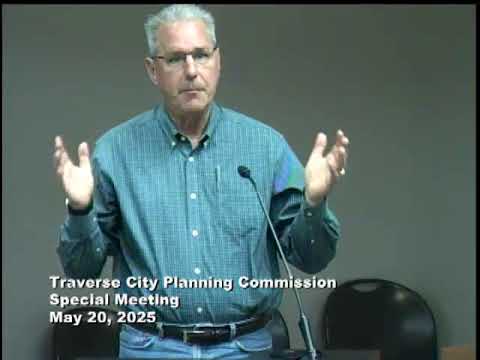
Traverse City Planning Commission members voted May 20 to find that a proposed park at city-owned property at 429 East Front Street is consistent with the city’s master plan.
The vote, taken solely on the question of plan consistency as required by the Michigan Planning Enabling Act, affirms the park’s location, character and extent as presented to the commission. Chair Hershey said the statute “requires us to state whether or not we feel this public park is consistent or inconsistent with the master plan.”
The finding does not approve the park design, construction or any private participation; commissioners and staff emphasized the determination was limited to whether the park fits the master plan’s policies. Commissioner Shea moved to affirm the proposed park; the motion was seconded and carried.
Commissioners and members of the public used the hearing to highlight issues they said should be addressed later in the process. Commissioner McGillivray and others noted the city master plan’s commercial core section makes little explicit mention of pocket parks or recreation and said the planning commission must rely on other planning documents, including the city’s Parks and Recreation plan. “Our commercial core does not mention parks, pocket parks, anything,” McGillivray said, calling that omission an oversight when the master plan was adopted.
Concerns raised during public comment included shoreline and riparian-buffer coordination and multimodal safety on nearby streets. A commenter identified only as representing Baykeeper asked how the conceptual park plan aligns with an in-process riparian buffer project. Chair Hershey and staff reiterated the commission’s limited task: the riparian-buffer question and detailed park design are matters for the City Commission and Parks staff at later reviews.
Richard Robbins, representing the Grand Traverse Safe Streets Alliance, urged planners to require a “future plan that has to be in place for multimodal, all-user usage for transportation” on Front Street and State Street so that the park and adjacent development do not outpace safe nonmotorized infrastructure. Robbins said the Alliance represents “hundreds of households” and urged incorporation of best practices for cycling and pedestrian access.
Joel Peterson, the applicant who proposed the adjacent development and discussed partnering on the park, described the park plan as conceptual and said Parks staff would decide the final elements. “I’m not trying to dictate what gets done on city property,” Peterson said. He described the proposal as a public–private partnership intended to reduce costs to taxpayers while improving downtown appearance.
A local resident, Fred Bembert, asked the commission to limit its action to the statutory consistency determination and not to imply broader project approval. “If this board is just eliminating itself to a determination of whether this location of a park in that spot is consistent with the master plan, have a motion and a vote that actually determines that,” Bembert said.
Commissioners discussed whether future City Commission review would return to planning staff for more detailed design review; staff confirmed they expected the City Commission and Parks Department to take up design, stormwater and other implementation matters. Several commissioners noted on-site conditions — including dead or hazardous trees observed on the parcel — and said those conditions argue for eventual site design and tree-removal plans.
The planning commission’s action on May 20 is a statutory consistency finding, not project approval. Any design, permitting, stormwater or riparian-buffer work, and any public-rights-of-way changes on Front Street or State Street, will require subsequent review and approvals by the appropriate city bodies and staff.
The commission had one agenda item and concluded the meeting after the vote.