Get Full Government Meeting Transcripts, Videos, & Alerts Forever!
Get email alerts on the City Budget topic
No spam. Unsubscribe anytime.
Finance director outlines city budget, fund‑balance drawdown; coalition asks for $1 million for permanent supportive housing
Summary
Finance Director Heidi Sheppey presented the proposed 2025–26 city budget, highlighting new internal funds, recommended staffing changes and an intentional drawdown of the general fund balance toward 29 percent, while a homelessness coalition urged a $1 million dedicated budget line for permanent supportive housing.
Traverse City’s finance director presented the proposed 2025–26 budget framework, describing organizational changes, recommended new and converting positions, and a planned reduction of the general fund balance. During public comment, the Northwest Michigan Coalition to End Homelessness asked the commission to establish a $1,000,000 budget line item to accelerate permanent supportive housing initiatives.
Budget highlights: Finance Director Heidi Sheppey told commissioners the draft budget uses ClearGov tools to increase transparency, separates information technology into a new internal service fund, and creates a distinct Fire/EMS fund to track the voter‑approved millage and avoid commingling with the general fund. Sheppey said the budget includes 18 position requests overall, with recommended positions built into payroll and benefits for 2025–26; two seasonal positions (marina dockmaster and a water‑treatment operator) are proposed to transition to year‑round roles.
Fund balance and capital tracking: Sheppey said the general‑fund balance was intentionally higher than policy last year (about 40%) and that the proposed budget draws that down to an estimated 29% by using some funds this year; the city’s policy target remains 15–20%. She emphasized caution given pension‑ and benefit‑related liabilities and flagged the need to monitor the impacts of new positions on long‑term unfunded liabilities (MERS). She also described reorganizing capital accounts so streets, bridges, sidewalks and other projects are tracked in their respective capital funds.
Grant revenue and capital projects: The presentation explained that the budget will include grant revenue only when there is sufficient confidence the grant will be received and that revenues are recorded as actuals when expenditures occur and auditors confirm eligible costs. Sheppey enumerated capital project totals in the packet and said many projects roll forward if not completed by fiscal year end.
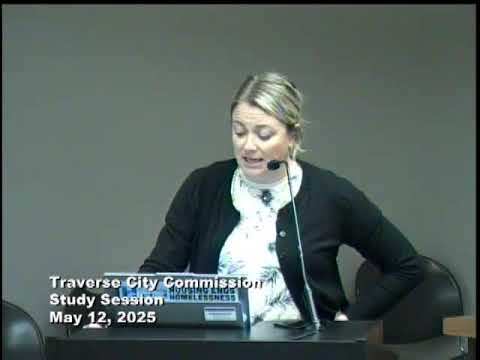
Public comment on homelessness: Ashley Halliday Schmanton, director of the Northwest Michigan Coalition to End Homelessness, asked the commission to create a dedicated $1,000,000 line item for fiscal 2025–26 to support priorities identified by the housing and homelessness task force, specifically to accelerate permanent supportive housing and related services. She framed the request as a way to leverage state and federal funding and to enable quick implementation of task‑force priorities once the task force finalizes its plan.
Commission reaction: Commissioners asked about the fund balance level and whether the city should use more of the surplus for priority needs. One commissioner said the commission should discuss whether to deploy additional fund balance beyond the proposed drawdown. Sheppey said she would continue monitoring projections and incorporate commission direction if provided.
Next steps: The budget will move through the city’s adoption process; staff will provide further detail on recommended positions, grant matches, capital projects and the fund‑balance plan as commissioners request additional analysis.