Get Full Government Meeting Transcripts, Videos, & Alerts Forever!
Get email alerts on the Short Term Rentals topic
No spam. Unsubscribe anytime.
Traverse City planning commission advances short-term rental rewrite; public hearing set for May 6
Summary
Members of the Traverse City Planning Commission continued work on proposed zoning changes to limit short-term rentals, discussed grandfathering and nonconforming uses, and directed staff to refine draft language (including changing per-building limits to per-parcel). A public hearing is scheduled for May 6.
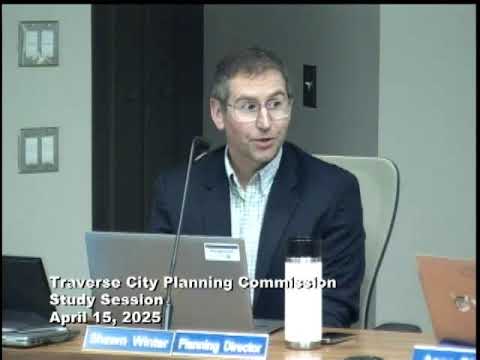
The Traverse City Planning Commission on April 15 continued a months‑long review of proposed changes to the city’s short‑term rental rules, setting a public hearing for May 6 and asking staff to refine draft language before that hearing.
Commissioners and staff focused on several technical and legal issues that will shape the ordinance, including whether caps should be applied per building or per parent parcel, how grandfathered (nonconforming) short‑term rental rights will be handled, and how to count units in site‑condo or multi‑building developments.
Sean, planning staff, said the process remains active and reminded commissioners of a procedural limit: “Per the Zoning Enabling Act, the planning commission is not allowed to take a vote until a public hearing is held,” and staff has scheduled that hearing for May 6. He also described draft changes under consideration, including reductions in allowable short‑term rental percentages across most zoning districts; the industrial district use that previously allowed 100% of dwellings to be rented short term would be eliminated, while the hotel/resort district would remain at its current level.
The commission asked staff to clarify how the city will treat existing, grandfathered short‑term rentals. Lauren, city attorney, said the city’s policy must preserve notice and an opportunity to be heard when taking away a vested use: “the requirement is that you have, notice and, you know, due process, which is notice and the opportunity to be heard.” She warned that legal challenges are possible but said the draft ordinance and policy attempt to build procedural protections into the process.
Commissioners raised practical concerns about implementation. Commissioner Brian pressed staff on how to count units in developments where individual site condos have separate tax IDs but derive from a common parent parcel, asking, “if you’re on one city lot … shouldn’t our restrictions be per city lot? Okay? Not per building.” Staff said the language can be changed from “per building” to “per parcel” if that is the commission’s direction; staff noted complications because many site condos already have unique tax IDs tied to the assessor’s records.
Commissioner Jackie and others urged better data. Jackie said she appreciated prior data requests and noted an offer from Aspire North to share short‑term rental data collected by that organization; commissioners asked staff to distribute any outside data to the whole commission ahead of the public hearing. Staff and the clerk’s office told commissioners that some requested turnover information — for example, how many licensed short‑term rentals lapsed in prior years or how often ownership changed — is not collected in a standard, easily exportable way and would require additional work by clerk’s staff to compile.
Several commissioners flagged a potential loophole in the draft: developers constructing multiple detached structures or separate units could, by design, create more rentable units than the draft limits intend. Commissioners noted a specific Twelfth Street development that secured licenses at 100% because it had commenced construction before the prior changes took effect. Staff suggested defining “hotel/condo‑hotel” or using the parent parcel as the baseline limit to prevent developers from exploiting per‑building accounting.
Katie, the city’s GIS coordinator, demonstrated a dashboard that maps licensed vacation rentals and permit data. She told commissioners the dashboard “is not live. As you can see, it gets updated on the twentieth of each month,” and that the display is limited to licenses the clerk’s office reports (it does not show unlicensed listings). Staff said they will continue to use and refine the dashboard as a working resource for commissioners.
Commissioners also discussed implementation tools beyond zoning: incentives to convert units from short‑term to long‑term rental use were raised as an option, and staff said the city could coordinate with state programs such as MSHDA and Community Development Block Grant resources when a conversion incentive program is developed.
Next steps included staff drafting revised ordinance text to: (1) change references from per‑building to per‑parent‑parcel where commissioners direct, (2) tighten a hotel/condo‑hotel definition to prevent circumvention, and (3) attempt a building‑by‑building analysis of how many nonconforming units would result under proposed percentage caps. The public hearing is scheduled for May 6; notice will be published in the weekend newspaper prior to that meeting, and the planning commission may vote after the hearing closes if it chooses to do so.
The discussion produced no formal vote or final action at the April 15 session; staff and the city attorney said they will return with refined language and any additional legal analysis before the hearing.