Get Full Government Meeting Transcripts, Videos, & Alerts Forever!
Get email alerts on the Short Term Rentals topic
No spam. Unsubscribe anytime.
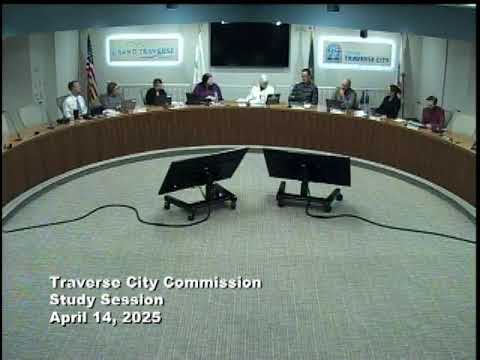
Traverse City commissioners weigh short-term rental regulations, direct staff to gather legal and market data
Summary
At a study session, commissioners discussed a rise in licensed short-term rentals, possible regulatory tools (ownership limits, operational rules, incentives to convert units to long-term housing) and asked staff for a legal review and updated data; no formal action was taken.
Commissioner Anderson opened a study-session discussion April 14 on short-term rentals in Traverse City, saying the Planning Department reported 542 licensed short-term rentals in 2024 — roughly 6.4% of the city’s estimated 8,400 dwelling units — and asked whether the commission wanted an ad hoc committee to explore possible changes to the city’s regulations.
The topic matters because commissioners and residents said short-term rentals can affect housing supply, neighborhood character and municipal costs. Anderson noted new licenses rose from 34 in 2023 to 101 in 2024, while renewals increased modestly from 419 to 438, and pointed to several regulatory options used elsewhere: owner‑residency requirements, limits on number of units owned, higher permit fees, minimum-stay rules, hosted-only stays and conversion incentives such as Sedona’s one-time payments to convert units to long-term rentals. Anderson also said a state House bill introduced last year would add LARA oversight and a potential 6% excise tax on short-term rental revenues with 5% of that tax returning to local governments if enacted.
Commissioners raised legal and practical limits. Mayor Shamro and multiple commissioners emphasized Michigan limits on permit-fee structures and cautioned that fees treated as general revenue can be challenged as a hidden tax. Several commissioners asked staff to research specific legal questions and local data before the commission pursues an ad hoc committee or ordinance changes. Commissioner Jackie asked staff for citations and for a short briefing on which proposed tools are legally viable in Michigan.
During the discussion commissioners and residents separated two regulatory approaches: ownership controls (limits on how many units an owner may hold, local-residency requirements, transfer restrictions) and operational controls (minimum-stay requirements, occupancy/parking rules, hosted-stay rules and neighbor notifications). Several commissioners said they are most interested in ownership tools and incentives that could encourage conversion of short-term units to long-term rentals, while others stressed the need to coordinate with the Planning Commission’s zoning work, which is considering adjustments in C and D commercial districts and hotel/resort zones.
Public commenters included Connor Miller of Aspire North Realtors, who offered the Realtors association’s support and proposed partnering on objective research; Justin Reid, a city resident, who urged the commission to wait for the Planning Commission’s recommendation; and Teresa Woods of Visit Up North Vacation Rentals, who urged caution about assumptions that all short-term rentals are investor‑driven and highlighted long-term local owner involvement in some markets.
No motions or votes were taken because this was a study session. Commissioners asked staff to provide specific follow-up information prior to any formal proposal: a legal review of tools discussed (fee limits, owner‑residency requirements, incentives and transfer restrictions), updated data tying recent new-builds and multi-unit developments to short-term rental licenses, clarification of which zoning districts are affected by planning commission proposals, and examples of pilot incentive programs used elsewhere. The Planning Commission was scheduled to consider zoning percentage adjustments April 15; commissioners said staff should coordinate any factsheets so the bodies’ work runs in parallel.
Commissioners and residents agreed on the need for data-driven consideration rather than immediate regulatory change. The study session ended with direction to staff to return with legal analysis and a targeted data report; no ordinance changes were proposed or adopted at the meeting.