Get Full Government Meeting Transcripts, Videos, & Alerts Forever!
Get email alerts on the Homelessness topic
No spam. Unsubscribe anytime.
Traverse City approves two-year pilot to allow Safe Harbor shelter to operate year-round
Summary
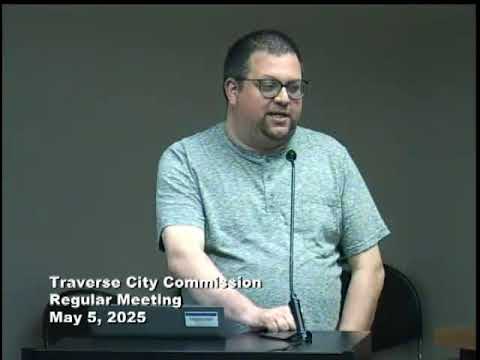
After a lengthy public hearing with neighbors, service providers and county officials, the City Commission on May 5 approved a two-year special land use permit that lets Safe Harbor of Grand Traverse operate an emergency shelter at 517 Wellington Street year-round as part of a community plan to address homelessness.
The Traverse City Commission voted May 5 to approve a special land use permit allowing Safe Harbor of Grand Traverse to operate a year‑round emergency shelter at 517 Wellington Street as a two‑year pilot.
The vote followed a public hearing that drew neighbors, business owners, nonprofit leaders and county officials. Supporters argued the extended shelter capacity will connect people to services and reduce outdoor camping; opponents urged more safety protections for the nearby residential neighborhood and asked the city to delay permanent approval until a fuller safety plan and alternative locations are developed.
Pat Livingston, chair of Safe Harbor’s board, described the volunteer organization’s work and recent operational changes: “Since being asked to operate year round with a blessing of 21 area churches and more than 2,000 volunteers, the Safe Harbor board and staff put together a plan.” Livingston told the commission Safe Harbor had transitioned to a summer schedule on May 1 and “in the first few days, we've already averaged 70 guests a night.”
Supporters framed the permit as a step in a wider, coordinated response. Grand Traverse County Commissioner TJ Andrews said the county voted in February to provide $400,000—$200,000 per year for two years—with conditions including task‑force convening and data reporting. Andrews read county reporting requirements into the record, calling for monthly metrics on guests, service connections and other indicators that Safe Harbor agreed to provide.
Nonprofit leaders said year‑round sheltering is essential to move people into housing. Dave Megabear, president and CEO of the Grand Traverse Regional Community Foundation, and Ashley Halliday Schmant, director of the Northwest Michigan Coalition to End Homelessness, told commissioners the shelter and a newly convened homelessness task force are part of a coordinated strategy that needs time and funding to produce results.
Neighbors and business owners described safety incidents, open drug use, discarded needles and confrontational behavior near the shelter site and in the nearby “pines” encampment. Betsey Corbett, who lives in the Boardman neighborhood, said she had “repeatedly witnessed open drug use, public intoxication, trespassing, [and] confrontational behavior” near areas where children walk and play and urged that the city hold off on any permanent expansion until police‑recommended safety measures are implemented.
Chief of Police Matt Richmond said the department has been working with outreach partners and volunteers and reported a recent cleanup in The Pines that reduced the number of active camps; he pledged continued outreach, enforcement of the no‑camping ordinance in parks and coordination with Safe Harbor and partners. Richmond also told commissioners the police QRT and community partners were engaging individuals remaining in the encampment and that some had plans to shelter, enter treatment or leave the area.
Commissioners discussed conditions recommended by the Planning Commission and staff. Planning Director Sean Winter summarized three conditions: secure all necessary permits, allow operation as a year‑round shelter with site improvements to be completed by Nov. 15, and add a pedestrian connection from the new parking lot to the shelter entrance at a location approved by the Planning Director. Commissioners also discussed monitoring, police foot patrols, reporting, and county funding conditions that tied public contributions to monthly transparency metrics.
Commission discussion emphasized the pilot nature of the approval. Several commissioners said they expected the two‑year pilot to run in parallel with the homelessness task force, additional investments in services and an ongoing search for longer‑term, campus‑style or nonresidential shelter alternatives.
The commission’s final motion adopted the Planning Commission’s recommendation to grant the special land use permit for a year‑round emergency shelter at 517 Wellington Street and removed language in the initial motion that would have rescinded an earlier permit. The motion passed by voice vote. The approval is explicitly framed as a pilot period during which the city, county, service providers and neighborhood representatives will report progress and return with data and possible adjustments.
Neighbors and service providers asked the commission to keep working on broader solutions—permanent supportive housing, stronger coordinated oversight, and neighborhood safety measures—while operating the shelter year‑round.
Commissioners and staff identified near‑term next steps: Safe Harbor will continue to implement the summer schedule; the police department and outreach partners will continue encampment engagements and cleanups; Safe Harbor and partners will supply data tied to county funding; and staff will monitor compliance with the Planning Commission conditions, including site improvements and pedestrian access.
The public hearing and vote concluded with commissioners urging continued outreach, transparency and an expedited homelessness task force to develop longer‑term housing solutions for the region.