Get Full Government Meeting Transcripts, Videos, & Alerts Forever!
Get email alerts on the Ethics Ordinance topic
No spam. Unsubscribe anytime.
Traverse City commission begins review of ethics ordinance; seeks ad hoc and public input
Summary
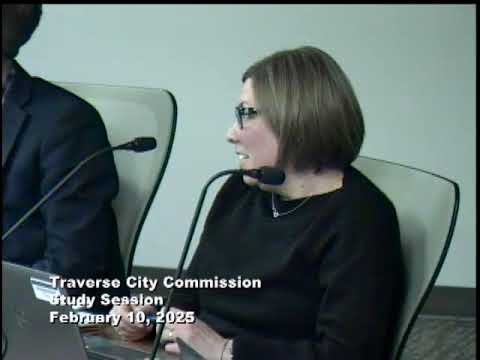
City attorney outlined options for an ethics ordinance at a Feb. 10 study session; commissioners signaled support for a broadly applicable policy, recommended an ad hoc group to draft language using model guidance, and by consensus asked staff to make prior closed-session material about a vendor contract public.
City officials on Feb. 10 opened a study-session conversation about creating or updating a municipal ethics ordinance, with the city attorney recommending a community‑specific approach and the commission directing staff to pursue an ad hoc drafting process and broader public outreach.
"What I hope for tonight is that we can have, kind of just a broad conversation," City Attorney Lauren Trevulao told commissioners as she summarized research into ethics codes across Michigan. She recommended an ordinance tailored to local priorities and urged the group to treat an ethics code as a "shield and not a sword" — designed to protect the public interest rather than to be used to attack political opponents.
Trambulao urged caution on placing detailed enforcement mechanics in the city charter and recommended instead a charter-level statement (for example, that the city shall have an ethics ordinance) supplemented by a flexible ordinance and administrative procedures that can be updated. The attorney also recommended a universal scope — applying to elected officials, appointed members, volunteers and staff — while recognizing that employee-discipline procedures must respect personnel rules and collective-bargaining obligations.
Commissioners responded favorably to a broad, accountable approach. Several members said they want a policy that emphasizes fiduciary duty, fairness, civility and public trust, and that includes a clear procedural path for investigating potential violations. "I would join… that an ad hoc committee to work together on this subject would be a great first step," Commissioner Jackie said, urging a mix of commissioners, community members and subject-matter experts on any drafting panel.
Mary Grover, a local ethics consultant who attended the session, and Trevulao were offered as resources. Commissioners asked that the ad hoc schedule be accessible to community members — for example, by holding some meetings before regularly scheduled commission meetings and scheduling some evening or weekend outreach sessions for broader participation.
Closed-session disclosure: Millennium Digital Commissioners also addressed a separate, previously closed-session discussion about a contract with Millennium Digital Consulting. Commissioner Stanley summarized the earlier closed-session disclosure: staff had told the commission in closed session that the city manager had a prior professional and personal relationship with the consultant and that commissioners had been given an opportunity to ask questions; they did not. The group reached consensus to make the prior closed-session information about the Millennium Digital matter public and to proceed with ethics work publicly.
Next steps and process Commissioners directed staff to (1) form an ad hoc group to draft proposed language that could include a charter-level statement and a supporting ordinance and procedures; (2) include city attorney support and include Mary Grover as a resource; (3) solicit broad public input through scheduled public sessions and online tools; and (4) return progress reports to the commission at regular meetings. Commissioners discussed a target cadence for work: ad hoc work could fit within the normal six‑month ad hoc charter if commissioners want a single-cycle review; staff also suggested that a simple charter amendment (for example, requiring an ethics ordinance) could be prepared quickly if the commission chose to place it on a future ballot.
Speakers and public comment Speakers who addressed the topic included Lauren Trevulao, City Attorney; Mary Grover, ethics consultant and local expert; Mayor Shamro; and multiple commissioners (Anderson, Shaw, Stanley, Werner/Warn er, Jackie). In public comment, resident Fred Bimber urged broad transparency and written public posting of comments and drafts so the community can follow the process and contribute in writing.
Why it matters Commissioners said they view an enforceable ethics framework as a way to increase public trust and to create clear, fair procedures that govern conflicts of interest, gifts, use of city resources, nepotism, and similar conduct. The group signaled a preference for "accountable" rules that include an investigative and enforcement pathway, not merely aspirational language.
Ending Staff will propose an ad hoc membership structure, a public engagement plan and a draft timeline. Trevulao and invited experts will support the ad hoc’s drafting work; the commission expects periodic public updates and a formal ordinance or charter proposal for later commission action.