Get Full Government Meeting Transcripts, Videos, & Alerts Forever!
Get email alerts on the State Street Two Way Pilot topic
No spam. Unsubscribe anytime.
Traverse City study session weighs two‑year extension of State Street two‑way pilot to gather post‑construction data
Summary
City staff and the DDA presented two years of data from a two‑way circulation pilot on State, Boardman and Pine streets and asked the commission to consider extending the pilot to collect traffic, pedestrian and bicycle data under non‑construction conditions and to test additional design changes.
At a Jan. 13 study session, Traverse City staff and the Downtown Development Authority (DDA) discussed whether to extend the State Street two‑way circulation pilot for two more years to gather data after the recent bridge and Grandview Parkway construction projects conclude.
The pilot — installed after a DDA recommendation and a traffic control order that expired in October — converted Boardman, State and Pine to two‑way traffic and included signal and pavement changes, curb modifications and painted bump‑outs funded through TIF 97. Harry Burkholder, executive director of the DDA, told commissioners the conversion was intended to slow vehicle speeds, improve pedestrian access and spur private investment along those corridors.
Burkholder said staff collected repeated counts of vehicle volumes, speeds, pedestrian and bicycle activity and crashes at multiple points over two years. “We were averaging about 22 miles per hour. At the beginning of this project, we’re down to 20,” he said, noting the change is modest but measurable. He told the commission some speeding counts declined substantially (staff cited a previous season with about 911 of roughly 4,000 drivers exceeding a threshold and said later counts were markedly lower) and that vehicle volumes increased during construction periods.
Why it matters: City staff and the DDA told commissioners that the pilot’s traffic data were skewed by multiple construction projects — bridge work and Grandview Parkway phases — that pushed abnormal volumes onto the downtown grid. Extending the pilot would let staff observe the corridor under nearer‑normal conditions, test signal and pavement repainting fixes for difficult left‑turn movements (including at Cass and Union), and evaluate whether to propose further changes such as mid‑block crossings or dedicated loading zones.
Options presented: Burkholder and staff outlined three paths: return the three streets to one‑way operation; adopt the two‑way conversion as permanent with additional improvements; or extend the pilot (staff recommended extension) to collect more data and implement iterative, low‑cost changes such as repainting lanes or modifying signal timing. They emphasized that any change to Front Street would require a separate traffic control order and additional outreach. “To be absolutely clear: Front Street is not part of this decision,” the mayor said during the discussion, reiterating that Front Street conversion would be a separate process.
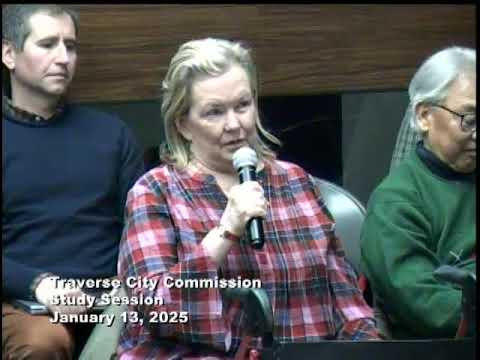
Public input and stakeholder comments: Several people and groups — including a representative citing the Cherry Capital Cycling Club and local mobility advocates — urged the city to prioritize all‑modes safety and involve cyclists and pedestrians in further design work. Heather (identified in the record by first name) said she supported continuing the pilot to gather more reliable post‑construction data: “I’m supportive of the continuation of the pilot,” she said. Commissioners asked for clearer pedestrian counts and for staff to show where crashes and near‑misses have occurred, not only automated counts of speed and volume.
Technical and cost notes: Burkholder said the initial conversion and iterative modifications were paid from TIF 97; staff estimated a modest additional investment would allow targeted repaints and signal adjustments. He told the commission the city has already invested in physical changes and data collection and that a two‑year extension would capture four seasons of traffic patterns to address snow‑removal and seasonal event effects.
Next steps and direction: Commissioners directed staff to return with recommended language and timing if the commission chooses to extend the pilot. Staff recommended extended data collection, additional targeted paint/micro‑engineering changes (for left‑turn queues) and more outreach to cycling and pedestrian groups. No formal motion or vote was taken; the session was explicitly a study session and no action was scheduled.
Provenance (transcript excerpts):
"We're gonna now start our discussions for today. The first discussion is the extension of the State Street 2 way pilot." — (staff announcement at start of item)
"We were averaging about 22 miles per hour. At the beginning of this project, we're down to 20." — (Harry Burkholder, DDA; data summary)