Get Full Government Meeting Transcripts, Videos, & Alerts Forever!
Get email alerts on the Short Term Rentals topic
No spam. Unsubscribe anytime.
Traverse City Planning Commission recommends zoning limits on short‑term rentals, asks city to preserve grandfathering policy
Summary
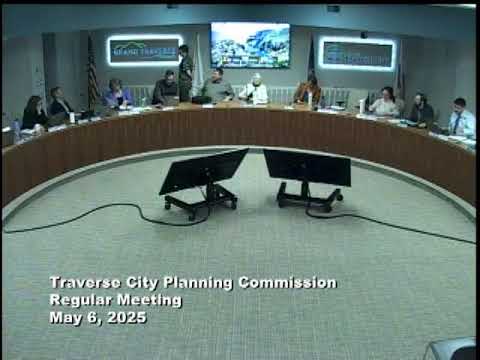
Traverse City Planning Commission on May 6 voted to forward zoning changes that would lower allowable short‑term rental percentages in several zoning districts and to urge the City Commission to preserve current grandfathering/transfer policies for existing licenses.
Traverse City Planning Commission on May 6 voted to send proposed zoning changes for short‑term rentals to the City Commission, with a clarification lowering one district cap and a formal request that the City Commission preserve the existing grandfathering/transfer policy for current licenses.
The commission’s recommendation would reduce allowable percentages of short‑term rentals in multiple commercial and development zoning districts and set the D‑3 district percentage at 25% (amendment to draft ordinance section 13.47.01, number 2.c). Planning commissioners also included a statement urging the City Commission to adopt the same grandfathering policy that has previously governed transfers of licenses.
The change before the Planning Commission addressed only the zoning allowances (what uses the land can accommodate), not the licensing rules enforced by the clerk’s office. Planning staff said licensing and enforcement (police powers) are a separate, parallel process that the City Commission will address. Leslie (planning staff) told the hearing, “If you currently have a short term rental and you've been asking for licenses every year, you will be able to continue to do that.” She later summarized: “Nonconforming status is a legal status under state law, and it travels with the land, not the property owner.”
Why it matters: The commission’s action would change the mix of uses allowed in future new development across multiple districts, rather than immediately revoking existing STR licenses. Public commenters warned that, even if zoning changes are limited to new development, uncertainty about whether licenses transfer after a sale could harm owners and local investment. Several owners and managers said STR income is necessary to remain in town and to finance property investments.
Public input and concerns: More than a dozen people spoke during the public hearing. Connor Miller, a Garfield Township resident who identified himself as employed by Aspire North Realtors, urged objective research before adopting policy: “The goal of this study is to provide objective third party research on the economic contributions and workforce housing impacts of short term rentals.”
Property owners and managers repeatedly asked for clarity about license transfer on sale. Trent Sims, who described himself as a licensed realtor and owner/operator of multiple STRs, said developers and owners “face the risk of losing significant value, potentially hundreds of thousands of dollars if they can no longer sell their STRs with the ability for new owners to reapply for a license.” Other owners described STR income as essential retirement or housing income.
Commission discussion: Commissioners and two City Commissioners in attendance stressed the separation between zoning (a land‑use decision the Planning Commission recommends) and licensing/police powers (a City Commission decision). Commissioner Brian (last name on file) urged caution with arbitrary percentage figures and said a citywide cap had enforcement benefits but would require City Commission action. Several commissioners favored sending a clear zoning recommendation upward so the City Commission could address licensing and enforcement details.
Formal action and outcome: Commissioner Anna Detturi moved to recommend approval of the draft zoning changes (sections 13.44.01, 13.46.01, 13.47.01 as presented) with an amendment changing 13.47.01.2.c to 25%. The amendment adding a commission statement asking that the City Commission adopt the same grandfathering/transfer approach as previously used was added and passed as part of the recommendation. The final recommendation carried in a roll call vote: 7 yes, 1 no (Commissioner Anderson opposed). The Planning Commission’s recommendation now goes to the City Commission for final policy and licensing decisions.
What was not decided: The Planning Commission did not change licensing rules or adopt a citywide cap on total STR units — those are policy decisions for the City Commission. Planning staff and the city attorney noted that state law protects nonconforming uses and that licensing transfer rules intersect with state statutes and city policy.
Next steps: The Planning Commission’s recommendation and the public hearing record will be forwarded to the City Commission. The City Commission must decide whether to adopt zoning amendments and whether to change licensing or transfer rules for existing STRs.