
Trustees debate proposed animal-control text amendment; board asks staff to revise
Get AI-powered insights, summaries, and transcripts
Subscribe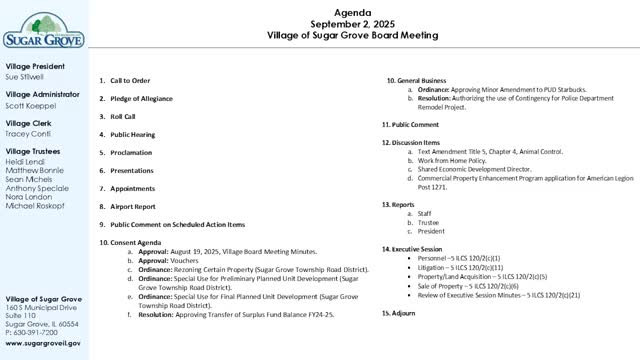
Summary
Trustees discussed a proposed text amendment to Title 5, Chapter 4 (animal control) that would reintroduce limits on dogs and cats, add regulations for residential chicken keeping and tighten permitted animals language. The board did not adopt an ordinance and asked staff to return with revisions after further review and community feedback.
Sugar Grove — Trustees discussed a proposed text amendment to the village animal-control code, including limits on the number of dogs and cats, new minimums for chicken coop and run sizes, and tightened language about animals allowed at large. The discussion produced multiple concerns about unintended consequences; the board provided direction for staff to revisit the draft rather than adopt it at the meeting.
Community Development Director Danny Marion told trustees the amendment grew out of a complaint about ducks kept near neighboring homes and a separate set of complaints about residents with more than four dogs or cats. Marion said the village discovered a prior limit of four dogs and cats had been in the code at one point but was no longer present in the current posted ordinances. Staff proposed reintroducing a four-animal limit and strengthening language about animals at large. Marion also proposed changing the chicken-coop minimum from 10 square feet per hen to four square feet per hen after reviewing other municipalities and speaking with the county farm bureau. He said additional language about electrical requirements, building permits, and sanitary enforcement was included.
Public comment included a long statement from an area falconer, who said falconry is heavily regulated at the state and federal levels and asked trustees to add an explicit exception for licensed falconers. The speaker cited “Title 17, Chapter 1, part 1590” (state falconry regulations) and the federal Migratory Bird Treaty as governing authorities for raptor possession and feather handling.
Trustees raised concerns that the draft text might be overbroad and could unintentionally prohibit commonly kept pets (such as larger parrots, pot-bellied pigs or outdoor rabbits) or conflict with zoning that permits agricultural animals on oversized lots or properties with existing annexation agreements. Several trustees said they were comfortable keeping a four-animal limit if it could be clearly tied to residential neighborhoods and be replicated exactly as found previously on the village website; others asked staff to remove preferential language that might exclude some domestic animals from being kept outdoors.
Board members debated chicken-coop sizing at length. Trustees and at least one trustee with direct chicken-keeping experience warned that a single coop-size rule does not fit all breeds and that an outdoor run minimum should be part of any standard to avoid creating circumstances in which birds would be confined indoors without adequate outdoor space. Marion and trustees pointed to Lombard’s model — a combined requirement of coop and run area that sets a minimum and a maximum — as a possible template. The board asked staff to bring back revised language that considers coop and run size (with a suggested compromise range of 2–4 square feet per hen for coop space plus a minimum run), clarifies whether roosters are allowed (trustees signaled no), and preserves reasonable exceptions for existing agricultural uses such as Rosewood Farm’s annexation agreement.
No ordinance was adopted. Trustees directed staff to: (1) verify and codify the historical four-dog/cat limit that appears on the village website, (2) revise the chicken sections to include run minimums and a coop size range informed by peer communities, (3) add a specific falconry exception for state- and federally licensed falconers or otherwise clarify permitted raptor conditions, and (4) return with a revised draft and legal confirmation of any enforcement implications.