Get Full Government Meeting Transcripts, Videos, & Alerts Forever!
Get email alerts on the Mental Health Services topic
No spam. Unsubscribe anytime.
Ventura County Behavioral Health outlines local crisis, prevention resources to Santa Paula council
Summary
Ventura County Behavioral Health presented a menu of local mental-health and suicide-prevention resources to the Santa Paula City Council and asked the city to help spread information about crisis lines, trainings and prevention programs.
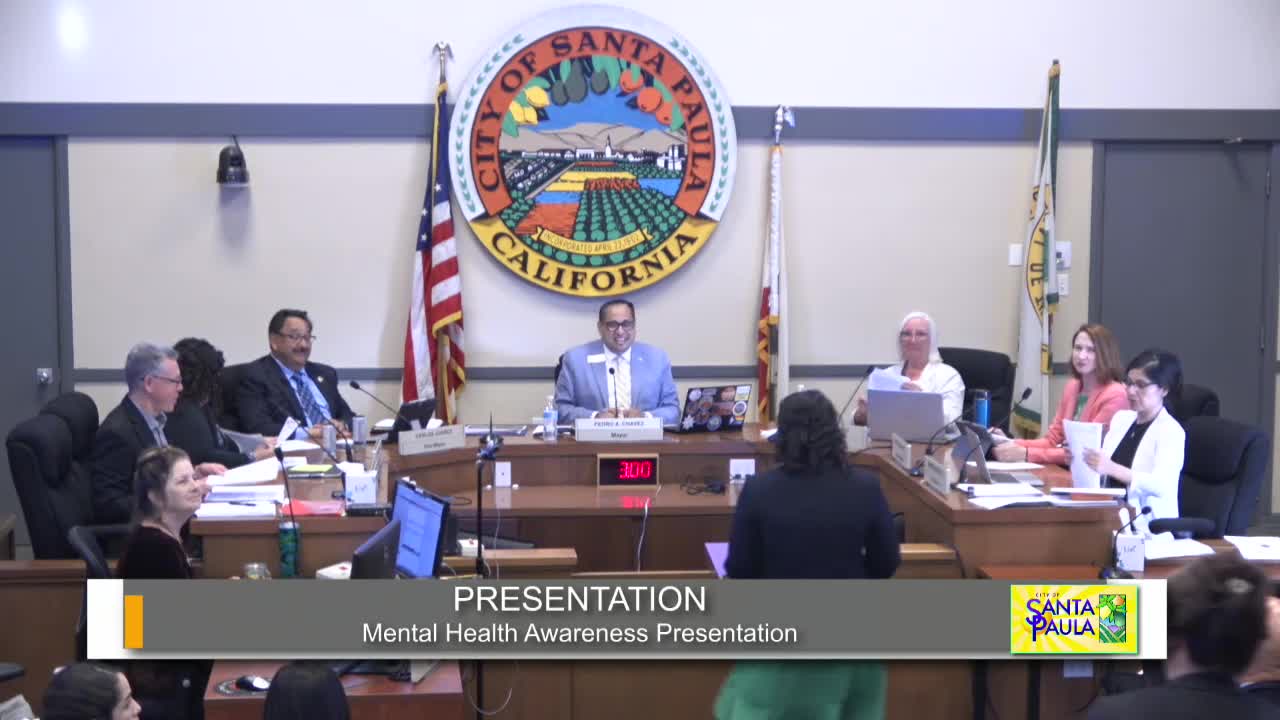
Ventura County Behavioral Health officials told the Santa Paula City Council on June 18 that the county offers crisis, prevention and early-intervention services and urged the city to link residents to those resources.
The presentation focused on local access points, suicide-prevention resources and community-based programs. Dr. Loretta Denning, Ventura County behavioral health director, said the county’s mandate is to serve people with serious behavioral-health needs while also investing in prevention and early intervention to reduce demand for intensive services.
“Your mental health is just as important as your physical health,” Dr. Denning told the council, adding that primary-care providers in recent years have begun routinely asking patients about symptoms of depression, anxiety and substance use.
Connie Moreno Perez, assistant director of Ventura County Behavioral Health, described warning signs and crisis contacts and gave the county access line and guidance. “Ask, be there, keep them safe, keep them, help them connect and check-in,” Moreno Perez said, summarizing the national suicide-prevention campaign she recommended to residents.
The county packet for the council lists a main access line, +1 (866) 998-2243, and reminded residents that 988 is the nationwide crisis number for people in urgent need of mental-health support. County staff said they can provide printed packets and a web resource to the city for distribution.
Council members thanked the speakers and asked that the county’s materials be posted on the city website and distributed through normal city communications. Council member Cornelius noted the stigma men sometimes face in seeking help; Moreno Perez said the county recently launched a “helping men recover” program that integrates substance-use and mental-health services.
The presenters asked the council to continue to refer residents to county services and to partner with local community-based organizations such as Project Esperanza for prevention and outreach. No formal action or vote was required or taken on the presentation.
For follow-up the county offered to email the council the packet of public resources and to provide copies for distribution at city events.