Get Full Government Meeting Transcripts, Videos, & Alerts Forever!
Get email alerts on the Utility Assistance topic
No spam. Unsubscribe anytime.
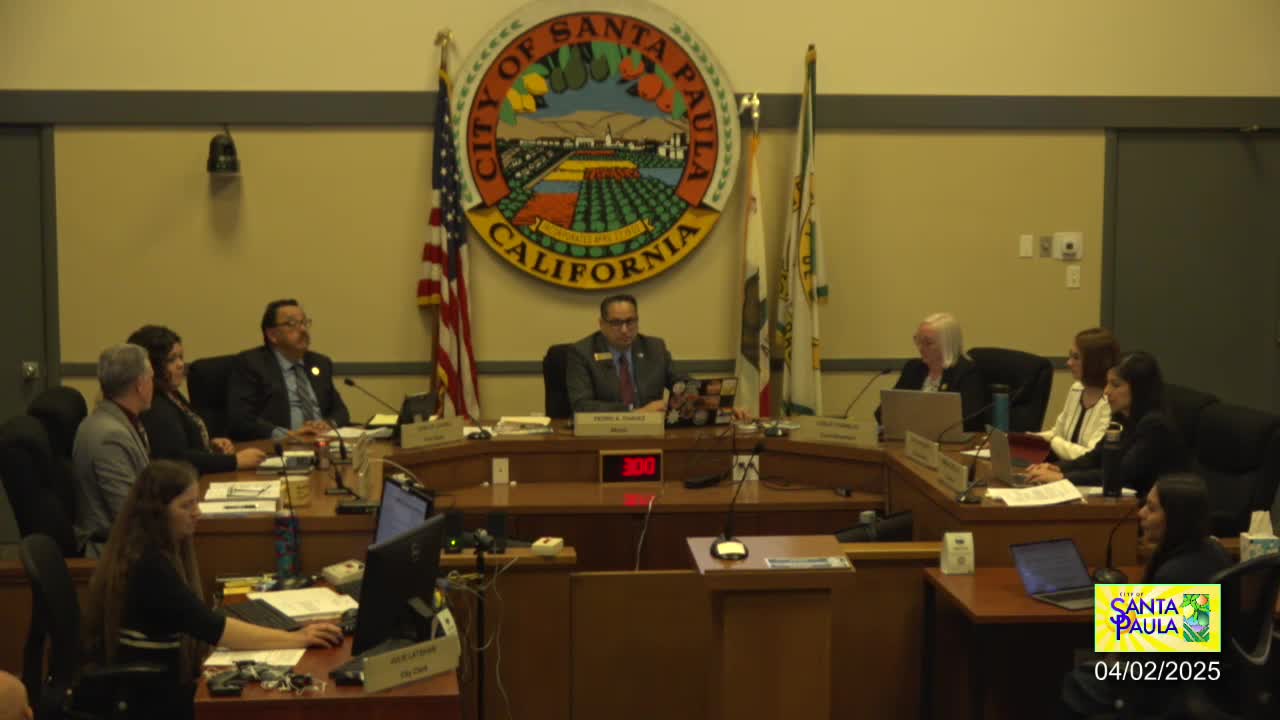
Council asks staff to keep exploring a pilot utility-rate assistance program for low-income customers
Summary
After a staff presentation, the Santa Paula City Council asked staff to continue researching a mixed funding pilot — using penalty revenues, voluntary bill round-ups, donations and grants — and report back with estimates and staffing needs before implementation.
City staff presented policy options on April 2 for a utility-rate assistance program to help low-income water and sewer customers and asked the council whether to proceed with further research. Staff urged council guidance on funding sources and program scope.
Senior analyst Mirka Vargas summarized models used in nearby cities (Ventura, Camarillo, Oxnard and Thousand Oaks). Those programs usually provide small monthly bill credits ($10–$25) and are commonly funded from late-penalty revenues, voter assessments, donations (including customer bill round-ups) or outside grants. Vargas told the council Santa Paula collected about $402,552 in penalty fees in 2024 (staff later clarified that was the amount levied/assessed and not necessarily cash collected), and that during the pandemic the county’s Low Income Household Water Assistance Program delivered one-time payments — Santa Paula residents received $205,055 directly from the program, Vargas said.
Council members expressed support for a pilot approach with limits and safeguards. Several suggested targeting low-income seniors as an initial cohort, adding a community donation or “round-up” option, and capping program funds to avoid depleting enterprise revenues that back system costs. Finance Director Christy Ramirez said penalty revenues remain within the water enterprise and are not general-fund dollars; she warned that staff collection rates vary and that some penalty revenue is only on the books and not yet received as cash. Ramirez also said current utility-billing staffing is at capacity and the finance team lacks bandwidth to launch a program immediately.
Councilmembers asked staff to quantify systemwide budget impacts before moving forward — for example, how using penalty or other enterprise funds for assistance would affect future rate-setting — and to estimate staff time and system upgrades needed for a roll-up/round-up billing feature. Staff said a rate-study kickoff is expected in May, and recommended returning with a plan after staffing and the rate study are aligned. The council directed staff to continue researching a combination of funding sources (penalty revenues, voluntary donations, grants) and to return with cost estimates, capacity needs and a recommended pilot design rather than beginning enrollment immediately.
No formal vote established a program that night; councilmembers did approve by consensus moving ahead with further research and asked for an estimated fiscal and staffing impact to be presented at a future meeting.