Get Full Government Meeting Transcripts, Videos, & Alerts Forever!
Get email alerts on the Cannabis Regulation topic
No spam. Unsubscribe anytime.
Santa Paula planning panel recommends ordinance to allow medicinal cannabis delivery, limits non‑storefront facilities to industrial zone
Summary
The Santa Paula Planning Commission unanimously recommended the City Council adopt an ordinance to align the municipal code with state Senate Bill 1186, allowing licensed non‑storefront medicinal cannabis delivery and restricting such facilities to the city’s industrial zone under a conditional use permit and operational standards.
The Santa Paula Planning Commission voted unanimously to recommend that the City Council adopt an ordinance amending Chapter 16.79 of the Santa Paula Municipal Code to comply with Senate Bill 1186 and allow licensed non‑storefront medicinal cannabis delivery within the city.
The change stems from SB 1186, which bars cities from imposing rules that effectively prohibit licensed medicinal cannabis businesses from delivering to patients or caregivers. Staff told the commission the ordinance would permit retail sale by delivery of medicinal cannabis citywide while limiting non‑storefront retail facilities (delivery-only operations) to the industrial zone south of Highway 126 and subjecting them to a conditional use permit (CUP) and specified operational standards.
Why it matters: SB 1186 narrows local authority over medicinal delivery; failure to align local code could expose the city to fines or litigation, staff said. The ordinance also establishes local controls intended to address public‑safety and nuisance concerns while complying with state law.
Key provisions and discussion
- Zoning and permits: Non‑storefront (delivery‑only) medicinal cannabis retailers would be permitted only in industrial zones (staff identified those zones as south of Highway 126) and only after approval of a conditional use permit. The CUP process will allow the commission and council to impose conditions tailored to a proposed location.
- Operational standards: Proposed codified standards (SPMC 16.79.050, as discussed by staff) would require a Santa Paula Police‑approved operations plan, building and health code compliance, on‑site uniformed security personnel where required, odor control devices, monitored security systems and a prohibition on signage on buildings or delivery vehicles. Staff noted some standards will be implemented through the CUP process and other existing development and nuisance codes (for noise, odors and property maintenance).
- Licensing and agencies: Staff said the packet incorrectly named one licensing authority; operational standard B3 will be updated to reference licensure from the Department of Cannabis Control (state) and local authorization by the city. The commission also discussed coordination with the state Bureau/Department of Cannabis and local law enforcement on compliance and auditing.
Public comment and enforcement concerns
Two residents spoke during the hearing and one email comment in support was received. Robert Bagdasian asked whether delivery operations would be audited to ensure clients present proper medical documentation and whether black‑market diversion or other security issues had been observed in nearby jurisdictions. Joseph Bierhalter argued the city must comply with SB 1186 and warned the city was already losing tax revenue from deliveries that originate outside Santa Paula.
Staff and police‑related comments responded that the Department of Cannabis Control maintains strict seed‑to‑sale accounting and that the CUP process and Police Department review would provide local oversight. Staff noted other cities require CCTV with police access and a named on‑site contact for rapid response; those conditions may be recommended if a specific facility applies. The commission also discussed whether a development or enforcement agreement (analogous to agreements used for alcohol retailers) should be required; staff and the city attorney said the CUP process could impose and enforce comparable conditions and revoke the permit for unresolved violations.
CEQA and noticing
Staff reported the ordinance was exempt from CEQA under the stated sections (staff cited CEQA Guidelines sections 15060 and 15061) and said the project was properly noticed. Staff also corrected an item in the packet: a notice date in the packet (Santa Paula Times, Jan. 15) was noted as incorrect and will be clarified in final materials.
Commission action and next steps
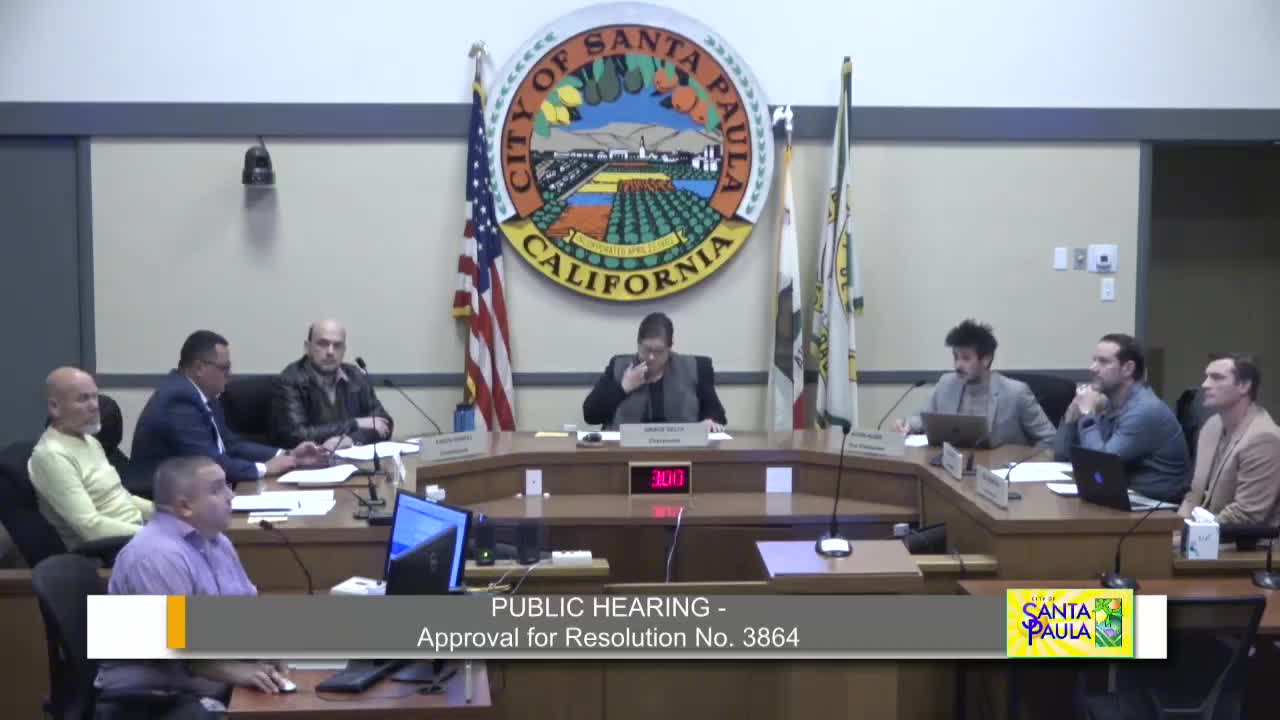
Commissioner Dunkel moved to approve Resolution No. 3864 recommending the City Council adopt the ordinance amending Chapter 16.79 to align with SB 1186, with edits to operational standard B3 (to reflect the correct licensure authorities) and to update the resolution’s general‑plan conformance reference. Commissioner Herbert seconded. A roll‑call vote was taken and the motion passed unanimously (5–0).
The commission directed staff to return any proposed brick‑and‑mortar or specific facility proposals with recommended CUP conditions informed by other cities’ practices and to coordinate with the Department of Cannabis Control and the Police Department on enforcement and auditing expectations. The commission’s recommendation will be forwarded to the City Council for consideration.
Votes at a glance
- Motion: Approve minutes of the Dec. 10, 2024, Planning Commission meeting. Moved by Vice Chair Auger; seconded by Commissioner Dunkel. Vote: unanimous approval (5–0).
- Motion: Approve Resolution No. 3864 recommending the City Council adopt an ordinance amending Chapter 16.79 (Regulation of Cannabis Activities) to align with SB 1186, with edits to operational standard B3 and to the general‑plan conformance reference. Moved by Commissioner Dunkel; seconded by Commissioner Herbert. Vote: unanimous approval (5–0).