Get Full Government Meeting Transcripts, Videos, & Alerts Forever!
Get email alerts on the Utilities And Infrastructure topic
No spam. Unsubscribe anytime.
Homer Glen directs attorney to draft ordinance requiring franchise agreements for utilities
Summary
Village attorneys located existing franchise agreements with Commonwealth Edison and Comcast and the board gave consensus to direct the law firm to draft a resolution and ordinance to require water and sewer utilities to sign franchise agreements covering village rights‑of‑way.
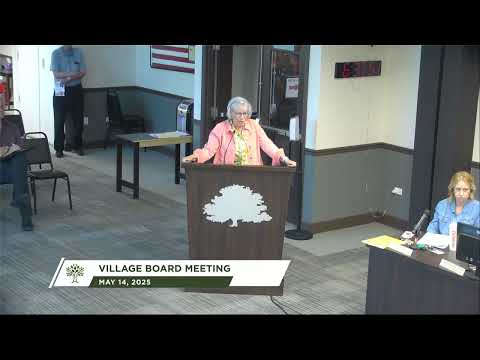
The Village of Homer Glen Board of Trustees asked legal staff on May 14 to draft a resolution and ordinance that would require public utilities that use village rights‑of‑way to enter franchise agreements.
Village Attorney Philip Train cited the municipal code, saying “the village in its discretion and as limited by law may require utilities to enter into franchise licenses or similar agreements for the privilege of locating their facilities on, over, above, along, upon, under, across, or within the village rights of way.” He told trustees his office had found two existing franchise agreements — with Commonwealth Edison and Comcast — and recommended using a resolution to deem a franchise necessary and then to propose an ordinance requiring agreements for water and sewer utilities operating in the village.
The board discussed whether franchise arrangements could include Illinois American Water and whether existing utilities might be grandfathered. Trustee Steilen asked whether currently operating utilities would be exempt; the attorney replied there is no automatic grandfathering and that terms vary. Trustee LaPorte asked about typical franchise lengths; Train said they vary widely and that the firm had seen terms from 10 to 50 years, noting that a 10‑ to 20‑year term would be reasonable in some cases.
Trustees signaled consensus to direct the law firm to prepare a resolution and ordinance that would require utilities using village assets and rights‑of‑way to enter franchise agreements; the village attorney said the proposed ordinance would be brought back to the board for consideration at a future meeting.
Train also reported on related state legislation: portions of a prior “quick‑take” bill were rolled as amendments into House Bill 250 and a separate Senate Bill 1513 addressing valuation of public utility infrastructure is still pending in Springfield. He said the village has submitted remarks opposing the quick‑take language when it was presented as amendments to HB 250.
The board did not adopt the ordinance at the May 14 meeting; the law firm was directed to draft documents for a future meeting where trustees may vote on a formal resolution and ordinance.