Get Full Government Meeting Transcripts, Videos, & Alerts Forever!
Get email alerts on the Tree Preservation topic
No spam. Unsubscribe anytime.
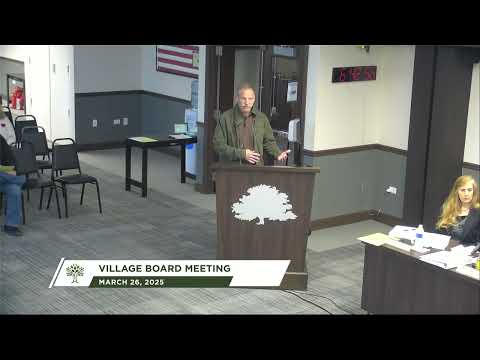
Homer Glen trustees hold lengthy workshop on proposed tree-preservation rules as residents press for stronger protections
Summary
Residents and the environment committee urged the Village of Homer Glen to broaden tree protections and raise mitigation requirements during a long board workshop; staff and trustees asked for concrete examples and cost scenarios before deciding on final ordinance language.
The Village of Homer Glen Board of Trustees held an extended workshop to consider proposed amendments to Chapter 138 of the village code that would change environmental conservation and tree-preservation rules, drawing public comment from homeowners and the environment committee and detailed staff presentation of proposed mitigation and penalty changes.
The proposed revisions would apply tree-protection rules to all parcels, lower the minimum diameter that triggers mitigation from 6 inches to 5 inches for deciduous trees, tighten mitigation ratios for larger “heritage” trees, and raise cash-in-lieu rates where on-site replacement is not possible. Director Gruber told the board the broad goal was “to help preserve as many of the existing mature trees in the village as possible.”
At least eight residents and environment-committee members spoke in favor of stronger protections. Joe Therese, a member of the environment committee, said residents “just love their trees” and argued the changes would “help development here in Homer Glen” by preserving the wooded character that attracts homebuyers. Andy Penelli, president of the Deborah Woods Homeowners Association, said the current ordinance “doesn’t effectively discourage enough removal of trees or encourage replacement when they need to be removed,” and cited examples he said showed substantial tree loss on smaller lots. Heidi Pasella, who reviewed the proposed code changes, said, “The bottom line is that trees are important to our community, and we need to be sure they are healthy, replaced if cut down, and we need to incorporate the residents into these changes so that they are educated on the environmental responsibility aspect.” Michael McGee, who described operating a foster-based senior dog rescue in Homer Glen, urged the board to adopt revisions so new development does not remove the tree canopy that drew residents to the village.
Staff reviewed specific technical changes. The draft would re-label some categories (for example, “heritage” and “protected” trees instead of prior terms), and would change mitigation and restitution rates as follows: heritage trees (generally 24 inches DBH and larger) — proposed on-site replacement increased from 2 inches of caliper per 1 inch removed to 3 inches per 1 inch removed; if on-site mitigation is impossible, cash restitution would rise from $250 per caliper inch to $500 per caliper inch (staff noted current market cost to plant a 2.5-inch caliper tree is roughly $700, or about $280 per caliper inch); protected trees (5–24 inches DBH) — proposed on-site replacement increased from 1.25 inches per 1 inch removed to 2 inches per 1 inch removed, and cash restitution would rise from $125 per inch to $300 per inch. The draft also lowers the minimum size of trees subject to mitigation and would allow staff to waive mitigation when a tree poses an immediate hazard.
Trustees and staff devoted much of the discussion to implementation and impacts. Trustees asked for concrete, visual examples showing a building footprint (the house, driveway and associated disturbance zone) and a 20-foot buffer, then a comparison of how the new mitigation rules would apply to several representative parcels — single-family infill lots, a typical residential lot with a house footprint, and one or two commercial parcels (staff and trustees referenced a heavily wooded Bell Road parcel proposed for commercial use as a high-impact example). Trustees repeatedly requested scenario-based cost comparisons showing the financial impact on a homeowner or developer under the current ordinance and under the proposed draft. Trustee Mason said he supported stronger protection in principle but called the preliminary example calculations “a huge shock” and asked staff to present alternatives and scaled options.
There was also discussion of enforcement and staffing: trustees asked whether staff would perform tree surveys on small residential lots or whether the cost would be borne by applicants via certified arborists. Staff said the plan is to require formal tree surveys for larger development and to allow staff to handle small-lot cases to avoid imposing survey costs on modest projects; staff and trustees discussed the possibility of a performance bond or letter of credit that would be returned if replacement trees survive a two-year establishment period.
The board did not vote on the text of any ordinance. Trustees and the environment committee agreed to continue work: staff were directed to prepare a short set of scenario comparisons (residential infill example(s), a subdivision example and a commercial example), include pictorial site-plan overlays that mark the proposed disturbance envelope and 20-foot buffer, and run the numbers with alternate restitution and mitigation rates so the board can compare outcomes. Trustee Reinders suggested convening a committee-of-the-whole meeting with the environment committee and staff to review those examples and refine the ordinance language before formal text-amendment drafting.
The workshop also surfaced technical clarifications trustees said must be resolved before a final ordinance: how to treat trees in utility easements (existing trees would require mitigation but new plantings would be prohibited in pipeline easements), whether the “like-for-like” replacement requirement for very large trees should be relaxed (staff recommended removing a strict like-for-like mandate), and whether the emerald-ash-borer fund could be repurposed or renamed to a broader tree-preservation fund. Several trustees and the environment committee favored a clean rewrite of the code sections that now spread across existing ordinances, rather than incremental amendments to multiple locations in the municipal code.
The board expects staff to return with the scenario comparisons and a recommended path (committee-of-the-whole and further workshops) for refining the ordinance text; no formal adoption timeline was set.
Ending
Trustees and committee members praised the environment committee’s work but asked staff to produce clearer, shorter materials for future meetings: a clean, single draft ordinance (no redlines), a small set of pictorial examples and a spreadsheet showing how alternative ratios and restitution values change the total cost for representative parcels. The board agreed to continue discussion at a future meeting after staff provides the requested examples and cost scenarios.