
United Way to track ALICE households in Lee County, plans local kickoff this fall
Get AI-powered insights, summaries, and transcripts
Subscribe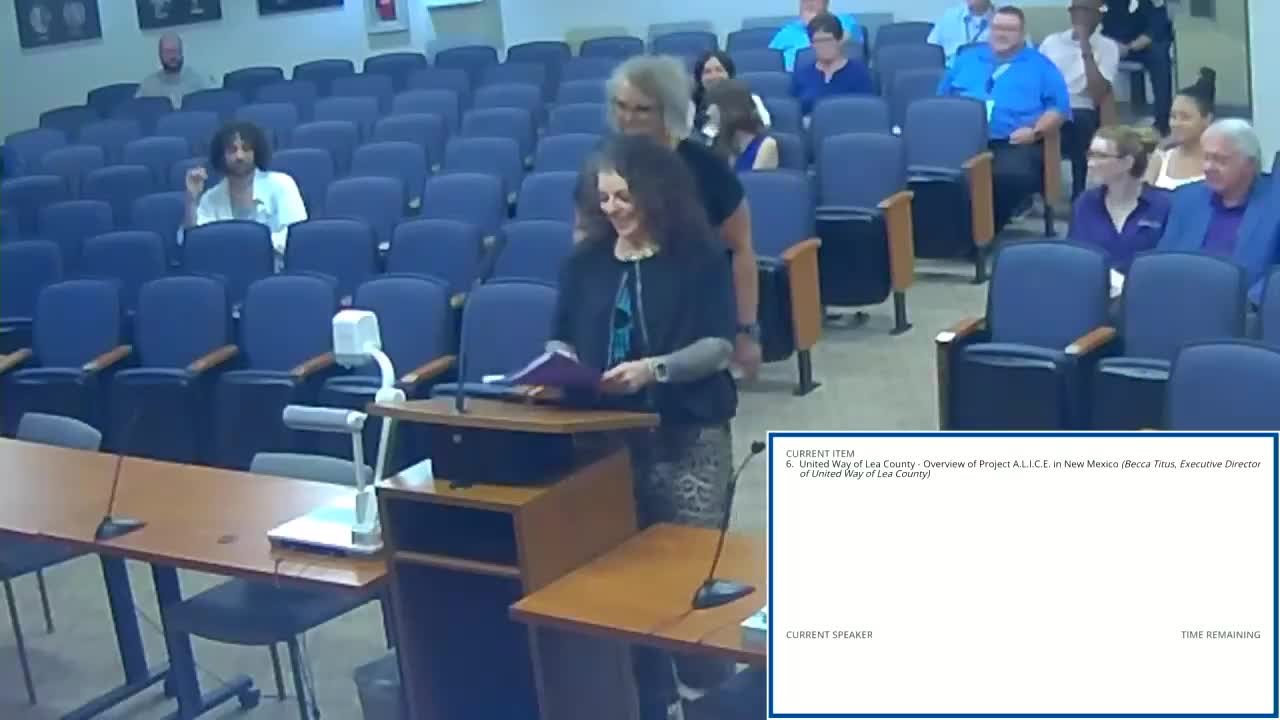
Summary
United Way of Lee County outlined a three-year data collection effort using the ALICE (Asset Limited, Income Constrained, Employed) framework and said a local kickoff will follow statewide work; organizers said the tool will help target assistance and partnerships and that seed funding has already been used for at least one mortgage intervention.
Becca Titus, executive director of United Way of Lee County, told the Hobbs City Commission that United Way plans a local kickoff this October for ALICE, a United Way data initiative that measures households earning above the federal poverty line but below the local cost of basics. The presentation described a three-year data-collection effort intended to give more frequent, finer-grained information than the decennial census.
Why it matters: Commissioners were told the ALICE data will allow local government, nonprofits and funders to identify residents who are “one emergency away” from falling into poverty and to target services and philanthropy accordingly.
Titus introduced Christie Hughes, vice chair of the United Way board, and Karina Carrasco, coordinator for the 2-1-1 resource line, who described how the ALICE tool will be applied. Hughes told the commission the measure counts households that earn too much to qualify for some assistance but not enough to meet costs for housing, childcare, food and transportation in their county. “This will be a year-glance — you won't have to wait many years like the census,” Hughes said.
United Way representatives said the project will allow county-level and legislative-district breakdowns, comparisons with SNAP participation and other local filters so nonprofits and government can plan services. Titus noted United Way staff and board members recently briefed federal legislators in Washington, D.C., about the HELP Act and 2-1-1 funding, saying those federal conversations reinforced the need for better local data.
The presenters described early local funding and use of funds. Titus said the J.F. Maddox Foundation and Permian Strategic Partnership had agreed to support the effort and that an initial allocation of leftover local funds — cited as $12,000 returned from a state partner — was used to assist a local household behind on mortgage payments. “She is a perfect definition of ALICE,” Titus said of the person helped; United Way staff documented mortgage paperwork and used those local ALICE funds to bring the homeowner current.
Hughes said the ALICE dashboard will allow United Way to produce reports for specific occupations and districts and that the statewide rollout includes 3,000 counties. She asked commissioners and staff to expect a local kickoff in October and noted a North Central New Mexico cohort event scheduled for Sept. 11. Carrasco highlighted 2-1-1 as a local referral point for residents seeking services.
Commissioners expressed support and asked staff to consider whether city and school employee salaries should be tracked alongside county results to see whether employees fall into ALICE categories. Titus said the local report will make it possible to check those questions annually.
United Way asked commissioners to consider the data tool as a way to align philanthropy and city planning with on-the-ground needs; no formal action or funding request was taken at the meeting.