
Brentwood reviews draft residential design guidelines; staff to seek public input before Planning & Zoning adoption
Get AI-powered insights, summaries, and transcripts
Subscribe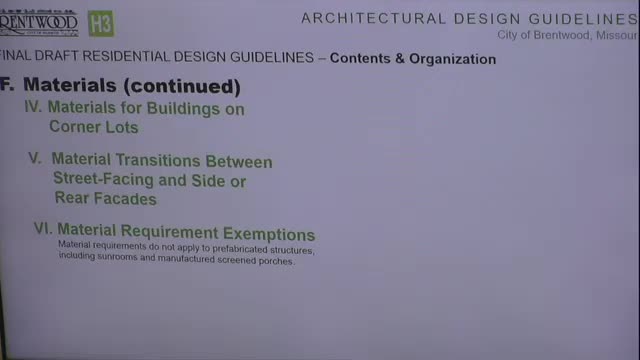
Summary
Consultant h3 Studio presented draft residential design guidelines intended to give the Architectural Review Board and staff consistent standards for evaluating home alterations, rebuilds and additions; the board asked questions and the draft will return to Planning & Zoning for further action.
Brentwood aldermen and staff reviewed a draft set of citywide residential design guidelines on July 21 intended to give consistent direction for review of home renovations, additions and new houses. H3 Studio presented the draft after a roughly yearlong engagement process involving a steering committee, the Architectural Review Board (ARB) and the Planning and Zoning Commission.
Consultant Tim Bridal (h3 Studio) said the guidelines cover applicability, administrative review procedures, architectural principles (roof forms, window and door trim, porches, eaves) and material transitions between facades. The package also includes suggested zoning text amendments—outside the guidelines themselves—for subjects such as driveway width, front-yard setback averaging and possible future floor-area-ratio consideration.
The guidelines would be applicable to single-family (A and B), attached single-family and multifamily residential districts. Bridal said the guidelines are intended to be advisory, not a standalone code; they provide review criteria for staff and ARB and are intended to increase predictability and reduce discretionary variation across reviews. He said certain small projects could be administratively approved by staff to reduce ARB workload, while the ARB retains authority to review projects as needed.
Aldermen asked several clarifying questions about materials and additions. Bridal said additions visible from the street will face the more stringent guidelines and that an addition’s materials should either match or be visually subordinate to the existing house; he noted ARB feedback had moved vinyl siding into the permitted-materials category at the Planning and Zoning Commission’s request. The draft also includes a recommendation to increase allowable driveway width where side retaining walls create tight conditions, and to require material wrap/transition rules where front facades use brick and side facades use siding.
Staff said the Planning and Zoning Commission had held public hearings and recommended adoption of the residential guidelines; however, final adoption of any comprehensive plan or zoning text amendments requires the Planning and Zoning Commission’s formal review and later action by the Board of Aldermen. The board did not take an adoption vote July 21; staff said the plan will return to Planning and Zoning on Aug. 13 for further consideration.
Advocates of the guidelines said the document aims to reduce uncertainty for property owners, provide a clearer checklist for building-permit submittals and reduce the administrative burden on the ARB by formalizing existing review expectations. The draft also recommends zoning code updates be handled as separate text amendments—e.g., driveway width and front-yard averaging—rather than being embedded inside the design-guideline document.