
Commission questions retaining-wall encroachment, stormwater detention and tree loss at 11 Saint Alfred Road
Get AI-powered insights, summaries, and transcripts
Subscribe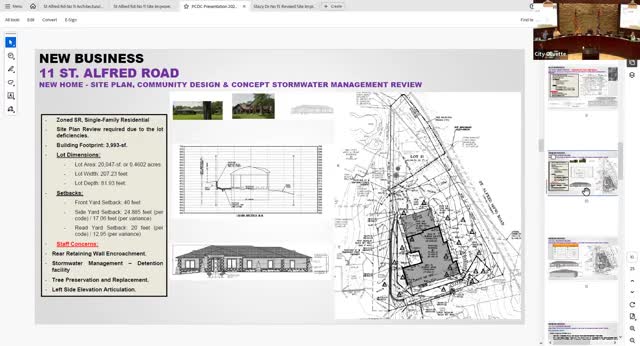
Summary
Commission and staff discussed a new single-story home proposal at 11 Saint Alfred Road, focusing on a proposed retaining wall whose geogrid would extend onto a neighbor’s property, stormwater detention calculations, and a tree-removal plan. The petitioner said neighbors have signed easements; staff asked for legal and stormwater review.
The Olivette Planning and Community Design Commission reviewed a petition on May 1 to build a new single-story house at 11 Saint Alfred Road and spent significant time on two technical site issues: a proposed retaining wall whose geogrid would extend onto an adjacent lot, and whether the roof-area stormwater detention system may legally accept runoff from the rear yard.
Carlos Trejo, director of Planning and Community Development, told the commission the lot is triangular and constrained by multiple easements. The retained geogrid needed for the proposed modular block retaining wall would extend roughly 5–6 feet onto the neighbor’s property, Trejo said, and the city’s “best practice” is to avoid improvements that occupy two separate property titles. “It’s not ideal to have a structure that embraces two different properties,” Trejo said.
Petitioner Jeff Eichols, who identified his address as 15 Saint Alfred Road (the adjacent owner to the south) and said he is the owner of the 11 Saint Alfred parcel, told the commission he has executed and notarized temporary grading and construction easements and a maintenance easement with the adjacent owner for the retaining-wall construction and geogrid maintenance. Eichols said the current property had a prior fence encroachment and that both properties were purchased with that encroachment in place.
Commissioners asked whether the city should accept a permanent easement that allows geogrid to remain under a neighbor’s land. Trejo said the city could not prohibit private easements but that the city would want to review any easement language and asked that the city attorney review documents provided by the petitioner to make sure the city is protected. “We would want our city attorneys to have an opportunity to take a look at that on the city’s behalf,” Trejo said.
The second technical issue was stormwater. Staff cited section 4 22.08 of the city code, which states that on-site detention for a new detached single-family home must be “designed to accommodate the entire roof area on a 15-year 20-minute rain event.” Carlos Trejo and others told the commission that the city interprets that code to require a detention volume sized for the roof area; the petitioner’s engineer and the petitioner said the design consultant (THD) included the backyard area in the detention calculation and disputed that the code forbids including additional areas. “Because according to chapter 4 22, the detention pit is designed specifically for the roof area of the house,” Trejo said.
Both sides agreed stormwater calculations needed formal review. Commissioners directed staff to obtain a stormwater consultant review and to get the full easement documents to the city attorney. Jack Carswell, planning and zoning administrator, said staff had received a copy of a temporary grading/retaining-wall easement but asked for the full recorded language. The commission did not take a vote and indicated that the retaining-wall and stormwater issues can likely be worked out administratively once the city attorney and a stormwater review are complete.
The commission also reviewed an arborist report: 22 trees were identified on the lot and staff noted 18 were proposed for removal, with two replacement trees proposed. Staff said the draft tree-preservation/replacement approach being developed by the city would require additional calculations; Trejo said, after applying the proposed formula to this site, the replacement requirement would amount to roughly nine trees before accounting for trees the petitioner intends to keep. Staff and commissioners discussed the difficulty of placing required trees on a lot with multiple easements and tight buildable areas.
The petitioner told the commission the house is being designed for accessibility, with roll-in showers and 4-foot hallways to accommodate future wheelchair access for a family member. The commission requested additional documents: full stormwater calculations, the complete easement instruments (including maintenance language), and a stormwater consultant review and legal review before administrative permitting or a return to the commission.