Get Full Government Meeting Transcripts, Videos, & Alerts Forever!
Get email alerts on the Municipal Budget topic
No spam. Unsubscribe anytime.
Kearney presents proposed fiscal 2026 budget; officials plan major street, sidewalk and water projects
Summary
City Administrator Sheila presented the proposed Fiscal Year 2026 budget to the Kearney Board of Aldermen, outlining $31.9 million in non‑transfer, non‑debt revenues, $30.6 million in capital projects and a proposed water and sewer rate increase. Members asked about reserves, specific grants and timing for sidewalk and road projects.
Kearney City Administrator Sheila presented the proposed Fiscal Year 2026 budget to the Board of Aldermen during its regular meeting, outlining projected revenues, major capital projects and proposed utility rate increases.
Sheila said the city expects $31,900,000 in revenues that are not interfund transfers or debt proceeds and listed total proposed current‑year revenues of $43,500,000, which include federal grants and other inflows. "The city is expecting to get $31,900,000, of revenues that are not transfers and not debt, if that makes sense," Sheila said during the presentation.
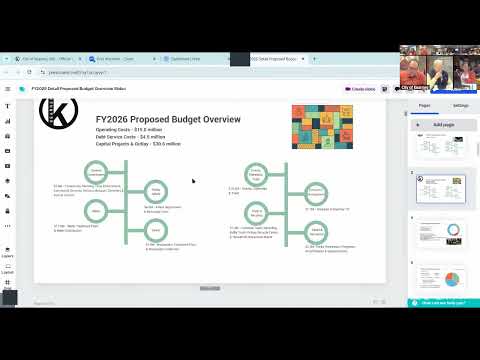
The budget proposal directs $30,600,000 to capital projects in the coming year, with the single largest capital investment — $19.5 million — aimed at streets, sidewalks and trails. Sheila said $8,400,000 of the year's revenues are federal grants, most of which she tied to the Nineteenth Street complete‑street project (Watson Drive to Meadow Lane) and related intersection work at Nineteenth and Route 33. She also named the pathways/sidewalk program, including Regency Drive, as a large grant‑funded focus.
On operating costs, the proposal budgets $15,000,000 for regular operating expenditures and $4,500,000 for principal and interest on existing debt. Sheila described the general fund operating revenues at about $8.9 million versus operating expenditures of $8.6 million, leaving $284,949 in operating excess but with $980,000 of planned capital outlay paid from reserves.
Board members pressed staff on reserves. A board member characterized the trend bluntly: "So we're eating up our reserves." Sheila replied that the city projects a $1,400,000 fund balance at fiscal year end — roughly two months of operating expenses — and emphasized the need to hold reserves to cover short‑term emergency spending while awaiting federal disaster reimbursements.
Water and sewer rates: The proposed budget includes utility rate increases to address aging infrastructure, regulatory requirements and higher operating costs. Sheila presented proposed water and sewer rate steps (examples cited in the presentation: $0.28 per 1,000 gallons for the first block of water usage and $1.25 per 1,000 gallons for the first block of sewer usage, with tiered rates thereafter), and showed a chart comparing Kearney's proposed rates with nearby communities. She said most residential customers use about 3,000 gallons per month and that, even after the increase, Kearney would remain among the lower‑cost providers in the comparison set.
Capital highlights and projects: Staff listed key capital items included in the proposed budget or in related capital funds: - Nineteenth Street complete‑street project and the Nineteenth/Route 33 intersection improvements (engineering and match funds budgeted; total estimated project cost shown in materials). - Sidewalks and pathways (multiple grant‑funded segments including Regency Drive, Lions Park crossings and connections in Stone Lake and other neighborhoods). - Water tower and waterline projects (Gateway West waterline, South Clark replacements); the water tower debt was noted as issued and debt service will begin. - Police equipment (patrol vehicles, body‑worn camera funding partly supported by grants) and computer/network upgrades across departments.
Funding sources and constraints: Sheila explained that the budget relies heavily on federal grants and intergovernmental revenues (including MoDOT funds and Clay County transfers) for capital work. She noted use tax and a transportation sales tax (including a half‑cent capital improvement sales tax) as ongoing local revenue sources that fund transfers to capital projects and debt service. Shops at Kearney TIF obligations remain a contractual charge in the sales tax/capital fund structure and were explicitly shown as an economic development payment.
Unfunded requests and prioritization: Departments requested additional personnel and services that were not funded in the proposed budget. The city administrator summarized unfulfilled requests totaling about $1.3 million in personnel costs (examples listed included three school resource officers, a parks maintenance full‑time position and a police records clerk) and roughly $3.6 million of non‑personnel requests across funds. Sheila framed the proposal as conservative budgeting intended to avoid mid‑year cuts.
Other items: Staff noted several internal accounting and presentation changes (for example, moving property and liability insurance line items into the departments they relate to) and described steps to survey fees and meter costs in the coming year to align charges with actual costs. Sheila also described a DNR planning grant for an integrated utility management plan and a water/sewer asset study that will inform future rate and capital decisions.
Votes at a glance: The meeting recorded two formal motions during the budget discussion segment: approval of the consent agenda and a short recess. The consent agenda motion passed with the board answering "Aye"; the board also approved a five‑minute recess by voice vote.
Why it matters: The proposed budget outlines multi‑year capital commitments — particularly for streets, sidewalks and water infrastructure — funded largely by federal grants and local sales/use taxes. The proposal includes a utility rate increase intended to stabilize water and sewer finances and to fund required capital work; it leaves multiple department requests unfunded, signaling continued prioritization choices for the aldermen.
Next steps: The presentation was informational only; no budget adoption vote was taken at the meeting. The city administrator said the board may revise the proposal and that staff will bring required supplemental materials (amortization/debt details, grant award acceptances) to future meetings as decisions proceed.