Get Full Government Meeting Transcripts, Videos, & Alerts Forever!
Get email alerts on the Radiation Exposure Compensation topic
No spam. Unsubscribe anytime.
Guam lawmakers present resolution honoring downwinders, urge inclusion in Radiation Exposure Compensation Act
Summary
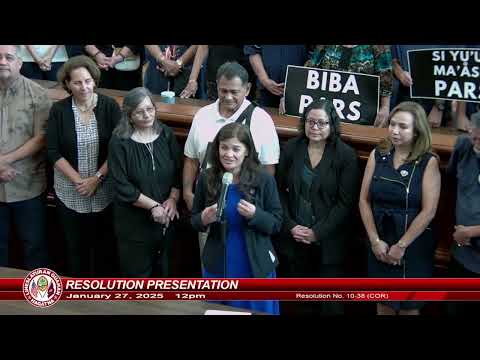
A senator from the Guam Legislature presented Resolution 10-38 at the Guam Congress Building on the National Day of Remembrance for Downwinders, honoring residents who say they were affected by radioactive fallout and calling for Guam’s inclusion in the federal Radiation Exposure Compensation Act (RECA), the presenter said.
A senator from the Guam Legislature presented Resolution 10-38 at the Guam Congress Building on the National Day of Remembrance for Downwinders, honoring residents who say they were affected by radioactive fallout from U.S. nuclear testing and calling for Guam’s inclusion in the federal Radiation Exposure Compensation Act (RECA), the presenter said.
The resolution “pauses to honor the lives and sacrifices of those who lived and [to] renew our collective call for justice,” the senator said, citing the Marshall Islands’ Pacific Proving Grounds and saying fallout from testing between 1945 and 1962 reached Guam.
Why it matters: supporters said expanding RECA to Guam would recognize past harms, provide health-care access connected to radiation exposure, and offer compensation to survivors. The presenter stated that the expansion would “extend health care to those who have been exposed,” and framed the measure as a matter of dignity and accountability rather than only compensation.
The presenter described historical and testimonial evidence in support of the call for inclusion. She said 67 nuclear detonations occurred at the Pacific Proving Grounds from 1945 to 1962 and cited sworn testimony from a radiological safety officer stating that a Geiger counter “went off the scale” after the Ivy Mike test. The presenter also said studies by congressional committees and the National Research Council, plus local survivor testimony gathered by advocates, support the claim that radiation affected Guam residents.
Robert Celestial, president of the Pacific Association of Radiation Survivors (PARS), accepted the resolution on behalf of PARS and urged continued advocacy. “For 23 years, we’ve been advocating to get Guam into the Radiation Exposure Compensation Act,” Celestial said, and he thanked Guam’s legislative supporters and a coalition of national advocates who have raised the issue with Congress.
Speakers and advocates recounted a history of local testimony and legislative requests: the presenter said Guam’s legislature has submitted testimony and resolutions in past sessions and named local advocates, including Celestial and the late Dr. Walter Perez, as central to the effort. The presenter also said nine of the 11 cancers listed under RECA are among the leading cancers on Guam, citing survivor testimony compiled by PARS.
Action taken at the ceremony was ceremonial: the presenter introduced and read Resolution 10-38 and handed it to Robert Celestial and PARS. The transcript records the presentation of the resolution but does not show a formal vote on the resolution or a new legislative action recorded in the meeting minutes.
Outlook: speakers urged continued outreach to Guam’s congressional delegation and the sponsors who have reintroduced related legislation in the U.S. Congress. The presenter and Celestial urged residents and lawmakers to keep advocating for federal recognition and the health and compensation benefits supporters say RECA would provide for Guam.